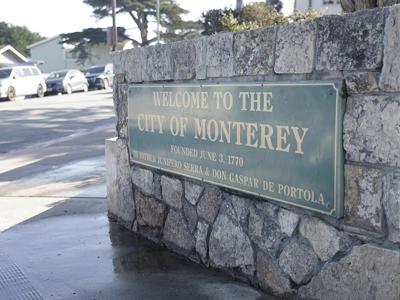

When Spanish explorer Sebastián Vizcaíno sailed along the California coast in 1602, he had the sense our local bay was special, and he coined the first non-Indigenous place name in the region: Bahía de Monterrey – Monterey Bay – in honor of New Spain’s viceroy at the time, whose ancestral home was Monterrey, Spain.
There are many ways cities and towns get their names, and knowing the origin stories can often deepen one’s understanding of a place. Donald T. Clark, who became the founding librarian at UC Santa Cruz in 1962, certainly understood that when he published a deeply researched – and now out-of-print – book in 1991, Monterey County Place Names. It’s an astonishing piece of work, stretching more than 600 pages, all packed with stories.
According to Clark’s research, Carmel also comes from Vizcaíno – he named the Carmel River “Río del Carmelo” in 1603, as he had with him three Carmelite priests. To honor them, he named the stream after their patroness Lady of Mount Carmel, also the spiritual protector of their expedition. Big Sur, too, comes from the Spanish: They referred to the mountainous wilderness as El País Grande del Sur – “the big country to the south.”
Pacific Grove is more prosaic, derived from the Pacific Grove Retreat Association, a group of Methodists who convinced landowner David Jacks to give both funding and land to form a Methodist summer camp in 1875. Del Rey Oaks, a hybrid of Spanish and English (Oaks of the King), came by a vote of its residents, likely inspired by Canyon Del Rey.
Seaside was named by its founder, Dr. John Roberts, who in 1887 bought 150 acres of a former rancho then-owned by his uncle. Sand City is descriptive in another way: A sand mining industry was active in the city at the time of its incorporation in 1960, and the naming effort was led by sand-mining industrialists who feared Seaside would annex the local coastline and shut the sand mines down. Marina gets its name much in the same way as Seaside: In 1913, William Locke-Paddon purchased 1,500 acres of land from Jacks and laid out tracts for a settlement. He negotiated a railroad stop there and the location was originally dubbed Mile Post 117 and, later, Paddonville. He didn’t like either and changed it to Marina, Spanish for “shore.”
While the Spanish imprint is evident across modern maps, Castroville is dedicated to Monterey native Juan Bautista Castro. The act that made him worthy of recognition? He subdivided the land for the town – which was on his father’s rancho – to be settled in the early 1860s. Moss Landing honors Charles Moss, who built a wharf at the location in 1866.
Salinas finds its origins in the brackish lagoons at the mouth of the valley – it’s a pluralization of the Spanish “salina,” which roughly translates to salt lagoon, or salt mine. Salt was harvested by the Spanish as early as 1770. Further south, Chualar was named by Jacks (he owned much of the land), and per Clark, it was “a Spanish adaptation of an Indian word meaning ‘place where chual (pigweed) grows.’” Gonzales gets its name from two brothers, Dr. Mariano and Alfredo Gonzales, who founded the city in 1874 on land granted to their father, Teodoro, who arrived from Mexico in 1825.
Soledad, established in 1873 by Doña Catalina Munras, was named after its mission, which in turn was named after Most Holy Mary, Our Lady of Solitude. (Soledad is Spanish for solitude.)
King City was laid out by Charles Henry King when the Southern Pacific Railroad established a stop there in 1886. King’s father was born in France, and the family translated his last name, Le Roi, to King.
San Ardo is a creation of the U.S. Post Office: M.J. Brandenstein bought the San Bernardo Rancho, and laid out a town in 1886. The Post Office, seeking to avoid confusion with San Bernardino, chopped the first four letters.
The result is that the town now bears the name of an obscure ninth-century French saint that no one locally even knew existed.


(1) comment
A great article. I knew most of those, but not all. Thanks for sharing!
Welcome to the discussion.
Log In
Keep it Clean. Please avoid obscene, vulgar, lewd, racist or sexually-oriented language.
PLEASE TURN OFF YOUR CAPS LOCK.
Don't Threaten. Threats of harming another person will not be tolerated.
Be Truthful. Don't knowingly lie about anyone or anything.
Be Nice. No racism, sexism or any sort of -ism that is degrading to another person.
Be Proactive. Use the 'Report' link on each comment to let us know of abusive posts.
Share with Us. We'd love to hear eyewitness accounts, the history behind an article.