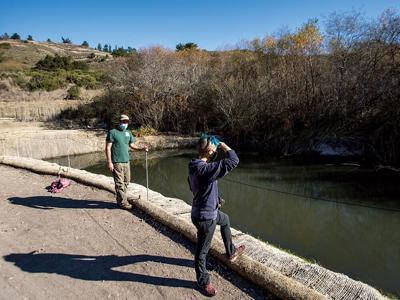

Late last summer, biologist Rachel Anderson was working at the small c-shaped Animas Pond in the mountains above Carmel Valley, and she was expecting a normal day’s work of surveying the area for amphibians. “My job is to see what species are here, what life stages they are in,” she says. “Are they breeding? How are they using the habitat?”
These surveys usually offer her quality field time with her favorite creature, California red-legged frogs. “They are big and charming and sort of doofy,” Anderson says. “Also, they are part of our local heritage, a part of California culture for thousands of years.”
Her job involves scanning the banks of the pond with binoculars, listening for the typical calls of amphibians, searching for egg masses – “basically any evidence of who’s there.”
On this particular day of surveying, the vegetation had grown so thick it was overtaking the pond, darkening the water and generally making it difficult for frogs and salamanders to use. To get a better look, Anderson got down to the surface of the water and started scooping up algae and rotting tule and cattail where tadpoles might be found.
That’s when she spotted something unexpected: what looked like a gray bug, thrashing in the net. The first thing identifying it was its tail. “It sort of flapped its tail under, in a way that’s really distinctive of crayfish, and had the claws and the antennae and the little beady eyes,” she says.
“I’d never seen crayfish here and I’ve been coming here for years,” she says. “I knew that these are a big threat to the amphibians that are here, and thought, we have to do something about this right away.”
The presence of crayfish is alarming because they’re ravenous omnivores, eating the eggs and larvae of native amphibians – but what made the situation worse was that Anderson had no clue how the crayfish arrived.
On a recent visit to Animas Pond, she still doesn’t know for sure.
“I wish we had more answers about them,” she says, exchanging glances with Ranger Nicholas de Paolo of Monterey Peninsula Regional Park District. “We don’t really know how they got here. We can remove them all we want, but if it seems like they might be able to come back it’s an ongoing threat to species like California red-legged frogs, Pacific chorus frogs and California newts.”
Anderson and de Paolo have three main theories on how the invasivecrawfish may have arrived.
One involves the crayfish propelling themselves. Crayfish have been known to inhabit the nearby San Jose Creek, which connects with the creek that leads to the pond. “They maybe could have navigated their way upstream somehow,” de Paolo says.
Another theory says that they could have been introduced by birds. “Larvae or eggs could have been attached to a bird,” he says. “We see certain species transported by just crawling onto a bird and getting under the feathers.”
The least likely culprit would be humans: “People do eat them, fishing them in the Carmel River,” de Paolo says. “Maybe someone was thinking, ‘we’re gonna put this in here so we can come and fish this pond.’”
In the fall, after the discovery of the crayfish, the park district launched a restoration of the pond, excavating sediment, removing overgrown vegetation and invasive plants. The work was timed to not interfere with the breeding cycle of the protected amphibians. De Paolo crouches down to explain how he planted seeds in the holes of the biodegradable jute netting that is now blanketing the banks of the pond; the netting helps stop erosion.
Anderson suddenly breaks her silence. “I can barely speak,” she says. “You see that big blob of vegetation?” she asks, pointing. “Just to the right of it, something in the water looks like a gray moldy grapefruit.” The thing in the water is not a discarded piece of fruit. It is an egg mass laid by a red-legged frog.
“I’m amazed because I was up here at night two weeks ago, just hearing one lonely male call. It must have worked.”
Now, if only the crayfish will stay away.


(0) comments
Welcome to the discussion.
Log In
Keep it Clean. Please avoid obscene, vulgar, lewd, racist or sexually-oriented language.
PLEASE TURN OFF YOUR CAPS LOCK.
Don't Threaten. Threats of harming another person will not be tolerated.
Be Truthful. Don't knowingly lie about anyone or anything.
Be Nice. No racism, sexism or any sort of -ism that is degrading to another person.
Be Proactive. Use the 'Report' link on each comment to let us know of abusive posts.
Share with Us. We'd love to hear eyewitness accounts, the history behind an article.