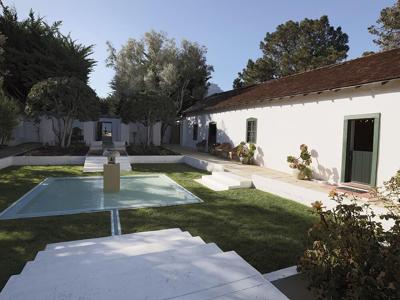

As Blake Matheson walks down the hallway of Casa Boronda, the oldest private residence in Monterey, he notes the slant of the floor, which very slightly leans downhill. But oddly, he points out as he gestures into the adobe’s bedroom, the door frames have stayed level.
“As the Japanese say: wabi-sabi.”
Matheson, a Monterey Peninsula native whose family bought the four-acre property in 2008 for $2 million, put it on the market in early November for $3.75 million. It’s a three-bedroom, three-bathroom home, though the adobe itself only has one of each – the others are in two separate wooden structures built around 1940.
To say the property is unique is an understatement – it’s one of the most historic residences in all of California.
Dating back to 1817, the adobe was the first in Monterey built outside of the Presidio walls. Set on a mesa that overlooked the San Carlos Cathedral – trees have since obscured the view – it was first owned by José Manuel Boronda, who was born in Jerez, Mexico in 1750 and is believed to have arrived in Alta California around 1770.
He twice enlisted in the Spanish military and, among other things, worked as a carpenter and schoolteacher. Boronda married 13-year-old Maria Gertrudis Higuera in 1790, and she ultimately gave birth to 13 of their children, the first in 1792.
The Borondas came to Monterey in 1811. Until then he had served in Santa Barbara and Yerba Buena. As payment for his years of military service – and perhaps because he was reportedly favored by Father Junipero Serra due to his piety – Boronda was granted the four acres on which the adobe sits. When the home was completed in 1817, Don Manuel, as he was then known, also turned it into the first boys school in Monterey at the behest of then-governor Pablo Vicente de Solá.
The Borondas’ great-great-granddaughter, Tulita Westfall y de Boronda, wrote a history of the adobe that the New Deal-era Works Progress Administration published in 1937. She said of the construction of the house: “The Indians would run away and refuse to help with the falling of the timber and the mixing of the adobe, consequently the Spanish troops did most of the work.”
She adds that the tule roof suffered damage from wind (before the roof was tiled), and had to be tied down by ropes so that it wouldn’t blow away. During windstorms, she writes, the family prostrated in prayer uttering (in Spanish), “Holy God, Holy Strength, Holy Immortal, Free us oh Lord from all evil.”
Boronda died in debt in 1826, but per tradition at that time, the home stayed in his family and was passed down for generations along maternal lines until 1939, when Alexander Tiers bought the property.
Tiers quickly set about modernizing it with plumbing, heating, electricity, a modern bathroom and more.
Tiers also added a tall adobe wall around the gardens, and distinctive flourishes like a rectangular adobe slab at the garden’s southwest edge.
Regarding that particular design element, Matheson says he’s always thought it was a projector screen, “like a drive-in movie theater, though I’ve never corroborated that.”
Matheson, and his father before him, have at various times tried to get permitted to host events at the property – it would be a stunning location for a wedding – but eventually gave up after vocal neighborhood pushback.
Realtor John Romley, leading a tour with Matheson, says the first thing most prospective buyers ask is whether they can turn it into an income-producing property. Ultimately, the owner would have to be someone who is passionate about preservation. “You get a dose of California history,” Romley says.
Matheson, who’s lived briefly at the property a few times over the years, says that’s why his parents bought Casa Boronda more than a dozen years ago.
“Nobody is going to buy if they don’t have some fundamental appreciation of history,” Matheson says. “We might keep it forever if it doesn’t sell.”


(0) comments
Welcome to the discussion.
Log In
Keep it Clean. Please avoid obscene, vulgar, lewd, racist or sexually-oriented language.
PLEASE TURN OFF YOUR CAPS LOCK.
Don't Threaten. Threats of harming another person will not be tolerated.
Be Truthful. Don't knowingly lie about anyone or anything.
Be Nice. No racism, sexism or any sort of -ism that is degrading to another person.
Be Proactive. Use the 'Report' link on each comment to let us know of abusive posts.
Share with Us. We'd love to hear eyewitness accounts, the history behind an article.