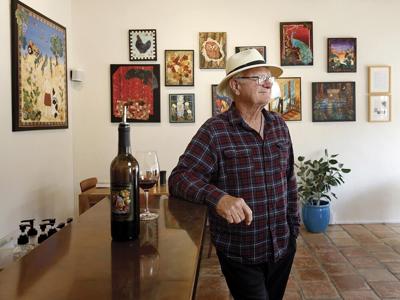

Bill Parsons bought a vineyard after he “burned out on garbage management.”
It may be the first time such a phrase has been uttered by a winemaker. But a young Parsons did not foresee grapes in his future. Nor did he plan on a career in waste. Living on a ridge just outside of Carmel Valley’s village wasn’t in his plans, either.
Parsons’ goal after discharge from the army was to write a book based on his experiences as an intelligence officer teamed with Special Forces on the border of Cambodia. “I could go on for hours about the idiocy of putting someone like me in that position,” he says.
With that in mind, Parsons earned a master’s degree in journalism from Columbia University and returned to California – he’s a Whittier native with a bachelor’s from UCLA – in 1971 with the promise of a job at KSBW.
Just how military service and a journalism degree landed Parsons, now “almost 80,” on a property he turned into a vineyard is a tale worthy of a book, and might be considered far-fetched even for a work of fiction. But it happened and he planted the first vines of what would become Parsonage in 1998. The family operation is now considered one of the better wineries in Monterey County for its hedonistic approach to winemaking (some vintages of their Estate Reserve Dario has been called the region’s top Merlot).
“It was something I was crazy enough to do,” Parsons says of the vineyard and the crash course on producing wine, adding that his wife Mary “fought this like crazy.”
In 1971, broadcast journalism – and time to write his novel – were top priorities. But the reporter who he was to replace decided to stay put. “I showed up and there was no job,” Parsons says.
He caught on with the Carmel Pine Cone. Covering local government and other stories, however, left him little time for his literary pursuit. There were other pressures, as well. The pay was low, his wife was pregnant. And this being the ’70s, the bank at which she worked cut her loose when it became apparent she was expecting. So Parsons looked for something that would allow more free time and provided a bit more in the way of salary.
“One day I’m a staff writer at the Pine Cone, the next day I’m riding on the back of a garbage truck,” he says.
That job lasted a day and ended with him “completely buried in fish guts” as the result of a stumble. Still reeking, Parsons interviewed for a city position in Pacific Grove. After telling about his mishap, Parsons was offered the role of assistant building inspector. He believes it was a case of sympathy for his plight.
It wasn’t long before he was bumped up to wastewater project coordinator. When the consultant overseeing the Marina landfill died, what was then the Monterey Peninsula Garbage and Refuse Disposal District decided to make the role permanent and asked him to submit a resume. “What do I know about running a landfill?” Parsons recalls asking. “But I got the job.”
This is how random and roundabout his working life had been: Parsons remained at the post seven years – a long stretch by his standards – but the calendar had only reached 1980 when he left.
What lured him away was the chance to go in with a partner on speculative house building and renovation projects – at a time when the prime lending rate was 21.5 percent and the nation was in a period of stagnant growth and inflation. “We were just idiots, I guess,” Parsons observes. “We basically lost everything.”
Fortunately, he knew people in local government and the waste collection industry. He helped the owner of a disposal company negotiate a 10 percent rate increase with the city of Marina. “Next thing I know I’m vice president and general manager,” Parsons says.
And that, in short form, is how one goes from waste management to winemaking. Parsons spent 16 years with the Carmel Marina Corporation.
“That was what funded me,” he says. And semi-retirement as a winemaker finally allowed Parsons to write. His novel Do Unto Evil is rated five stars on Amazon.


(0) comments
Welcome to the discussion.
Log In
Keep it Clean. Please avoid obscene, vulgar, lewd, racist or sexually-oriented language.
PLEASE TURN OFF YOUR CAPS LOCK.
Don't Threaten. Threats of harming another person will not be tolerated.
Be Truthful. Don't knowingly lie about anyone or anything.
Be Nice. No racism, sexism or any sort of -ism that is degrading to another person.
Be Proactive. Use the 'Report' link on each comment to let us know of abusive posts.
Share with Us. We'd love to hear eyewitness accounts, the history behind an article.