
The lights are the brightest on the Founders Theatre stage inside the Golden Bough Playhouse in Carmel, where actors are grooving to the beat inside a makeshift diner and belting out the high notes with expertise.
The high energy of Pacific Repertory Theatre’s performance of Waitress is infectious. And the audience doesn’t need the ability to hear to be part of the party.
On this particular night this past summer, there were two other performers just off to the side of the stage, with their own lights shining down on them. For a section of audience members, these two people were critical to their understanding of the show.
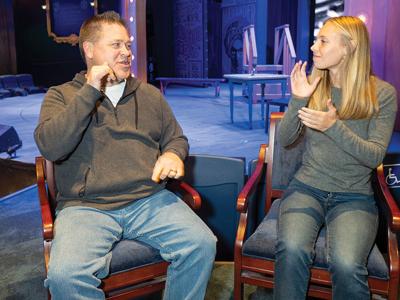
They are American Sign Language (ASL) interpreters, silently capturing the dialogue, lyrics and overall energy of the show using hand signals, facial expressions and other body language cues. They are every role in the performance rolled into two people.
Trevor Tuell and Damiana Kelsey have interpreted three PacRep shows so far, beginning with Waitress in July. Both are thrilled they have the opportunity to bring theater to an audience that historically has been left out of such an experience.
Stephen Moorer, founder and executive director of PacRep, says the theater company has experimented with ASL interpretation over its more than 40 years, but committed to the offering this summer.
The deaf and hard-of-hearing community is “a community that needs to be represented just like everyone else,” Moorer says. “This is making the theater even more accessible than it ever was.”
He adds that after the ASL performance of Waitress, PacRep received word from Monterey County Bank that it wanted to support the offerings through a sponsorship, which allowed the nonprofit theater company to offer such interpretation at its following shows throughout this year. More ASL-interpreted performances are coming: Gypsy on Dec. 5 and Rudolph the Red-Nosed Reindeer The Musical on Dec. 14.
Tuell says typically, the interpreters will watch the performance twice before it’s showtime for them. For the first viewing, they will decide which characters to interpret. That involves setting a balance between the team of two: if one takes on a major character or two, the other will take on more side characters, to help even out the dialogue load.
During the second viewing, they will be in the background practicing their self-assigned roles.
Kelsey says she works to match the energy of the actors on stage in order to give the deaf viewer the same experience as the rest of the audience.
“I really try to get into the mindset of that world that they’ve created on stage,” she says.
Tuell adds that he captures different body language cues to differentiate the characters that he’s interpreting.
“I generally interpret with a lot of emotion and a lot of facial expressions,” he says. “I’ve been told by deaf consumers that I’m not shy.”
While Tuell has been a professional ASL interpreter since 1998, the last decade serving as an interpreter for K-12 students, it’s something he’s done his whole life. He grew up with a deaf mother and was her interpreter. He landed a job as an interpreter in college and never looked back.
“As the years went on, it became my passion and something I was meant to do,” Tuell says.
Interpreting Waitress was the first time he had done so for a theater performance, and he found the experience to be perhaps simpler than traditional interpretation, despite constantly having to keep up with what’s happening on the stage.
“It goes with the experience from interpreting and the ability to keep conversation and dialogue at a consistent flow,” he says. “With theater, we know what will be said beforehand. We’re used to interpreting on the fly. Who knows what’s going to be said?”
Moorer says the goal is to continue growing the program, adding that the work the interpreters put in during the show is an art form in itself.
“We are all in awe,” he says. “I am just astounded at the talent and the commitment of these interpreters.”
ASL-interpreted performances for PacRep’s Gypsy and Rudolph the Red-Nosed Reindeer The Musical are held Dec. 5 and Dec. 14, respectively. For tickets, visit pacrep.org


(0) comments
Welcome to the discussion.
Log In
Keep it Clean. Please avoid obscene, vulgar, lewd, racist or sexually-oriented language.
PLEASE TURN OFF YOUR CAPS LOCK.
Don't Threaten. Threats of harming another person will not be tolerated.
Be Truthful. Don't knowingly lie about anyone or anything.
Be Nice. No racism, sexism or any sort of -ism that is degrading to another person.
Be Proactive. Use the 'Report' link on each comment to let us know of abusive posts.
Share with Us. We'd love to hear eyewitness accounts, the history behind an article.