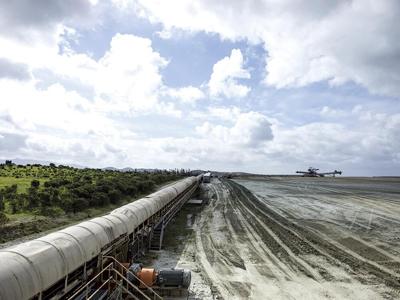

Part of this story begins in 1900, when MIT graduate Arthur R. Wilson started a quarry in Aromas, employing a team with picks and shovels to mine granite. Graniterock, still owned by the Wilson family and still mining on the 121-year-old quarry from that original granite vein along the San Andreas fault, now employs roughly 1,000 people and supplies material for asphalt, including on runways at airports including SFO, SJC and MRY.
Another part of this story begins in 2016, when Donald J. Trump was elected president of the United States. Activists in the small, rural community of Aromas started meeting in living rooms, partly to vent, but partly to come up with an action plan. “We got together and said, ‘We can’t just sit here, we have to do something,’” says Leslie Austin, an early member.
That something became the Aromas Progressive Action League (APAL), which formed committees to focus on different areas. One of those, a climate action team, set an ambitious goal: to make Aromas a net-zero community, generating at least as much energy as they consume. They promoted solar panel installations and hosted electric car shows. But Seth Capron, a cofounder of APAL, knew that to really achieve their net-zero goal, they’d have to go bigger – they would have to team up with a company that has a big carbon footprint, Graniterock.
Capron, who also serves on the Community Advisory Council of Central Coast Community Energy, decided to approach Graniterock’s quarry manager at 2017’s annual Aromas Day celebration. What might’ve been confrontational instead became collaborative – Graniterock, it turned out, was already at work on a 1-megawatt solar installation, and was interested in pursuing something bigger.
“It was refreshing to get a very positive response,” Capron says.
That bigger project has been through years of planning and design, and is now in its early stages, with pallets of photovoltaic panels piled up on a dirt field as crews grade 20 acres where the 15,000 panels will be installed. This 5.3-megawatt project will generate about 65 percent of the mining company’s energy needs when combined with the existing 1-megawatt project.
The 20-acre dirt pile where this solar farm will go sits about a mile from the main quarry, at the end of a conveyor belt that snakes uphill, transporting material – known as overburden – that’s removed to get to the desired granite underground. At the top of the conveyor belt, a massive spreading machine known as “Big Bill,” named after the larger-than-life man named Bill who once operated it, spreads the dirt over about a grayish plateau that resembles a moonscape.
Jon Erskine, Graniterock’s director of geological and environmental science, expects the installation to begin in April or May, and the project should be complete within about a year.
On the adjacent 20-acre parcel that once also resembled a gray moonscape is a green meadow, sprinkled with young oak trees. It’s a different form of reclaiming overburden, where crews first graded rolling hills, then biologists planted native species.
Graniterock executives expect the $15 million project to pay for itself within about 15 years. The panels will last an estimated 30 years; after that, the company may reinstall solar panels, or they might move on to the next stage of reclamation, planting natives like on the adjacent 20-acre parcel.
“This is setting us up for another 120 years,” Erskine says. “It’s not just for right now. Looking at the entire construction industry, customers want greener [supplies]. That’s clearly where the industry is going, greener and greener.”
Austin now works as an organizer for Greenpower, an initiative of the Santa Cruz-based nonprofit Romero Institute, with a focus on local and regional solutions to the climate crisis. The Graniterock partnership became a perfect example of achieving a goal at that scale. “What’s remarkable to me is this small community that believed we could do something bigger, and set out to do it,” Austin says. “If we can do it, other communities can do it.”


(0) comments
Welcome to the discussion.
Log In
Keep it Clean. Please avoid obscene, vulgar, lewd, racist or sexually-oriented language.
PLEASE TURN OFF YOUR CAPS LOCK.
Don't Threaten. Threats of harming another person will not be tolerated.
Be Truthful. Don't knowingly lie about anyone or anything.
Be Nice. No racism, sexism or any sort of -ism that is degrading to another person.
Be Proactive. Use the 'Report' link on each comment to let us know of abusive posts.
Share with Us. We'd love to hear eyewitness accounts, the history behind an article.