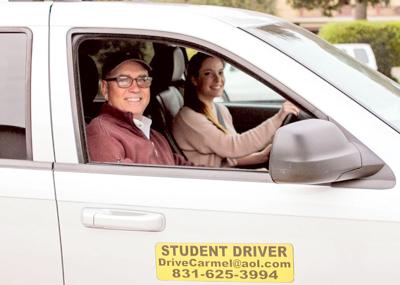
For most of Richard Richards’ life, it has been his duty to lessen dangers on the road. He was a California Highway Patrol officer for 30 years. He served as former California Gov. Pete Wilson’s private driver for eight, and as Arnold Schwarzenegger’s during his campaign for the state’s top seat. He remembers driving Wilson through the bustling streets of Los Angeles during intense events like the 1994 O.J. Simpson trial, where hordes of protesters slammed picket signs against the car.
Now his years spent navigating form the foundation for his road safety curriculum at Drive Carmel, which involves its own intense moments. Richards remembers one incident when firewood flew off a truck in from of a less-than-aware young driver, who froze.
“I grabbed the wheel and swerved right to a shoulder,” Richards says. “The wood hit the driver’s side door. Thankfully, it didn’t break anything. That kid really learned his lesson that day.”
On a recent day, as he’s directing Sabrie Flynn, a Trinity High School student, down the narrow and car-congested Dolan Road near Moss Landing, Richards reminds her to keep her distance from the car in front of her.
“The further you can see down the road, the earlier you can see the problem,” he tells Flynn.
Richards encountered problems many times during his CHP service. Notifying parents their children had been harmed was paticularly tough. He adds fatal accidents are more frequent in Monterey County than Los Angeles, because down south the freeways are better designed for fast travel, as opposed to local rural streets such as Prunedale’s Echo Valley Road, where Richards responded to a 2005 accident that left five dead and four injured, the oldest only 21.
Teenage drivers face dangers across the board. According to the CHP’s website, traffic collisions are the leading cause of death for youths ages 16 to 19. A teen driver is twice as likely to get into an accident when carrying just one passenger. When they carry two passengers, the risk jumps by 158 percent.
“I’ve seen too many people die from simple mistakes,” Richards says. “If my lessons can prevent one student from making a quick error that could end their life, I’ve succeeded.”
Disturbed by the 2002 death of Vanessa Forgnone, killed in a San Benancio Road accident on her way to school, Richards helped found the Start Smart driver safety program at CHP’s Monterey office. The program educates soon-to-be-licensed drivers via testimonials from CHP officers and images of deadly collisions caught on dashboard cameras of police cruisers. Start Smart soon became a statewide program funded by the Office of Traffic Safety.
After he retired from the CHP in 2006, Richards continued his anti-accident work. After finding out about Drive Carmel, Richards contacted its founder, Mary Gifford, and his expertise was more than welcome at the small school.
“I was trying to do it all; teaching and organizing,” Gifford says. “Richard was a major help.”
She started the school 15 years ago after she noticed, as a mother of six, that local schools had ceased to offer driver’s education classes.
She runs classroom curriculum, teaching roadside rules and assigning quizzes that test road judgment. Classroom lessons are supplemented with heartbreaking stories from young drivers responsible for fatal collisions, trauma surgeons, and visits to courthouses to talk with local judges.
Drive Carmel’s team of instructors, which includes three former police officers (including Richards’ brother), practice the fundamentals on the road.
“Staying involved is key,” Gifford advises parents. “Follow up by making a routine, like driving to get ice cream.”
For Richards, safe driving is a skill that demands mindful practice long after his students have received their driver’s licenses. He often does an additional lesson with students after they pass the test.
“The Driver’s Handbook is the letter of law,” Richards says. “I teach the spirit of the law. I show the reasons speed limits and seat belt laws matter.”
To elaborate, he says the intent of a speed limit is to ensure traffic is flowing, but the spirit of the speed limit, like most traffic laws, is to keep people safe. So if he saw a driver going 67 miles per hour in a 65 zone, he’d be a lot less likely to cite him or her than a driver deliberately breaking a law, like looking at their cellphone or making an illegal U-turn.
A few days later he’s back with another student, talking traffic and test-taking with Mary Grebeing, a Pacific Grove High School student finishing her final Drive Carmel lesson before her big exam.
“I feel super confident in my driving,” she says. “I’m ready for what’s ahead.”


(0) comments
Welcome to the discussion.
Log In
Keep it Clean. Please avoid obscene, vulgar, lewd, racist or sexually-oriented language.
PLEASE TURN OFF YOUR CAPS LOCK.
Don't Threaten. Threats of harming another person will not be tolerated.
Be Truthful. Don't knowingly lie about anyone or anything.
Be Nice. No racism, sexism or any sort of -ism that is degrading to another person.
Be Proactive. Use the 'Report' link on each comment to let us know of abusive posts.
Share with Us. We'd love to hear eyewitness accounts, the history behind an article.