
During the last period of the day at North Salinas High School, the colorful white, blue, red and yellow tiled hallways are nearly dead silent. Some teenagers sit restlessly, trying to focus on a math problem or history lecture, while other are slouched over on their desks struggling to stay awake. But at least one classroom is bustling with noise and energy, a rarity in the late afternoon on a high school campus.
The commotion is coming from the high school’s floristry class. Inside the classroom, about 30 kids huddle over three long tables, clipping and snipping at stems. In the backdrop are industrial sized shelves of vases and pots, ranging from bold turquoises and bright greens to rich terra-cottas and clear glass. Another shelf holds boxes of scissors, short knives and clippers – all tools that the quick and diligent hands of students are comfortably using.
Teacher Kyle Robinson sends out orders, loudly and curtly, to her students. “Make sure to fill in,” she says in a booming voice just shy of yelling. “I don’t want any bald spots.”
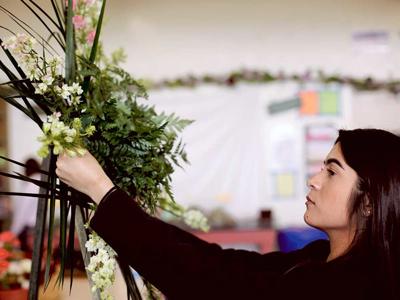
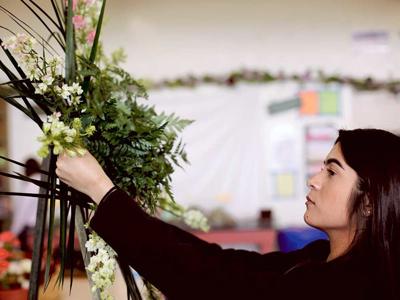
The bald spots she’s referring to are the patchy spaces in the wreaths that her students are working on. Students take heed and pick up and spin their wreaths, checking for any so-called “baldness,” and filling the gaps as they go, throwing leaves and petals in their wake. These wreaths of blue and white hydrangea will adorn various panels and stands on prom night, an event for which these students have been tasked to make all the floral decorations. They’ll make everything from the made-to-order boutonnieres on their suits to centerpiece bouquets on the tables.
With a quick look at the clock, Robinson switches gears. On to the next project: simple spherical vases filled with short-stemmed gerberas. With precision they take foot-long indigo, purple and white gerberas and cut the stems diagonally to 4 to 5 inches, alternating lengths to produce a full globe like arrangement. It’s a traditional American style like all of their projects, says Robinson. This one is simple and plays up color and shape rather than variety.
The vases are table arrangements for the Mission Trails Regional Occupational Program open house, a program of hands-on vocational training. Think culinary arts, auto repair, agriculture and this class, floristry.
It’s a fast-paced environment with a lot of side conversation – to an observer, the opposite of a quiet and focused learning environment. But Robinson (Ms. Rob, as her students affectionately call her) is in complete and total command of her room. In part she draws on her 12 years of experience as a retail florist, but also her experience as a floristry teacher at Soledad High School for 10 years. She began teaching at North Salinas in 2012.
She gives concise but clear directions. Easy enough for a sleepy student to follow, but minimal enough for students to chat with each other. “It’s good for them to socialize,” Robinson says. “They’re sitting down most of the day, anyway.”
It’s one aspect students like about Robinson’s class, not only because they can talk freely, but they also get a chance to forge new relationships.
For example, a pair of seniors, Alejandra Mejia and Luis Navarro met in a history class last year. “Mostly, I just sat behind her,” Navarro says, adding he wouldn’t go so far as to call her even an acquaintance last year. Mejia adds, “The only thing he said to me last year was, ‘Can I borrow a pencil?’” But today they’re friends, chatting about the upcoming prom and making fun of the time Navarro accidently cut himself on some shearing scissors.
On top of the social freedom the class affords students, it’s also an opportunity for real job training. “We do some weddings, a lot of private events,” Robinson says. “We do a bunch of funerals.”

Yocelyn Jimenez attentively patches a wreath. Students in Kyle Robinson’s floristry class are trained to have the skills of an entry-level retail florist.
Those events are not just projects for students, they’re real-life, paid-for business transactions. Robinson says it’s that real-world expectation that drives students to keep up the reputation of the floristry class: “People really do trust these kids to turn out quality stuff.”
The reputation about their quality work has spread. Not only does Robinson break even every year, she turns a profit. She won’t say how much of a profit, but it’s all goes back into the class. It’s enough money to maintain a constant delivery of fresh flowers every day, replace old tools and buy materials like concrete and clays for special projects.
Fifteen minutes before the last bell rings, students busy themselves sweeping up clippings and gathering tools. They spritz their flowers to refresh the geranium petals before placing them into the walk-in fridge. One student, Marlene Mejia, takes her time, fluffing her gerbera petals. “I like this class because I get to create something,” she says. “I don’t think this will be my career, I know it will be.”


(0) comments
Welcome to the discussion.
Log In
Keep it Clean. Please avoid obscene, vulgar, lewd, racist or sexually-oriented language.
PLEASE TURN OFF YOUR CAPS LOCK.
Don't Threaten. Threats of harming another person will not be tolerated.
Be Truthful. Don't knowingly lie about anyone or anything.
Be Nice. No racism, sexism or any sort of -ism that is degrading to another person.
Be Proactive. Use the 'Report' link on each comment to let us know of abusive posts.
Share with Us. We'd love to hear eyewitness accounts, the history behind an article.