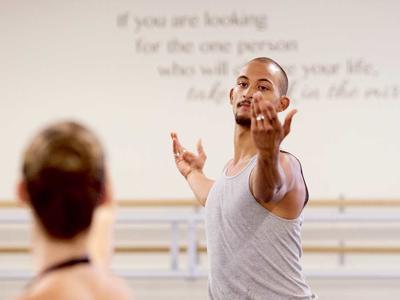

The Dance Center in Carmel is mostly empty late on a Thursday afternoon. But in its fifth studio, things are moving. Inside, Isaiah Bindel is helping a 17-year-old dancer with the finer points of the roughly five-minute “Pas de deux” routine of Pyotr Ilyich Tchaikovsky’s ballet The Nutcracker.
The music is overwhelming in the empty space swirling around the two dancers. When the music crescendos around the 2:30 minute mark it bounces off the walls, echoing – and is broken only by the sound of Bindel’s assurance to his student as he holds her up. “And high!” he says. “High. Good.”
In the four months leading up to Monterey Peninsula Ballet Theatre’s production of theNutcracker at Sunset Center, these kinds of one-on-one practices are far removed from the big audiences, professional lighting and the customized costumes.
“We wanted to give our community a real professional ballet experience,” says Tia Brown, MPBT’s founder and artistic director. She adds that though there are an abundance of dance programs in Monterey, community ballet performances that include an audience not just comprising students’ family members but the greater community are rare. “There are tons ofNutcrackers in big cities,” she says. “We want to foster that level of appreciation for the arts here.”
What that means is a multi-pronged approach to first get kids interested in dance – and not just the performative aspect of it either. What that looks like is putting what few financial resources the MPBT has – from donors and an annual fundraiser – toward one production, for one weekend. (Since the theater’s founding in 2017, they have only performed the Nutcracker.) It also looks like going to South County schools and performing a stripped-down version of theNutcracker, with an emphasis on exposing the mechanics behind the lighting and scene change.
“We want to show kids that they don’t have to be the Sugar Plum Fairy or the Prince,” Brown says. In other words, it’s not all about the star and showing the behind the scenes can spark interest in kids that aren’t naturally attracted to dance. “We want to show kids, this is how lights work – maybe that’s something you’re interested in.”
Another approach: bringing in award-winning dancers to teach. One such dancer is Bindel, who was a former ballet student of Brown’s when she was with the Carmel Academy of Performing Arts. Among other accolades, Bindel is currently a company dancer with Dawson Dance SF and a 2018 winner of the Isadora Duncan Dance Award for an individual “Outstanding Achievement in Performance” for his solo work for Les Vérités.
“I didn’t even begin to really like ballet until I got to college,” Bindel says. He specializes in contemporary dance, but adds, “ballet is a muscle – it helps you out in other forms.”
Brown agrees, emphasizing that ballet is a foundational genre to build from, but she also acknowledges that ballet isn’t for everyone – especially for young boys. “If you walk into any dance class in this area you’ll see maybe one boy in a ballet class,” she says. But to her, that doesn’t matter because ballet doesn’t have to be the only entryway to dance. Just as some kids want to do the lights instead of perform, Brown says some boys get into different types of dance other than ballet. “We get most boys through hip-hop,” she says. “And that’s OK, that’s their starting point.”
Bindel has also witnessed the gender disparity as a professional dancer, particularly because he is a gay man and because he is American. “You get these dancers from Russia, Cuba and Spain – big, cut guys – and dance schools there are a 50-50 gender split, so they have that built-in confidence. They’re from macho cultures, but America is different,” he says. In the U.S., dance schools enroll more women than men by a longshot: Nonprofit Quarterly estimates the ratio could be as low as 1 man to 20 women.
Additionally, because being a dancer is not “macho” in America, Bindel says he had to work extra hard to stand out from the few men who were in his same auditions. “I love my gays, but when you add the leotard and everything it becomes extra flamboyant. Choreographers don’t want another wispy male dancer,” he says. “I take pride that my style is masculine.”
And from carving out style, he in turn wants to help others find their footing – be it the next Sugar Plum Fairy or the next Cavalier. “Teaching is more enriching – and being able to teach in my hometown is extra-fufilling,” he says.
In the studio with the future Sugar Plum Fairy, the routine ends with smile and high-fives, then Bindel runs through some notes. He reminds her to hold herself up, and go for height: “Don’t be scared of the music – you’re bigger than the music.”


(0) comments
Welcome to the discussion.
Log In
Keep it Clean. Please avoid obscene, vulgar, lewd, racist or sexually-oriented language.
PLEASE TURN OFF YOUR CAPS LOCK.
Don't Threaten. Threats of harming another person will not be tolerated.
Be Truthful. Don't knowingly lie about anyone or anything.
Be Nice. No racism, sexism or any sort of -ism that is degrading to another person.
Be Proactive. Use the 'Report' link on each comment to let us know of abusive posts.
Share with Us. We'd love to hear eyewitness accounts, the history behind an article.