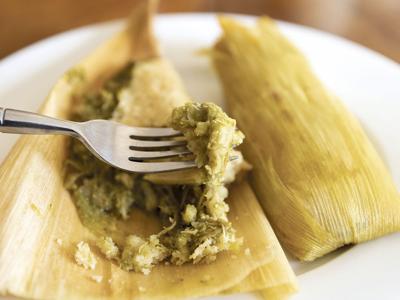

A silver steamer with a batch of tamales cooks, filling the kitchen with the smell of green chili. It’s a clear sign that the tamales are one step closer to being ready. Taking a tamale out of the steamer and unwrapping it in preparation for that first bite feels like a mission accomplished – and a reward for the hard work everyone did that day.
Making tamales isn’t a simple task. It requires hours of preparation, several hands and an organized setting to get them onto the stove. In the traditional method, the process begins with cleaning maize, making the hominy, grinding it and mixing it with broth, lard and salt until it has the right consistency (for corn husk tamales, that consistency is when the dough isn’t too sticky and spreads easily on the husks). Next comes washing and soaking the corn husks (or cutting and softening banana leaves for Oaxacan-style tamales). Then there’s prepping the filling – which can come in endless combinations – pork with green sauce, chicken in red sauce, veggies with chili dressing and so on.
Then tamale-makers must form the tamales – add the dough to the husks, fill them, and wrap them – before finally putting them on the stove and waiting patiently for about two hours before they are ready.
Tamales are a typical holiday dish during posadas, Christmastime and New Year’s Eve for many Mexican and Mexican-American families, and making tamales is an intergenerational activity in which each family member collaborates on a designated task.
It is a tradition that has been around since long before colonization in Mexico and the rest of Latin America (tamales are called humitas in Bolivia and hallacas in Venezuela). Indigenous people prepared this dish for parties and social gatherings. In Mexico, Indigenous people ritually offered tamales to their gods like Tlaloc, the god of rain, or Huitzilopochtli, the Aztecs’ god of war.
Nowadays they are used in different celebrations and are eaten year-round, but they remain more popular during the winter holidays.
Julissa Reyes of Salinas says she learned how to make tamales from her mom and aunt, and loves that she can celebrate her Aztec culture and indigenous traditions. Reyes is vegan so her Aunt Julieta modified the recipes and taught her how to make vegan versions of her favorite tamales. For fat, she uses avocado oil and makes green tamales with vegetables including green beans, zucchini and jalapeño. Her tamales became popular among friends and family, so she started selling small batches during the holiday season.
Nowadays, people don’t need to start completely from scratch – local bakeries, including Leal Bakery in Salinas and La Fortuna in Castroville sell corn dough, making it easier and faster to make a batch of tamales.
Tamales come in different sizes, shapes and colors. The most common meat fillings are chicken, pork, beef (in green or red sauce) and cheese with chili. For savory tamales, thin, moist masa and flavorful filling are key. Aurelio Salazar Jr. likes the ones from La Mariposa Bakery in Salinas. “They are always moist, never dried out and full of meat,” he says, noting the size is also larger compared to other places.
Not everyone has time to make tamales themselves. Luckily, you can find tamales at different places across Monterey County, including bakeries, food trucks and in the parking lots outside large grocery stores. While most places offer at least one meat-free option, it doesn’t mean those tamales are animal-product-free, since lard is the traditional fat used to make them.
One popular place in Greenfield is Tamalaso – their cheese and jalapeño is a favorite. For those who like something extra, La Fortuna fixes their tamales with sour cream, lettuce and spicy red sauce. Susana Avila, who works at La Fortuna, says this is a common way to eat the dish in Michoacan. Avila says both the size and quality are important. “If tamales are too small, people return them,” she adds.
In Seaside, Macri’s Tamales and Catering, a food truck in front of La Morenita store, offers tamales with corn husks as well as traditional Oaxacan tamales wrapped in banana leaves. Options include chicken with mole, pork in green or red sauce, and cheese and jalapeño in a red sauce.


(0) comments
Welcome to the discussion.
Log In
Keep it Clean. Please avoid obscene, vulgar, lewd, racist or sexually-oriented language.
PLEASE TURN OFF YOUR CAPS LOCK.
Don't Threaten. Threats of harming another person will not be tolerated.
Be Truthful. Don't knowingly lie about anyone or anything.
Be Nice. No racism, sexism or any sort of -ism that is degrading to another person.
Be Proactive. Use the 'Report' link on each comment to let us know of abusive posts.
Share with Us. We'd love to hear eyewitness accounts, the history behind an article.