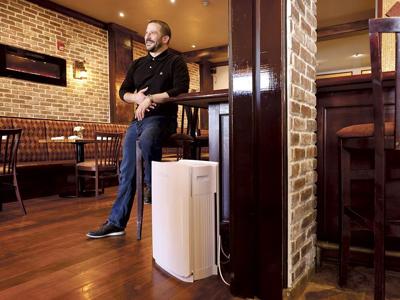

Dale Byrne has no patience for political skirmishes. The retired software executive, and president and “chief caring officer” of the successful all-volunteer group Carmel Cares, is more interested in getting things done than debating. When the pandemic threatened to shutter dozens of Carmel-by-the-Sea restaurants, he and Cares enlisted help to create a parklet design to share with restaurants free of charge. When political skirmishes over the parklets began, Byrne bowed out.
But that wasn’t all for Carmel Cares – before the parklets initiative, Cares created a lifeline for restaurants by offering grants to owners in exchange for cooking meals for nonprofits and shut-in senior citizens – all funded by a Community Foundation for Monterey County donor-advised fund created by real estate agent Tim Allen called Carmel Gives.
That grant money saved Mission Bistro, says owner Shaheen Alnuaimi. Now, Alnuaimi proudly declares that his restaurant is the first to be part of Cares’ newest initiative: Installing air filtration systems inside Carmel restaurants to protect both diners and employees. The effort fits within Cares’ mission statement to keep Carmel “beautiful, safe and inviting.”
The initiative got started last year after Allen called Byrne and asked him to work with Bill Hayward of Hayward Lumber (and the Hayward Healthy Home Initiative) on an air filtration project for restaurants. With the town’s political debate over parklets continuing to threaten their ongoing existence, air filtration was the next best thing.
Hayward had already partnered with Mark Hernandez, a civil and environmental engineering professor at the University of Colorado and director of the university’s Environmental Engineering Microbiology and Disinfection Lab, to design and study an air filtration monitoring system at the Post Ranch Inn’s Sierra Mar Restaurant in Big Sur.
“The Post Ranch Inn is really one of the first examples of opening back up right, using building science in an evidence-based way to reduce the risk of reopening post-Covid,” Hernandez says.
In Carmel, Byrne and Hayward found a Bay Area consulting company, AirByDesign, and a filtration unit manufacturer, Wynd, to partner on the project. AirbyDesign uses a LiDAR (Light Detection and Ranging) system of imaging to build a 3-D virtual model of a restaurant, which is then used to design the restaurant’s filtration system that includes the placement of units and sensors. Sensors collect data 24 hours a day and send the data to AirbyDesign. If the sensors detect levels of CO2 that are too high, the company alerts the restaurant to open windows and doors to increase airflow.
The Wynd machines outfitted with HEPA filters stand two feet tall and about a foot-and-a-half wide. They’re quiet, drawing impure air from the sides and pushing clean air out the top of the unit. Mission Bistro has three that facilitate six-and-a-half air changes per hour. The filters need to be changed once every six months.
“The customers should feel comfortable that this is not just a static thing where they bought a filter, stuck it in a corner and hope it works,” Byrne says.
Restaurants can sign up to be a part of the program, install the equipment and go through staff training on how to use the system. They are then given a blue window decal to let customers know they’re using the AirByDesign/Wynd system. It reads “Verified Clean Air; This business has invested in your health and safety.”
Byrne says Cares has 12-15 restaurants that have installed the equipment. Byrne and Hayward negotiated lower rates from AirByDesign for designs and monitoring subscriptions for those initial restaurants. Wynd is offering to divide the cost per unit – between $300-$400 – into 12 monthly payments with no interest. As they move forward, Carmel Gives will offer grants to owners to cover the first 10-15 months of subscription costs for those that have trouble paying for it.
“I hope to get all the restaurants and it becomes a national story,” Byrne says. “Because it’s necessary. We never thought about it with the flu… we’re always going to have something, so why not have clean air instead of dirty air?”


(0) comments
Welcome to the discussion.
Log In
Keep it Clean. Please avoid obscene, vulgar, lewd, racist or sexually-oriented language.
PLEASE TURN OFF YOUR CAPS LOCK.
Don't Threaten. Threats of harming another person will not be tolerated.
Be Truthful. Don't knowingly lie about anyone or anything.
Be Nice. No racism, sexism or any sort of -ism that is degrading to another person.
Be Proactive. Use the 'Report' link on each comment to let us know of abusive posts.
Share with Us. We'd love to hear eyewitness accounts, the history behind an article.