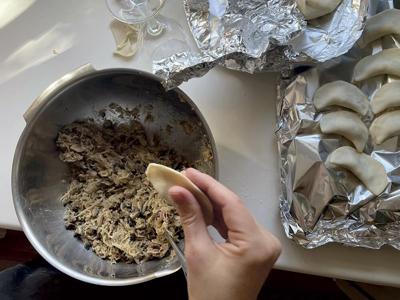

A legend claims that in the 13th century, St. Hyacinth of Poland went to Kyiv, Ukraine where he tried and was wowed by Chinese dumplings, bringing the recipe back to Poland. That’s how modern pierogi were born. These days, you don’t have to travel so far to learn how to make them from scratch, in under an hour.
This ultimate comfort food of Poland comes in countless regional varieties, many of them simply called dumplings (kluski) to emphasize that they don’t have the elegant pierogi form. There are Silesian dumplings with mashed potatoes and sweet “lazy” pierogi (pierogi leniwe) made of quark (similar to cottage cheese), eggs and flour, as well as “little ears” (uszka) to be served in borscht. They all differ from pierogi in terms of what you do with ingredients. For these dumplings, you combine all the ingredients while for pierogi you keep the dough and filling separate; filling becomes enclosed in the dough.
Pierogi – a Polish response to the ancient and everlasting love affair between flour and water – is widely popular and available frozen in Polish grocery stores. Locally, try the International Deli & Market at 580 Lighthouse Ave., Monterey. The most popular fillings include sauerkraut with mushroom, ground meat and onion and potato and onion; but also sweet quark or strawberry and blueberry.
One of the best things about pierogi is that they don’t mind being frozen. But the question is why would you buy frozen pierogi when you can make them yourself and then freeze them yourself to treat yourself again whenever you have a craving?
While a bag of a dozen pierogi should run about $5, you can make this inexpensive peasant dish even cheaper. Despite another legend – pierogi are easy to make. At left you will find a three-ingredient dough and a traditional Polish filling with sauerkraut and mushrooms. Mix it up by adding whatever combination of filling ingredients that sounds good to you.
The magic of pierogi – the reliability of its durable shape – comes from very thin wheat flour. For recipe testing purposes, the Weekly used finely ground Italian flour Caputo – type 00 – the same kind one might use for pizza or pasta.


(0) comments
Welcome to the discussion.
Log In
Keep it Clean. Please avoid obscene, vulgar, lewd, racist or sexually-oriented language.
PLEASE TURN OFF YOUR CAPS LOCK.
Don't Threaten. Threats of harming another person will not be tolerated.
Be Truthful. Don't knowingly lie about anyone or anything.
Be Nice. No racism, sexism or any sort of -ism that is degrading to another person.
Be Proactive. Use the 'Report' link on each comment to let us know of abusive posts.
Share with Us. We'd love to hear eyewitness accounts, the history behind an article.