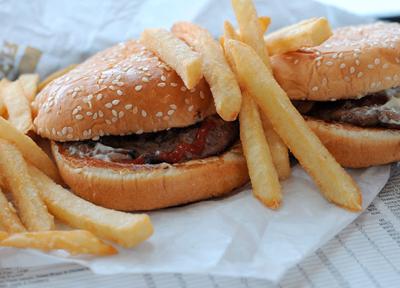
Foods that are organic or otherwise more “natural” have reached unprecedented levels of public acceptance. But in the valuations and price action that represent truth on Wall Street, fast food companies are beating the tar out of organic corporations. The stock market is a forward-looking indicator, reacting not to the way things are, but to the way the market expects things to be. And the fast food industry is counting on two new varieties of high-oleic soy oil, set to hit the fryers this year, to add gravy to its train.
Oleic acid is named after olive oil, the most concentrated naturally occurring source of this monounsaturated fat. Widely lauded for its healthfulness and flavor, olive oil offers many reasons to love it. But it’s the oleic acid that industrial food processors are drooling over – and not necessarily for its supposed heart-friendly virtues. Oleic acid is stable at room temperature for long periods of time, and can endure repeated bursts of heat without breaking down.
High-oleic oils first entered the market about 10 years ago as the industry attempted to phase out its use of partially hydrogenated oils – aka margarine – which have been shown to contain dangerous levels of trans fats. Several high-oleic oils have entered the market to fill this void of shelf – and heat-stable fats, including oils made from sunflower, corn and canola seeds.
These oils have become the industry’s preferred substitute for partially hydrogenated vegetable oils, and are used in all manner of processed food, especially snack foods and in hot oil used to deep fry. While these oils lacked trans fats, they were still not ideal, explains Melanie Warner in Pandora’s Lunchbox: How Processed Food Took Over the American Meal.
“Nearly a decade into the post-trans-fat era, no clear-cut winner for replacing partially hydrogenated soybean oil as processed food’s favorite fat has been found. Corn oil retains a corny taste; canola can only be grown in northern climates, limiting its production; sunflower and safflower are too expensive; and butter is way too expensive, as is coconut oil.”
Regular soy oil, Warner notes, is the cheapest form of fat there is, making it the first choice for industry. Since everything from burgers to fries to buns contains soy oil, subsidizing it equals subsidizing fast food. Same goes for junk food.
Enter high-oleic soybean oil. There are two new types, DuPont’s Plenish and Monsanto’s Roundup-ready Vistive® Gold. Both are made through the genetic modification technique called gene silencing. Plenish boasts higher oleic acid levels, on par with olive oil at 75 percent. Vistive® Gold is lower in saturated fat and also boasts lower levels of omega-6 fatty acid.
Efforts by Monsanto and Dupont to perfect high-oleic soybean oil, Warner told me via email, are “part of a decades-long struggle by the food industry to make soybean oil suitable for processed foods… the oil industry has been trying to find a way to prevent soybean oil from going rancid.”
Among its many industry-friendly qualities, high oleic soy oil can withstand up to three times as many fryings as current industry standard. Thus, oil costs for processed foods could be cut by as much as a third in the coming years.
Is high-oleic soy oil the only reason fast food outperforms whole food? No. But it’s interesting to see how each industry’s oil of choice reflects the basic qualities and values of the foods where they are found. Olive oil is the standard of healthy, natural oil, the backbone of the widely respected Mediterranean diet. Olives are grown by hand, while biotech soybeans are grown by machines on laser-leveled fields. Soy oil is extracted and treated with heat, pressure and chemicals, and olive oil is naturally healthy and delicious.
Perhaps the single most important comparison is that oils from corn, canola, safflower, sunflower, and soy – sometimes referred to as “seed oils” – are about as new to human diets as fast food.
The relatively new “getting to know you” process between humans and seed oils has already delivered an unexpected series of problems. First there were the issues with trans fats. More recently, problems created by linoleic acid have been discovered, including the creation of chemicals (toxic aldehydes) when linoleic acid is heated. Most seed oils contain linoleic acid. Olive oil does not. And to its credit, neither does Vistive® Gold.
Although soy has been eaten for thousands of years in Asia, it’s mostly been in fermented forms like soy sauce, tempeh, natto, miso and tamari. But soy oil was rarely consumed. Warner quotes Joe Hibbeln, acting chief of nutritional neurosciences at a research division of the National Institutes of Health, who calls the rise of soybean oil “the single greatest, most rapid dietary change in the history of Homo sapiens.’”
The many adjustments, dead-ends and wrong turns that have occurred as Homo sapiens have tried to adapt to vegetable oils are a clue we’re trying to fit a square oil into round bodies, so to speak.
On the other hand, maybe the gene jockeys at Monsanto and DuPont have finally figured out exactly what we want and don’t want from our oil, and how to get soy oil to be that, and only that. It’s entirely possible. But as the leading indicators on Wall Street are suggesting, it’s more likely they’ve figured out how to squeeze even more profit from soy.


(1) comment
Now I'm no huge fan of monsanto but in this case high Oleic oils really are a good thing. They are shelf stable and less likely to go rancid, and contain higher levels of omega 9 fats which are healthier to eat in large amounts than omega 6 fats are. They taste better than using Palm oil, having the nice 'light' flavor trans fats used to have while being probably the healthiest fat one could consume aside from olive oil or oils with lots of omega 3.
High Oleic is far healthier than high omega 6 soybean oils and I hope more companies use them going forward in things like mayo, salad dressings, and the like.
Welcome to the discussion.
Log In
Keep it Clean. Please avoid obscene, vulgar, lewd, racist or sexually-oriented language.
PLEASE TURN OFF YOUR CAPS LOCK.
Don't Threaten. Threats of harming another person will not be tolerated.
Be Truthful. Don't knowingly lie about anyone or anything.
Be Nice. No racism, sexism or any sort of -ism that is degrading to another person.
Be Proactive. Use the 'Report' link on each comment to let us know of abusive posts.
Share with Us. We'd love to hear eyewitness accounts, the history behind an article.