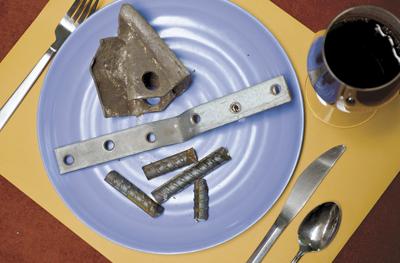
eavy metal pollution makes no distinction between how crops are grown. Supposedly clean agricultural practices like organic will offer no protection, if the likes of cadmium, arsenic, lead, nickel and mercury are in the soil or water. Human practices like mining and manufacturing are by far the largest source of potential contamination. Such activities release heavy metals into the air and water, from where they find their ways into the soil and plants, from where they are extremely difficult to remove.
Last April the Chinese government acknowledged that a staggering one-fifth of its arable land is seriously polluted with heavy metals, thanks to decades of aggressive industrial development. China’s Environmental Protection Ministry, looking at samples taken between 2006 and 2013, described the situation as “not optimistic.”
Heavy metals can accumulate in the body, causing chronic problems in the skin, intestine, nervous system, kidneys, liver, and brain. Some can occur naturally in soil, though rarely at toxic levels.
The most commonly found heavy metals were cadmium, nickel and arsenic. Cadmium, one of the most toxic of heavy metals, moves through soil layers with ease, and is taken up by a variety of plants, including leafy vegetables, root crops, cereals and grains. Last year it was discovered that nearly half of the rice for sale in the southern China city of Guangzhou was tainted with cadmium.
Nickel and arsenic, the other two found in greatest amounts, aren’t so great either. In the U.S., arsenic in apple juice has been on the radar since 2011, when Dr. Mehmet Oz reported high arsenic levels in multiple samples independently tested for his television show. More than half of the apple juice consumed in the U.S. comes from China.
WE CONSUME LARGE AMOUNTS OF CERTAIN THINGS FROM CHINA IN ADDITION TO APPLE JUICE, LIKE GARLIC AND FARMED SEAFOOD.
Oz was taken out to the woodshed by a number of experts and authorities, including the FDA. ABC News’ senior health medical editor Dr. Richard Besser called Oz’s claims “extremely irresponsible.”
A few weeks later FDA admitted that it had withheld many test results which did, in fact, support Oz’s claim. Besser apologized to Oz on national television, and soon after the FDA collected about 90 retail samples of apple juice. According to FDA documents now available, the levels reported by Oz are consistent with those detected by the agency in samples from China and Turkey.
Last year the FDA set a limit, also known as an “action level,” on arsenic in juice, at 10 parts per billion, the same level that’s enforced in drinking water. Currently, FDA has import alerts set for four companies that deal in apple concentrates, two each in China and Turkey. The products of these companies are regularly tested for arsenic because of previous violations of this action level.
While China isn’t the only polluted place from which we import food, with a combination of industrial development and legendarily lax enforcement, it’s become a poster child for scary food imports. But any region with rapid industrial development and suspect regulations could be a candidate for yucky stuff.
While we don’t import a huge amount of food from China overall, we do consume large amounts of certain things in addition to apple juice, like garlic and farmed seafood – including 80 percent of the tilapia we eat. Much of China’s surface water, including water where aquaculture occurs, is polluted, not only with industrial toxins but also agricultural fertilizers, which fuels the growth of algae. Algae can accumulate heavy metals, as will the fish that eat it.
“Foods offered for import are required to meet the same U.S. food safety standards as domestic,” explained FDA Press Officer Lauren Sucher. “If the FDA encounters a particular product [that] poses a public health concern, the FDA can target it for increased testing.”
When asked if the revelation that 20 percent of China’s farmland is polluted with heavy metals will inspire increased testing on Chinese imports, Sucher replied, “The FDA doesn’t announce its actions in advance.”
Wary consumers who aren’t interested in waiting for FDA to possibly ramp up its testing of Chinese food imports can take their own measures to minimize the possibility of contamination. Local, as in American-grown produce, will trump labels such as “organic.”
In fact, if the food is grown in a polluted place, organic produce could contain more heavy metals than conventionally grown food. Organic agriculture practices include the use of manure, which could add heavy metals to the soil.
The notion that organic food from a polluted place like China could carry more heavy metals than nonorganic food from the U.S. puts a new spin on the idea of eating locally. In this case, eating locally could mean consuming food grown anywhere in this vast continent. But in a way, the reasons are similar to why many people prefer buying from the local farm stand: you have more information about how something is grown. But using this information requires knowing something about where you live. Such as, is there any heavy metal contamination around here?


(0) comments
Welcome to the discussion.
Log In
Keep it Clean. Please avoid obscene, vulgar, lewd, racist or sexually-oriented language.
PLEASE TURN OFF YOUR CAPS LOCK.
Don't Threaten. Threats of harming another person will not be tolerated.
Be Truthful. Don't knowingly lie about anyone or anything.
Be Nice. No racism, sexism or any sort of -ism that is degrading to another person.
Be Proactive. Use the 'Report' link on each comment to let us know of abusive posts.
Share with Us. We'd love to hear eyewitness accounts, the history behind an article.