
When I stepped off the ramp from the plane in Charleston, South Carolina, I walked smack into a wall of delicious smells – simmering garlic, rich cheese, baking bread. It seemed appropriate enough for a city now internationally famous for its food, but…c’mon. We were still in the airport.
The guy next to me on the plane found out I planned to try as many foods as I could fit in. “Ohhh, you’re gonna like it here,” he said as we disembarked.
Local transplants like the three I saw from Salinas alone (Daisy Moses, Joanne Haruta and Bryan Davis) echoed the sentiment I heard from a cab driver: “One thing you won’t fall short on is food,” he said.
They weren’t lying. You can’t throw a hush puppy without hitting a hot restaurant. So I got my fill of Southern sushi at O-ku, smoked brisket at Lewis Barbecue, baked oysters at Leon’s, Charleston “nasty” biscuits at Hominy, bacon shrimp ‘n’ grits at The Grocery, and sustainable shrimp rolls and prosciutto-peach salads from Obstinate Daughter.
But this mission wasn’t exactly about eating. It was inspired by the first-ever BevCon, a much more intimate response to massive Tales of the Cocktail in New Orleans, led by Angel Postell, who ran Charleston Wine & Food for years, and Scott Blackwell and Ann Marshall of High Wire Distilling Co.
It overflowed with discoveries. Several stood out:
Craft spirits are the next craft beer.
One session debated the lasting merits of the term “craft” now that’s it’s been co-opted by corporate America. Whatever you want to call smaller, non-Bacardi, artisan-style operations, you have to call them booming. This spring’s annual installment of American Distilling Institute’s national conference took a look at the meteoric rise. From 2010-2016 the number of current Distilled Spirits Permits, the federal permit required to operate a distillery, leapt from 560 to 1,825. Last year 400 DSPs were issued, more than one a day. This year the number of operating craft distilleries cracked 1,000 for the first time ever. Some very intriguing creations are coming with the boom, from local potato-made gin from Colorado (Woody Creek Distillery) to honey-based vodka in Vermont (Caledonia Spirits Barr Hill).
Botanicals are badass.
Blackwell happened to be on campus when I visited his distillery the day before it would host BevCon’s opening party. He tasted me through some compelling and creative spirits made in a hand-hammered copper still visible through the tasting room window, like a whiskey made from sorghum grown on a Mennonite farm, a rare cane-juice rum (or rhum agricole) that sells out super fast, and the country’s first regional amaro (see “Bitter is getting bigger,” below). But it was a bottle of the Hat Trick Gin I ended up buying. After he taught himself to make gin with the help of a simple handbook, Blackwell spent weeks macerating ingredients in mason jars to see what combinations to add to his distilled juniper base. The result is a revelation, and High Wire’s flagship, riding a lively balance of lemon and orange peel, lavender, lemongrass, licorice root, cardamom, coriander and angelica root.
Robots make nice booze.
Monterey County natives Davis and Haruta’s Lost Spirits Distillery – which just relocated from Salinas to Silicon Valley to South Carolina – have already pioneered an amazing hack that gives liquors the molecular flavor profile of 20-year-old rum or whiskey in six days. (Get more on their technology on the blog,www.mcweekly.com/edible.) Now Davis and collaborating labels Rational Spirits and Rattleback Rye are in the final stages of automating their distillery in Charleston to be able to function with very little human effort – monitors will trigger different parts of the machinery to kick in at any time of day or night, a text will be enough to add yeast. “Wall Street builds value through deal structure, not by making stuff,” Davis says. “The use of technology from the Second Rise of Machines will break China’s economy, and redefine ours.” The next project: building a pond in the adjacent woods for an island tiki bar.
Bitter is getting bigger.
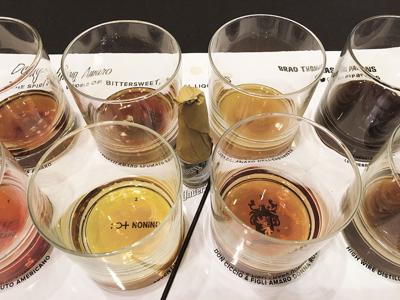
Brad Thomas Parsons won a James Beard award for his book Bitters: A Spirited History of a Classic Cure-All; next month comes Amaro: The Spirited World of Bittersweet, Herbal Liqueurs. He took a session through a tasting of American amari (“amaro” is Italian for bitter) that demonstrated the versatility and vibrancy of a category that enjoys ancient roots but is only now a widening phenomenon in the U.S., boosted by the popularity of negronis and barrel-aged cocktails. The absence of rules around how to make amaro (as opposed to, say, whiskey or beer) means lots of creativity. “Every bottle is a story,” he says. So while Fernet is most widely known, the alpine possibilities are endless. The Bruto Americano from St. George Spirits of Alameda, Calif. is a 14-ingredient wonder to watch. Blackwell’s amaro, made with foraged caffeinated herbs native to the South Carolina, presents a lesson on making something foreign personal. All bitters come with a good reminder for all eaters and drinkers: It’s nice to mark the end of a good meal and linger a little longer at the table.
~ QUICKBITES ~
- River Road Grill has closed as partners sort out their priorities. Bummer.
- The remodeled Pacific’s Edge (620-1234) at Hyatt Carmel Highlands has new menus in place, include a four-course plant-based tasting menu for $40. From the main menu, splurges like yellowfin tuna with tempura avocado ($42) and aged ribeye with Peruvian yellow pepper sauce ($56) leap out.
- Exec Chef Phillip Wojtowicz has returned to beloved Big Sur Bakery (667-0520), which he co-founded.
- Brand new Tricycle Pizza in New Monterey is doing pies as excellent as fans from Pacific Grove Farmers Market will remember. More on the blog.
- Annual Great Bowls of Fire Cookoff ($30-$35, 659-4000) hits Carmel Valley Ranch Wednesday, Sept. 21.
- Roux in Carmel Valley (659-5020), one of my favorite new restaurants of the last 12 months, is on the hunt for two more local restaurant spots.
- Waste Management helps business recycle organic waste (call 796-2256).
- Central Coast Juicery (747-7085) carries an incredible probiotic coconut yogurt from New Earth Superfoods. Even at $22 they can’t keep it on the shelf.
- The “combinado” at Tortuga Tortería (899-8429) in Seaside, half carrot juice, half orange, is nectar of the goddesses.
- Lalla Grill (324-4632), please bring back your veggie burger.
- NFL football is here. Baja Cantina (625-BAJA) has drink specials and a big screen. Peter B’s Brewpub (649-2699) does Sunday breakfast menu and drink specials and $5 house brews. Knuckles (372-1234) does $4 drafts 4pm until the first touchdown Monday Night.
- Wine Enthusiast drops props on some of Hahn’s Lucienne wines: 91 points for Lone Oak Vineyard Chardonnay and 93 for Hook Vineyard Pinot Noir.
- Folktale Winery’s Soberanes Fire fundraiser gathered $100K. Big ups to participating wineries, chefs and volunteers.
- LaZarre winemaker dinner at Cork & Plough ($65, 386-9491) in King City happens Sunday, Sept. 11.
- Ray Liotta: “It keeps going. You never get ‘There.’”


(0) comments
Welcome to the discussion.
Log In
Keep it Clean. Please avoid obscene, vulgar, lewd, racist or sexually-oriented language.
PLEASE TURN OFF YOUR CAPS LOCK.
Don't Threaten. Threats of harming another person will not be tolerated.
Be Truthful. Don't knowingly lie about anyone or anything.
Be Nice. No racism, sexism or any sort of -ism that is degrading to another person.
Be Proactive. Use the 'Report' link on each comment to let us know of abusive posts.
Share with Us. We'd love to hear eyewitness accounts, the history behind an article.