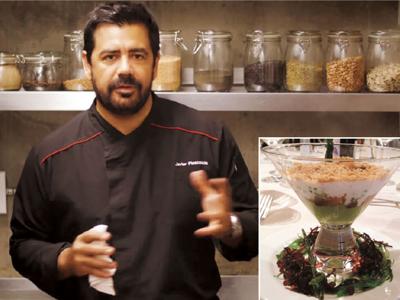

This would be a “shot” unlike any other, with oyster, urchin, abalone, quail egg and smoked steelhead roe. Then there are these shrimp-and-bone-marrow sopes, which don’t come around every day. Neither do salt-cured cactus and watercress salads. Or “street” tacos built around beef tongue confit, or cauliflower and pickled onion, or lamb neck (with a kombucha-pasilla pepper salsa).
Consider the pan-Mexican game changed. To be fair, changing the game is an established part of Javier Plascencia’s main menu. He’s done an uncanny border crossing daily to help run Romesco Mexiterranean Bistro in Bonita, California, for a decade, riding a reputation for creative revolution first hatched with landmark Tijuana eateries.
I felt compelled to go to his brand-new Bracero Cocina de Raiz in San Diego because of what he did in Pebble Beach.
Just a few weeks before Bracero’s debut, he anchored a June 6 event at Casa Palmero in Pebble Beach as part of Monterey Bay Aquarium’s conscious eating festival Cooking for Solutions.
He started eaters off with a typically adventurous cilantro-and-soy-bathed shrimp in a mini waffle cone, and later wowed with wood-grilled octopus plus boneless Niman Ranchbeef short ribs, fresh chickpeas, burnt habanero, salsa verde and a masa dumpling.
David Schmalz was on it for the Weekly. “Everything was tender, fresh, and the soft texture and subtle umami of the octopus proved to be the best pulpo I’ve ever tasted,” he says.
Schmalz cited Dana Goodyear’s 2012 profile of Plascencia in The New Yorker as part of his report. “Baja has no established regional cuisine,” Plascencia told Goodyear. “I’m trying to make Baja a food destination like San Francisco.”
The New York Times was among those who observed him changing a city’s culture with striking Mision 19: “I want there to be no mistake,” Plascencia said in 2011. “This is a Tijuana restaurant. This is what Tijuana can be.”
In TJ, local chef talents are returning like never before. In Pebble, Plascensia served his signature starter at Mision 19: a parfait of albacore layered with a Meyer lemon gel, complex purees crafted from garlic, ginger, cilantro, shallot and olive oil, and a cilantro seed-flavored crema, with crumbled chicharones on top.
Schmalz consumed every last molecule, like everyone else. “The marriage of flavor and texture – savory, soft with a slight crunch – not only worked, it was pleasantly unlike anything I’ve ever had,” he says.
Which is a succinct way of describing what often defies description, or what Plascensia and company call a tribute “to the heart and soul of those who have nurtured each and every plant that has produced what goes into recipes that are both reminiscent, and perfected.”
I’m still turning over the shrimp-bone-marrow sopes and the fava bean molote with 18-month aged cotija and radish-nopal salad in my mind, like I did in my mouth, and the corn masa-beef tartare with onion confit and crispy egg too. Which is part of the point.
Like edgy Tijuana installation artist Daniel Ruanova says in a testimonial, “This is the beginning of a Latin renaissance in the United States,” he says. “Food that’s not just digested in your tummy, but you digest it with your heart and digest it with your mind.”
Until Plascensia realizes his dream to start a restaurant in San Francisco, San Diego’s Little Italy is the best place to appreciate the completely from-scratch grub, open kitchens on both levels, the sweet open-air terrace and the clever cocktails like the No Mames (with mezcal and Byrrh Grand Quinquina) and Chupacabra Tears (aged rum, Cardamaro, mole bitters). But Monterey County is just as good a place to appreciate what he’s doing conceptually by honoring the farmworker in the name and sourcing and the connectivity between Baja and Alta California cultures, and sustainably so.
“We bring these two cultures and put them together,” Plascenscia says.
Restaurant partner Luis Daniel Pena elaborates.
“We need to expose what these [braceros] did: They made California fields the biggest in the states, the biggest in the world,” he says.
The three most recent blogs on the Bracero website include tributes to the braceros who died in the Soledad bus fire June 17, 1958 and in the farmworker train/truck-accident tragedy in Chualar Sept. 17, 1963. The latter adds a passage from They Saved the Crops, Labor, Landscape, and the Struggle over Industrial Farming in Bracero-era California (2012, University of Georgia Press): “Between 1952 and 1963, there were a total of 1,205 recorded farm transportation accidents, or more than 1 every 3.5 days, on average; 2,973 farm workers were injured seriously enough in these accidents to miss at least one day of work; another 159 were killed.”
The final blog of those three describes the kinetic sculptural installation hanging in the restaurant, made by Ruanova, and its 24 mechanically animated short handle hoes, which bob and plunge like they would in the fields, thanks to two 1-horsepower motors.
“What we’re bringing to the table is a broader picture of what Mexican food is,” Pena says, and like Ruanova, he is talking on more levels than one. “People will be amazed, and ask themselves, ‘Is this Mexican food?’”
It is. And something more.
QUICKBITES
• The backdrop: two historic train railcars making their public debut. The event: Dinner Party on the Train, 5-9pm Nov. 14 at Monterey & Salinas Valley Railroad Museum in Salinas. Some reserve River Road wines featuring Odonata in the lead, and Dan Beck Band’s jazz-blues fusion boost the museum benefit ($35 in advance is a bargain, 594-1799). The strolling menu goes long on tri-tip, cheese-infused mash potatoes, bacon-wrapped asparagus, Salinas Valley salads, roasted beets and more.
• Rich Pèpe, Jack Galante and Stefani Chaney’s Carmel-by-the-Glass returns Dec. 11, www.carmelbytheglass.com.
• New tasting room in Carmel Valley is immediately one of the area’s largest, and most historic. More on the blog, www.mcweekly.com.
• Come 1pm Saturday, Nov. 14, Monterey County home brewers share their creations in the backyard beer garden at Trailside Cafe in Carmel Valley (298-7453). The Redwood Coast Brewers Association also meets and live music brightens the affair.
• The county capital of Latino-style ice cream bars, or paletas, is in Gonzales, with 40 homemade flavors like cucumber-lime and mango, in a water sanitation store called PachecoWater. More on the surprising discovery on the blog.
• New fall menu, and official coming out party of Chef Jeremiah Tydeman, is now hitting plates at Alvarado Street Brewing (655-2337), with items like sweet-and-sour cauliflower, pumpkin-curry soup, pot pies, Angus beef steak frites and truffle crayfish mac ’n’ cheese.
• The Wharf Marketplace pairs with Ventana Estate Vineyard to host a benefit for victims of the Cachagua Fire 5-7pm Friday, Nov. 14 with The Hilltop Bluegrass Band, Ventana wines and gourmet hors d’oeuvres, win-win raffle ($25, www.ventanawines.com, 229-7163).
• Venus Spirits Santa Cruz Distillery, where gin, agave, whiskey make for a luxurious six sample tasting ($15), is worth a mission across the bay. PS: We need a Monterey-Santa Cruz ferry.
• Like the demotivational poster tells it so well, a family prays, “Jesus, thank you for this food,” and Jesus, in the produce fields, replies, “De nada.”


(0) comments
Welcome to the discussion.
Log In
Keep it Clean. Please avoid obscene, vulgar, lewd, racist or sexually-oriented language.
PLEASE TURN OFF YOUR CAPS LOCK.
Don't Threaten. Threats of harming another person will not be tolerated.
Be Truthful. Don't knowingly lie about anyone or anything.
Be Nice. No racism, sexism or any sort of -ism that is degrading to another person.
Be Proactive. Use the 'Report' link on each comment to let us know of abusive posts.
Share with Us. We'd love to hear eyewitness accounts, the history behind an article.