Maria Gonzalez remembers San Francisco’s late-night food offerings well. As bars shut down, food vendors emerged along the sidewalks of the Mission District to feed the inebriated. There were taco stands and gyros, but it was the smell of spicy, seasoned smoke wafting through the air from hot dog stands that really drew a crowd.
Gonzalez was working 15-hour days in the food and beverage department at the Ritz Carlton in San Francisco, and she regularly indulged in the decadent dogs, but her body paid a price.
“I wasn’t feeling very well,” she says. “I was gaining weight. I was super tired and all I wanted to do was sleep.”
She knew she was due for a lifestyle revamp. So, she and her husband, Alfredo Estrada, steadily cut meat out of their diet and became pescatarians, then transitioned to full-fledged vegetarians and eventually, vegans. They moved back to her hometown of Watsonville two years ago, where Gonzalez became her own boss and started Cali Dawg Vegan in September. Before launching her business, it took a year of experimenting to perfect the texture of her vegan dogs, which have a foundation of wheat and mushrooms for a meaty (not mushy) consistency.
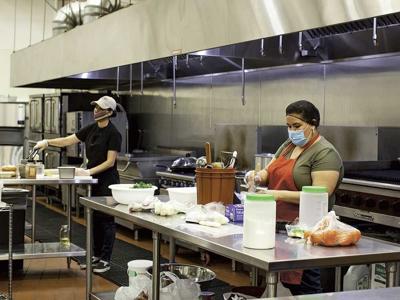
Backed with formal training from Le Cordon Bleu, Gonzalez is no stranger to a commercial kitchen, and began operating out of El Pajaro Community Development Corporation’s commercial kitchen incubator in Watsonville, along with 30 other small artisan food purveyors who have a rotating schedule to use the 8,000-square-foot commercial kitchen space. El Pajaro CDC’s program aims to help with all stages of opening and sustaining a food business: from applying for licenses and permits to marketing strategy, inventory procedures to creating the product.
And six of those food entrepreneurs are continuing to rotate in and out of the kitchen during the Covid-19 shutdown.
“It’s very inspirational, seeing people work – and keep going,” says Gonzales, who now sets up Cali Dawg mostly on Fridays.
Prior to the shutdown, Cali Dawg made cameos at pop-up dinners. Although those events have ceased, there’s a new pop-up venture at El Pajaro CDC itself. And it’s been gaining traction and drawing customers thanks to a special ingredient: a heartfelt dose of love for local farmworkers and their families. Every day, customers can show up to buy meals, and they can also make donations to pay for meals for farmworkers. In total, 83 donations came through in May, funding 498 meals distributed at local farms. (A donation of $50 feeds six people.)
“One-hundred percent of the proceeds go to the businesses,” says Cesario Ruiz, facility manager of the incubator kitchen, and owner of My Mom’s Mole, which is serving mole bowls one day a week.
As facility manager, Ruiz is now responsible for adhering to Covid-19 sanitation guidelines. He wears a white face mask and a colorful cap with a print of calaveras (sugar skulls), and traverses the kitchen to wipe down the door handles of all entrances to the building every hour-and-a-half, keeping up with Covid-19 sanitation guidelines. He also keeps a stockpile of hairnets in a desk drawer in case someone needs one (no one is allowed in the kitchen without one – a pre-pandemic rule.)
“Every time someone uses the kitchen, they clean,” he says. “That’s when I’m a mean person,” he adds, jokingly.
Ruiz has over 20 years of experience working in commercial kitchens. He landed at El Pajaro CDC in 2013, when he also created My Mom’s Mole. The sauce is now sold in specialty grocery stores in the San Francisco Bay Area.
He’s on the pop-up dinner rotation, offering mole bowls. They start with a heap of ancient grains – a medley of farro, spelt, rye, wheat berries and barley – topped with zucchini, onions, mushrooms, and grilled chicken. Each bowl can come with the three types of mole: traditional (the one with the chocolate); queso mole, made with gouda and asiago; and mole verde, made with tomatillos, fresh peppers and almonds. Each flavor-packed mole has up to 25 ingredients.
The pop-up dinners are a win-win for everyone involved, Ruiz says, and the farmworker meal donations are helping keep mom-and-pops working and keep essential workers fed.
“It’s really good food and prepared safely,” he says. “With $50 you are helping a business, and making these essential workers feel good and appreciated.”
TO SEE THE SCHEDULE OF POP-UP MEALS, or to donate to the farmworker meal program, visit elpajarocdc.org


(0) comments
Welcome to the discussion.
Log In
Keep it Clean. Please avoid obscene, vulgar, lewd, racist or sexually-oriented language.
PLEASE TURN OFF YOUR CAPS LOCK.
Don't Threaten. Threats of harming another person will not be tolerated.
Be Truthful. Don't knowingly lie about anyone or anything.
Be Nice. No racism, sexism or any sort of -ism that is degrading to another person.
Be Proactive. Use the 'Report' link on each comment to let us know of abusive posts.
Share with Us. We'd love to hear eyewitness accounts, the history behind an article.