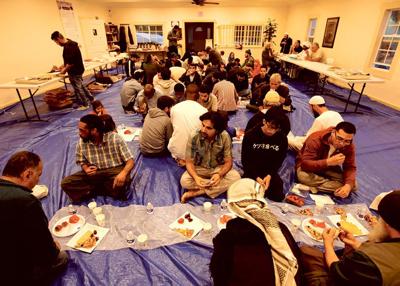

The adhan call summons a crowd inside a mosque for the maghrib, or sundown prayer. For 30 days, local Muslims have followed a fasting routine starting at 4:30am and ending at sundown. It’s 8:30pm on the last day of Ramadan.
The outreach coordinator of the Islamic Society of Monterey County, Ken “Mehmet” Stewart, explains the first part of the feast: “a bite of date, and three sips of water. Down to the detail, we try to emulate the prophet Mohammed.”
Easier said than done. The kids crawling all over their parents and seemingly out of every other nook and cranny are already indulging in more than their fair share of pizza.
The adults, on the other hand, take it more seriously. Ramadan marks the ninth month of the Islamic calendar, which is lunar, not Gregorian. Though Ramadan is known mostly for its strict fasting, Abdel-Qader Seck, ISMC president, comments that this aspect of the monthlong celebration is both “the beauty and the challenge of Ramadan.” Not only do Muslims adhere to a strict no-food-or-drink-during-daylight rule, but they are also expected to abstain from sex or even socializing. No hanging out with friends or going to the movies. The idea is restraint brings a person closer to Allah.
But as much as Ramadan is defined by what a person cannot consume, it’s also defined by iftar, the nightly sundown meal. While Seck explains that iftar is celebrated differently around the world, it is celebrated together. “It changes from country to country, culture to culture and family to family,” he says, but adds California, and Monterey in particular, have the advantage of being culturally diverse.
I agree: Diversity means better food, in this case on an amazing adventure of flavors, cooked by Iraqi, Pakistani, Palestinian, Indian, Sudanese, Lebanese and Senegalese relatives I’ve never had.
After the last prayer concludes, the crowd quickly – remember, these people have had nothing to eat all day – descends on a buffet of home-cooked delights set on shaky card tables. Stewart guides me, helping me pile what I can on a paper plate.
First a cucumber and tomato salad, roughly chopped and refreshing, a good contrast to the starchy goodness to come. Next, a ful medames, a staple dish of Egypt, made from spiced fava beans and sliced egg. Different hands dictate different levels of spiciness in this dish. This one was heavier on the cumin, lighter on the chili powder, simple and delicious.
“We wait the entire year for this tea.”
Then came bamia, an okra stew reduced with ripe tomatoes, often seen in Syria as well as many other Middle Eastern countries. The acidity cuts the natural gooeyness of boiled down okra, balancing texture with tanginess.
Next came the chicken makhani, commonly known as butter chicken, from India. The chicken was thankfully not overcooked and the buttery sauce that covered it enjoyed a beautiful deep orange color and earthy flavors of masala.
Then dolmas, but as Stewart explained, these weren’t “the kind you get in the can from Trader Joe’s.” The ubiquitous dish is found in various regions across the world, but is essentially rice wrapped in a tart grape leaf that’s been soaked in a salty brine. Different iterations stuff it with minced lamb or other goodies. My dolmas were stuffed with spiced rice.
Then came my favorite part: the rice dishes. Three ways. I was modest and picked two, hoping they would complement the food on my already heavy plate: a plain basmati to give my stomach something neutral to soak up the butter chicken and a kabuli pulao, an Afghan rice dish that bears some semblance to a pilaf, except it tastes much more exciting. Bright yellow from a mixture of spices ranging from cardamom and garam masala to cloves and cinnamon, it was tossed with raisins and carrots, although it can be made with meat and garnished with almonds. The rice dish I did leave (regrettably) was the makloubeh, a typical Iranian dish, made by boiling rice with chicken and spices and purposely crisping up the bottom of the rice then serving the dish upside down, crispy-side up.
I finished with a cup of mint tea, which I usually don’t like. I was pleasantly surprised when the herbaceous and intoxicatingly sweet beverage went down smoothly. “This is the best tea in the world,” Stewart says with conviction. “We all wait for the entire year for this tea.” He introduces me to the tea’s creator, Abu Omar, a Palestinian man who is hesitant to reveal the family recipe, but discloses that it’s a mixture of fresh mint and bagged tea and laced with a concerning amount of sugar.
Exchanges like the one with Omar continue on through the night. Strangers join and leave the table. Dialogues melt into one another. It’s like any other post-dinner conversation with family, except I’ve only just met these people. Here we are, from all parts of the world, sharing food and stories. Stewart remarks that for many Muslim immigrants, who don’t even necessarily follow Islam the same way, they can at least come eat together.
“Islam is the great equalizer,” he says.
I don’t know if I can attest to that, but sharing a meal is a great way to start that conversation.


(1) comment
Great story Marielle. You captured the essence of iftar very nicely. I hope you will come out and visit us again in the future.
Welcome to the discussion.
Log In
Keep it Clean. Please avoid obscene, vulgar, lewd, racist or sexually-oriented language.
PLEASE TURN OFF YOUR CAPS LOCK.
Don't Threaten. Threats of harming another person will not be tolerated.
Be Truthful. Don't knowingly lie about anyone or anything.
Be Nice. No racism, sexism or any sort of -ism that is degrading to another person.
Be Proactive. Use the 'Report' link on each comment to let us know of abusive posts.
Share with Us. We'd love to hear eyewitness accounts, the history behind an article.