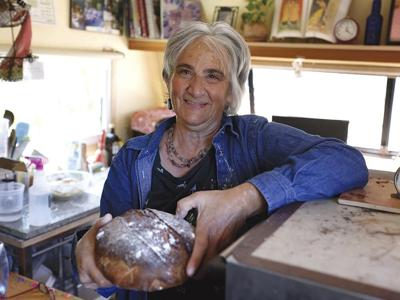

Anina Marcus acts upon big ideas in a small space. “I am a tiny home movement person,” she says in her Carmel Highlands tiny home.
The tiny home is in fact a 1980 Dutchman trailer, lovingly converted into a home with particular nooks for everything Marcus loves to do: write, listen to records and, primarily, bake sourdough bread.
For that latter purpose, she has an area set aside with a counter, bags and tubs of flour, and a convection oven that can fit four loaves at a time.
On a recent day, she’s just baked bread with emmer, getting slightly sweet, dark-colored loaves; she has a new batch of dough, made with Sonora wheat cultivated in Mexico, that will keep rising overnight.
Bread has always been part of Marcus’ life, even before she knew it. At 18, she says, she told her parents she wanted a bread route instead of a normal summer job; so she baked, and “went around with my basket like Little Red Riding Hood.” In those days, she used instant yeast, not sourdough, but it worked. “Germans bake, so I believe it’s in my blood,” she adds.
It doesn’t hurt that as a physical therapist and massage therapist, Marcus’ work deals with the body – but her original motivation to start baking was driven less by nutritional awareness than flavor and a sense of rebellion against corporate food. “It’s like tomatoes and coffee,” she says. “Where’s the flavor? I can’t stand phoniness in anything.”
She heard from a neighbor about baking sourdough, something she once felt was in the realm of only professionals. It was the neighbor and the Tartine cookbook that helped demystify it and show her anyone can bake bread, and it set her on a journey not just to learn how to bake, but to learn where the ingredients come from. She started reading about mills, industrialization, the processing of wheat to remove the germ and endosperm to help keep flour shelf-stable for longer, but minus the nutrition – and the flavor. “I just began to be pissed,” Marcus says of industrial bread. “We are not eating grain, we are eating a pulverized white starch.”
So she started ordering flours, usually made from heirloom grains, grown in places like Washington and South Carolina. She talks about a “small grain economy” and she orders flours made from grains like amaranth or red fife wheat.
She works with wheat varieties known as landraces – the ancient grains that pre-dated cultivated wheat. (Modern wheat is descended from white emmer.) Domestication of wheat around 10,000 years ago in the Fertile Crescent led to an initial reduction in diversity by as much as 84 percent, according to a study by Abdullah A. Jaradat for the Agricultural Research Service of the U.S. Department of Agriculture. That decline has only gotten worse, and faster. “During the last century, the introduction of high-yielding varieties, and the structural changes in wheat farming systems, led to the loss of genetic diversity… of wheat landraces,” according to the study.
The problems associated with replacing a range of wheat types with one monocrop are many. And they are familiar – degradation of soil, loss of biodiversity and with it resilience to disease. And there’s also, perhaps most importantly for eaters, a loss in flavor.
Marcus, 64, has a bread club she calls Ye Olde Highlands Bakery Shoppe, with about 25 members. They pay the cost of ingredients – there is no profit – and Marcus experiments each week with whichever flour inspires her. (It’s not a business, just a hobby – her work as a physical therapist pays the bills.)
The emmer bread is dark brown in color and tastes a little sweet, like bran muffin. The Sonora wheat bread will be yellower and have a tinge of corn flavor. Marcus is curious about the flavor, the texture, the color – a full-on sensory experience connected to eating bread, that’s different every time.
But in the end, she wants to emphasize that what she’s doing is in fact a simple thing: Turning flour into bread. “And in the end,” Marcus says, “it’s just bread.”


(0) comments
Welcome to the discussion.
Log In
Keep it Clean. Please avoid obscene, vulgar, lewd, racist or sexually-oriented language.
PLEASE TURN OFF YOUR CAPS LOCK.
Don't Threaten. Threats of harming another person will not be tolerated.
Be Truthful. Don't knowingly lie about anyone or anything.
Be Nice. No racism, sexism or any sort of -ism that is degrading to another person.
Be Proactive. Use the 'Report' link on each comment to let us know of abusive posts.
Share with Us. We'd love to hear eyewitness accounts, the history behind an article.