
Sara Rubin here, listening to the birds. One of the things I love about birds is they give us an opportunity to interact with wildlife from pretty much anywhere. You don’t need to hike miles into nature to observe these wild animals; they are part of our urban habitats too, and I regularly see and hear them from my kitchen table.
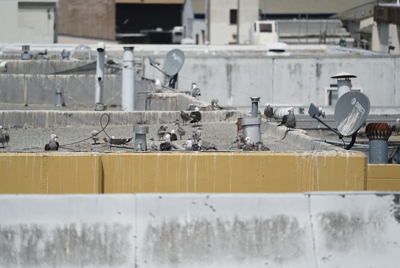
That is lovely from a bird appreciation perspective, but there are more complicated dimensions to this. In the case of the Heermann’s gull—not to be confused with its lookalike Western gull—it is a species approaching threatened status. It is also a species that has gravitated from Baja to nest in just one region of the U.S., which is on rooftops in Seaside.
Business owners have a mix of disgust and sympathy when it comes to these birds, which create quite a stench during their nesting season in spring and summer, as Katie Rodriguez reports in this week’s edition of the Weekly. (At Other Brother Beer Co., they’ve also used the bird as an unofficial mascot—have you tried the Heermann’s Lager?)
Rodriguez’s story captures some of the very real and justified disgust, but what makes it a great piece of reporting is the focus on what people are doing about it. City officials are hoping there’s a solution for a downtown in the midst of a revitalization effort to keep it less stinky. Audubon Society staff are hoping to learn about and protect these birds, seizing on the winter season while the gulls are out foraging in places unknown before returning to town to nest in the spring.
“You want the species to have more adaptability, but they just don’t,” Rodriguez tells me. “The Heermann’s gulls are choosing places that make sense to them but don’t make sense to us—it doesn’t advantage them to nest right next to a freeway. They have just taken a liking to a really inconvenient place; first it was the McDonald’s that burned down.”
Of course, wild animals have different priorities than us humans. When those priorities collide, it makes for difficult and interesting management challenges. The impacts of running a business with lots of nesting birds pooping on the roof are real. The challenges that human activity poses for the birds are real too. You can read more about attempts at finding a productive compromise in Rodriguez’s story, and check back in a few months for updates as it unfolds.


(0) comments
Welcome to the discussion.
Log In
Keep it Clean. Please avoid obscene, vulgar, lewd, racist or sexually-oriented language.
PLEASE TURN OFF YOUR CAPS LOCK.
Don't Threaten. Threats of harming another person will not be tolerated.
Be Truthful. Don't knowingly lie about anyone or anything.
Be Nice. No racism, sexism or any sort of -ism that is degrading to another person.
Be Proactive. Use the 'Report' link on each comment to let us know of abusive posts.
Share with Us. We'd love to hear eyewitness accounts, the history behind an article.