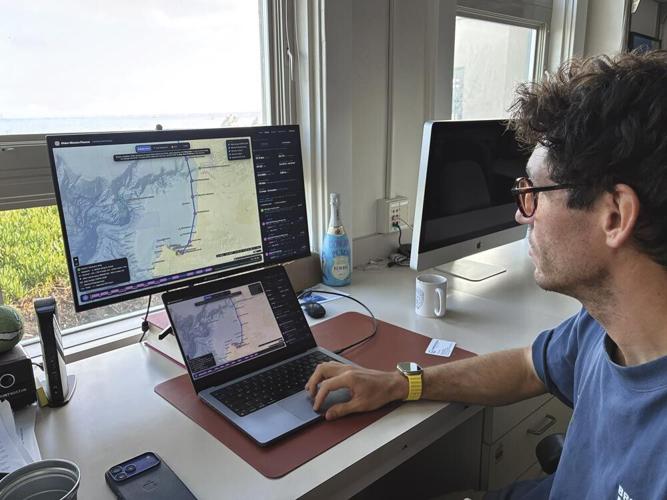

Peter Mastnak is getting ready to take a voyage. But there’s no need to get his feet wet or worry about seasickness – he is sitting at his desk, dry and indoors, charting the route on his computer screen.
He’s a computer scientist who formerly worked at Spotify, and now is a PhD student in the Oceans Department at Stanford University’s Pacific Grove campus, Hopkins Marine Station. Beyond the computer screen through his window, a pod of dolphins swims by. Mastnak grew up near the Adriatic and Mediterranean seas (he’s Slovenian and Italian) and notes there is less wildlife there than in our oceans. “I mean, we have a lot, but not what you have here in the [Monterey Bay Submarine] Canyon, which is very productive water,” he says.

Graduate student Peter Mastnak built software to evaluate a variety of conditions on the experimental voyage. Speed must be balanced with distance – at a slower pace, it will use less power. “If the mission is super long, like three, four or more days, and you don’t have much sun to recuperate power, you’d have to go slower,” he says.
This highly productive water supports a complex food chain from phytoplankton to apex predators like bluefin tuna and white sharks, contributing to a diversity and density of wildlife that inspired Barbara Block, the marine biologist who helms the Block Lab, to refer to the region as the “Blue Serengeti.”
Block and her team have spent decades researching large pelagic fish and publishing dozens of scientific papers. What they’re working on on this day, Friday, Oct. 23, that has Mastnak eagerly waiting at his screen, is an experiment on using a new type of vessel to do research.
The lab is renting the uncrewed surface vehicle, or USV, from the British Columbia-based manufacturer, Open Ocean Robotics; the company calls it the DataXplorer, but Block and her team call it more simply a “glider.” It’s parked outside the lab between experimental voyages.
“The experiment yesterday was the best in years,” Block says.
It’s too soon to know if it worked, but if it does, the USV might be a tool to help researchers gather more real-time data about wildlife in the ocean at a lower cost than ever before. And it might help municipalities and people make decisions about when it is safe to go in the water.
“The idea is to help the public understand that you are in a place as wild as Yellowstone; there are wolves and grizzlies there,” Block says. “We are working to build an appreciation that the Monterey Bay National Marine Sanctuary is wild in part because we’ve protected it, and that we have to understand we’ve got predators, and we need that natural cycle in order to bring a balance to the ecosystem.”
THE FIBERGLASS, PROPELLER-POWERED USV RESEMBLES A BIG STAND-UP PADDLE-BOARD, 12 feet long, with a patented self-righting roll bar mounted on the rear. This light-weight addition makes it able to tolerate big waves – it will flip itself over in the event that it gets tossed upside down. It is covered in solar panels to charge its battery. And like some other vessels on the market, it is autonomously operated. Mastnak can watch from his computer screen and assess roughly two dozen parameters that affect how it moves – currents, wind and waves will affect its energy output, while sunlight will affect recharge speed.

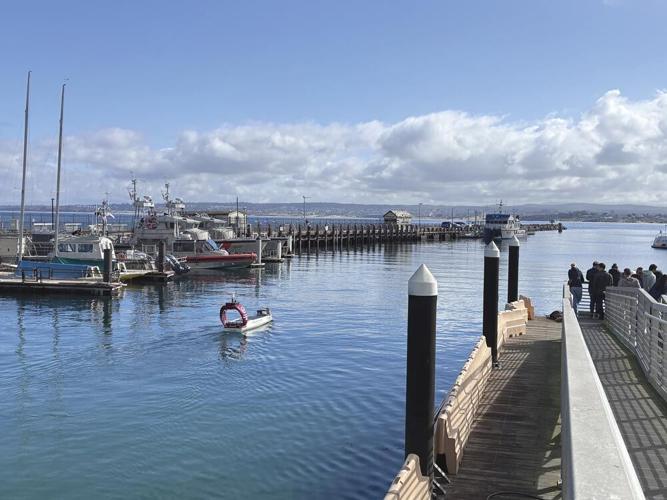
The uncrewed surface vehicle, or USV, launches from the boat ramp at the Coast Guard Pier in Monterey on Friday, Oct. 23, headed for Santa Cruz.
The team at Open Ocean Robotics holds the controls, steering the aquatic drone remotely. Mastnak built software to evaluate a variety of factors like currents and wind. The roll bar has 360-degree cameras mounted on top that are trained to recognize potential obstacles like ships, so the USV can adjust its course to avoid them. It can travel in the open sea for weeks at a time.
In this case, it arrived in Monterey Bay on Monday, Oct. 19 and took multiple voyages to Año Nuevo, Marina and Monterey. On Oct. 23, Block, Mastnak and team are getting its next route ready – it will depart from the boat ramp at the Coast Guard Pier around 11am and then, traveling at a speed of about 3.5 knots over 31 nautical miles, should arrive in Santa Cruz around 8:30am the next morning.
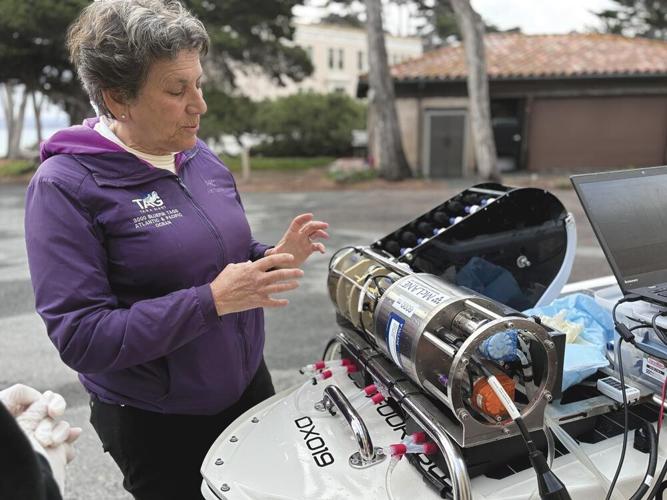
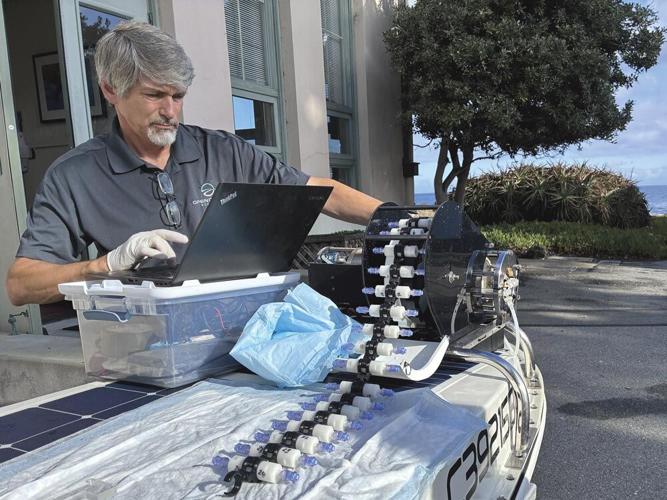
The glider is carrying an instrument built by Massachusetts-based McLane Research Labs that holds cartridges that will fill with water samples along the journey. The instrument is built to go as deep as 6,000 meters, but for purposes of this project, it’s using a short pipe, collecting water from just below the surface then pumping a preservation agent over it to effectively freeze biological activity.
If all goes right, those water samples will hold DNA from white sharks.
BLOCK AND HER TEAM KNOW WHITE SHARKS ARE HERE, because they’ve spent 25 years building a system to tag and monitor them. It’s a methodical multi-step system conducted throughout the Monterey Bay National Marine Sanctuary, a massive 6,094-square-mile area that extends well beyond Monterey Bay in all directions, north beyond San Francisco and south to Morro Bay.
The work involves a team of people taking a boat out into shark habitat. They use a seal-shaped decoy and a small tissue sample from an elephant seal or a sea lion for scent. When a shark approaches, the humans on board need to act fast: They photograph the animal above and below the water, they measure the shark, and someone on board uses a javelin-like tool to aim a tag on a dart at the shark as it swims along.
The Block Lab has identified about 300 adult and subadult white sharks in the Monterey Bay National Marine Sanctuary. (Subadults are teenage sharks, larger than juveniles and with different teeth for a different diet as they transition from eating fish and rays to marine mammals.)
Photo ID is a critical element of tracking this population, and the team uses the camera to sex the animal (the view underneath shows whether or not it has claspers, a male feature) and to document its distinct dorsal fin. The team’s database includes more than 1,000 individuals.
Thanks to AI, a photo of a shark today has a 96-percent likelihood of matching on its first try with the correct shark if it’s already in their database, says research scientist Samantha Andrzejaczek.
“These sharks can be quite distinct in their scarring patterns,” she notes. One shark that the team named Salami has a narrow slice missing in its fin; one named Pudding appears to have been bitten by another animal in 2024, and then when he was spotted a year later, the wound had healed but the scar was still visible. “That scar is really distinct and sticks around probably for the rest of that animal’s life,” Andrzejaczek says. “We saw Pudding a week ago. I’m not going to remember a number exactly for Pudding, but I remember his name.”
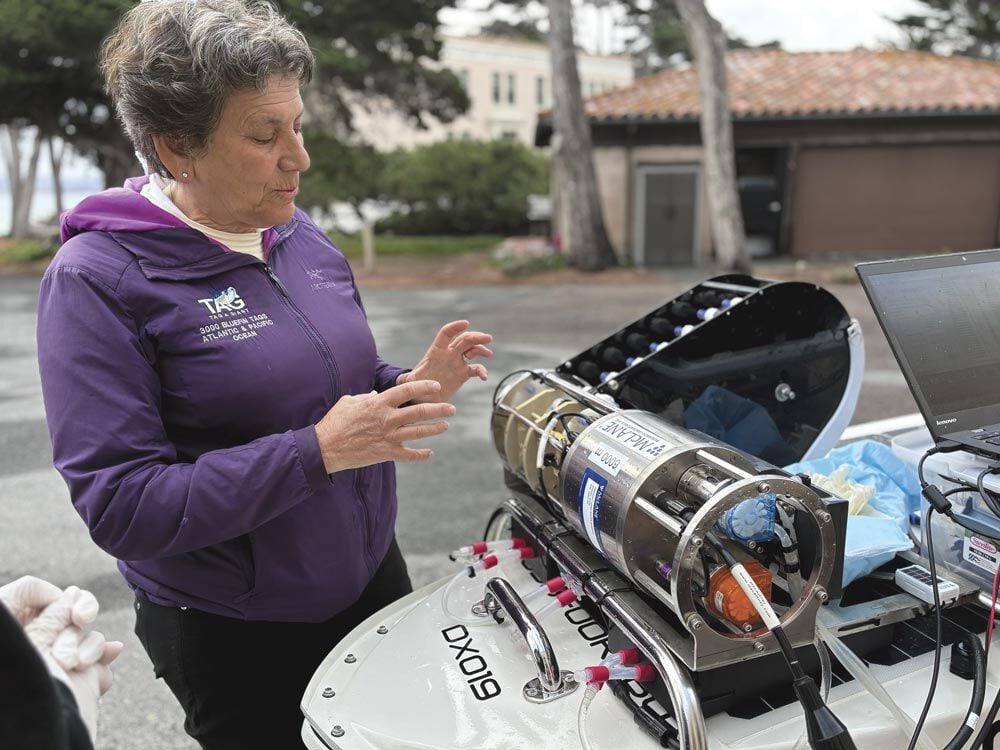
Barbara Block looks at the USV, which she hopes makes data collection more affordable and accessible to the public. “It’s one of the most fun things I did in years,” she says of accompanying the vessel to collect samples at Año Nuevo on a rainy day on Thursday, Oct. 22. “It’s the edge of science.”
(The naming practice is controversial for wild animals, Andrzejaczek says, but it helps researchers quickly refer to an animal in fast-changing conditions. “It’s good when we’re on a boat communicating with each other – ‘Pudding needs a tag,’” for example.)
Attaching the titanium tags, which are just a few inches long, requires a certain amount of athleticism and practice; a watermelon has been involved at least once. The field work also includes getting a tissue sample from each shark, which gives the tagger a practice run without a $4,000 device at stake. (All of this work is done under conditions of a NOAA permit.)
The group uses two types of tags and ideally, gets both on the same shark. Satellite tags transmit data on a shark’s location via satellite, meaning only when the animal comes to the surface or the tag detaches and floats up. It’s through this technology that the Block Lab figured out that white sharks travel thousands of miles across the Pacific Ocean, as far away as Hawaii, through a region dubbed the “white shark cafe.”
Acoustic tags can stay on for up to 10 years, but more typically last for two, and work by sending 69-kilohertz pings to 36 receivers located throughout the Monterey Bay National Marine Sanctuary. Five of these receivers generate real-time data.
Combined, the two types of tags are helping scientists see when and where sharks are going, where they are resident, where they are passing visitors and for how long.
Andrzejaczek was the lead author on a new study, published in September in ICES Journal of Marine Science, that focuses on 87 tagged white sharks (including males named Chippy and Gill) to evaluate whether they repeat their routes or not. They found a little bit of each.
“Adults exhibited higher repeatability than subadults, suggesting that behavioral consistency develops through experiential learning and/or spatial memory development,” the study determined. They found “a significant navigational and cognitive capacity for a marine predator moving through vast and dynamic ocean basins with minimal fixed landmarks.”
The two types of tags combined give a broad picture about shark movements over thousands of miles of open ocean. But it’s the 36 acoustic receivers throughout the Monterey Bay National Marine Sanctuary tell a story closer to home.
“Acoustic tags are most relevant to what people want to know,” ” Andrzejaczek says.
JUST OFFSHORE FROM HOPKINS MARINE STATION, viewable through the window from Block’s office, is buoy OA1, commonly known among locals as “the shark buoy.” It’s one of five buoys with live acoustic receivers, meaning that tagged sharks ping in real time, using technology similar to a FasTrak vehicle toll; live tracking has been happening since 2012.

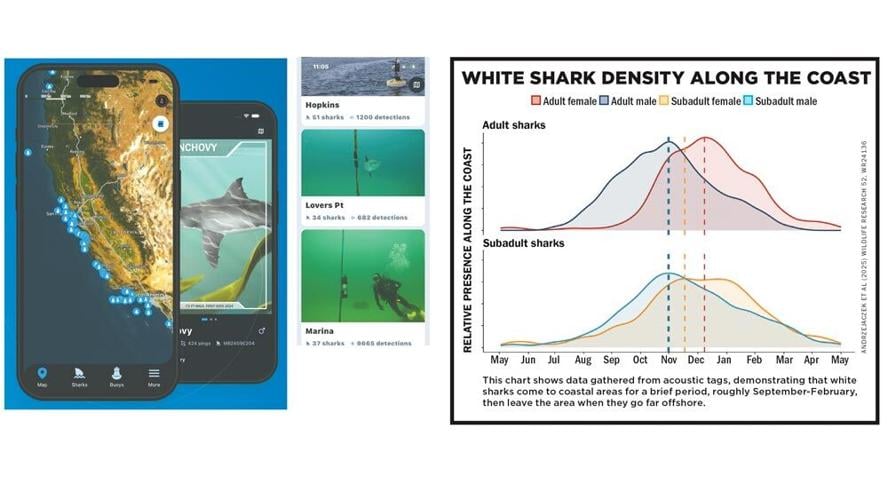
(left) The app sharkTAG Live is set to launch any day, and will provide real-time data on tagged white sharks to the public.
The other 31 receivers in the sanctuary are on underwater equipment, and the data must be downloaded, rather than appearing live.
This project, with funding from the California Ocean Protection Council, NOAA and others, means equipment spread around the Central Coast that can “hear” tagged sharks. The five live receivers – including the one at Hopkins, and another near the Salinas River Mouth north of Marina, plus Soquel, Santa Cruz and Año Nuevo – feed data to a public-facing website, montereybaywhitesharks.org, so anyone can see which tagged white sharks are pinging any of these buoys on any given day. Shark number 192500400 was around Marina for much of October, then hasn’t pinged since; shark 192600600 was there for the first half of November. At Hopkins, there’s been no acoustic ping since Oct. 15. Sharks are visitors in these areas, unlike Año Nuevo where 30 or so sharks ping regularly from September to February, before the activity drops off and the sharks go out to the white shark cafe in the remote Pacific.
Each of the acoustic receivers costs about $100,000. “It would be great if we had more, but they’re expensive,” Block says. (Other manufacturers have more affordable options that the lab is testing, including a $40,000 receiver now at “shark park” in Soquel.)
The cheaper options may turn out to work in the long run, but this equipment needs to be removed before the El Niño winter risks damaging costly equipment. And to use this system requires locating and tagging white sharks, a complicated and costly proposition that requires a crew of people to go out to sea in a boat.
There are other ways to detect where white sharks have been. As they move through the water column they shed DNA, and Block’s team has already proven they can measure environmental DNA, or eDNA, by scooping up a water sample in a plastic baggie. But that also requires a person on a boat and conditions that are suitable to that.
“Monterey is a difficult place to work as an oceanographer,” Block says. “It’s a hard ocean, it’s cold, it’s rough. MBARI has mastered persistence at depth. Persistence at the surface is difficult. Right now in North America, there’s not that many choices of instruments.”
That’s why she’s so excited about the “glider” outside. “It’s like a little Cadillac out there. It’s cute, but it really works.”
THE LITTLE CADILLAC IS THE UNCREWED SURFACE VEHICLE (USV). Block has been testing similar concepts since 2013, but this one’s self-righting capability sets it apart. The experiment from Oct. 19-25, when they are leasing the gear from Open Ocean Robotics, is to see whether the glider might be able to do the difficult work of traveling long distances in the ocean to collect water samples and if eDNA confirming white shark presence can be measured.
Raksha Doddabele is the graduate student running the experiment. She studies eDNA, and her work will focus on the tiny cartridges of seawater collected. “Our lab has never done anything like this before, so this is pretty exciting,” Doddabele says.
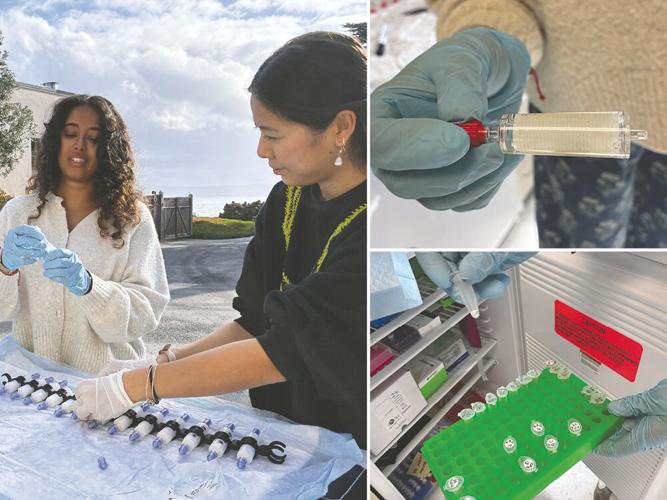
For a few hours between test voyages, the glider is parked at Hopkins, just outside the lab. Ann Tokoyoda, an undergraduate student at the University of Hawaii, is in town to assist. “I took off a complete week of school just because I wanted to come here and see it. It’s just a really amazing thing,” she says, as she lays a puppy pad on top of the USV, where she will rest the full cartridges. Wearing gloves, she begins pulling out the cartridges that are full of seawater. (Handling DNA is a delicate task. “We can’t contaminate these,” Block tells the team.)
Tokoyoda and Doddabele collect the cartridges. Doddabele will isolate the eDNA to see if it reflects what they know thanks to the acoustic tagging network: that white sharks have been here within the last 24 hours. It’s a sort of ground-truthing experiment, conducted during the peak period for sharks locally; the acoustic receivers provide real-time data so they can compare results. “Like all new technologies, we need some validation so we know it’s working,” Doddabele says.
If it works, and eDNA collected by this USV aligns with the data the acoustic receivers show, the team may be unlocking a new world of potential to detect the presence of white sharks and inform the public.
Unlike the laborious process of going out on a boat, finding a shark, photographing and tagging it, Doddabele imagines something much easier.
“The power of eDNA is you don’t have to interact with the shark, or even see the shark,” she says.

Fritz Stahr, the Chief Technology Officer for Open Ocean Robotics, loads fresh cartridges onto an instrument that will collect water samples on a 31-mile uncrewed voyage from Monterey to Santa Cruz on Friday, Oct. 23.
The glider may be able to do a lot of work for them. And it could detect the presence of any white shark, not only those that the team has identified and tagged.
AS DODDABELE BRINGS THE SAMPLES INTO THE LAB, another crew outside is getting the glider ready to go back out. They load it into the back of a pick-up, and drive it a mile down the road to the Coast Guard Pier.
For the launch, Mastnak pulls on waders and guides the USV on a trailer down the boat ramp. Using a handheld controller, Open Ocean Robotics’ Chief Technology Officer Fritz Stahr guides it into the harbor before the remote team takes over. (Before getting into oceanography, Stahr developed lasers and opthamology instruments. “It’s been much more fun since I got into oceanography,” he says.)
After the launch, Mastnak can watch from the computer screen to track the exact route of the glider as it makes its way along the coast to Santa Cruz, sucking up water samples from precisely selected locations.
“The pilot can be doing it in their living room with their cup of coffee and their cat on the couch,” Stahr says. “They don’t have to be at sea to do this.”
Sequencing of the DNA is still ongoing. If it works, it will answer some things – was a white shark present? – but not everything.
“These animals spend more time offshore than they do on the coast. We think they’re here about three months of the year, which means nine months they’re way offshore,” Andrzejaczek says. “We’re still learning a lot about what they’re doing. We don’t even know where these animals breed. This is one of the most-studied shark species in the world, and we don’t know this basic biological piece of information, which on one hand is crazy, but on the other it’s really exciting, because AI can’t tell us that. We scientists still need to be in the field asking these questions, and we still have discoveries to make.”
ON SATURDAY, OCT. 17, a group taking photos at Marina State Beach happened to capture a video of a white shark emerging up out of the water in the background, an incredibly lucky moment. (Andrzejaczek, the tagging master, is disappointed the camera did not capture the shark’s dorsal fin. Without that, she can’t identify whether it’s a shark in her database.)

Graduate student Raksha Doddabele, top left, works with undergrad student Ann Tokoyoda, visiting from the University of Hawaii, to collect samples from Año Nuevo. The samples must be handled carefully to avoid contamination. The seawater turns filters in the cartridges yellowish (above right); samples are later processed to isolate DNA which can be stored in a refrigerator at the Block Lab (bottom).
It’s not entirely clear what the shark was doing; it’s an unusual behavior, but some researchers think it was spy hopping, or trying to get a better look at the surrounding area.
The sighting became a viral TV news sensation, and prompted California State Parks officials to issue an advisory. But for the team at the Block Lab – and anyone following their live acoustic tracker – it was already obvious that white sharks were in the area.
Block imagines a way to collect real-time data and to communicate it meaningfully to the public. Past research already showed peak presence locally is in October, aka “Sharktober.” They know males arrive and peak earlier than females, who follow in November.
Beyond these broad trends, and the live data already provided, they imagine providing even more data over a broader area, with a USV that might focus on a variety of beaches. For now, it would only recognize that a white shark in general has been in the area, but maybe in the future it could distill individuals.
“What we want to do is come up with the most accurate way to provide information about the presence of white sharks,” Block says.
If the glider works, she envisions it could be sponsored by local communities interested in collecting real-time information on popular beaches; a glider could cruise around with instructions from a computer, no humans aboard, analyzing water samples for eDNA.
And it would be more affordable than acoustic receiver buoys, which cost about $1.5 million to install and over $250,000 a year to maintain – not to mention every storm can damage or destroy the equipment. The USV costs $150,000 for the base model, then software to operate it is licensed from Open Ocean Robotics.
Creative funding ideas are especially critical as the California Ocean Protection Council funding is coming to an end after a three-year grant.
“I am looking for an alternative technology to say that white sharks are present,” Block says. “Our job is to just report the presence of white sharks – then community leaders are the ones that decide, how do they use that?”
Any day, the team is launching a free app (at sharktag.live, and on the Apple app store) that provides real-time data from their network in a more accessible format than the acoustic pings, now posted on montereybaywhitesharks.org.
“We can’t ever tell you exactly when to go in the ocean, but we sure can inform you that there are live receivers here,” Block says. “My goal, my objective, is a healthy ocean that everybody uses. We want people to get to know the sharks, much as the wolves are known at Yellowstone. Engaging the public is the best way to teach about our Blue Serengeti.”
(0) comments
Welcome to the discussion.
Log In
Keep it Clean. Please avoid obscene, vulgar, lewd, racist or sexually-oriented language.
PLEASE TURN OFF YOUR CAPS LOCK.
Don't Threaten. Threats of harming another person will not be tolerated.
Be Truthful. Don't knowingly lie about anyone or anything.
Be Nice. No racism, sexism or any sort of -ism that is degrading to another person.
Be Proactive. Use the 'Report' link on each comment to let us know of abusive posts.
Share with Us. We'd love to hear eyewitness accounts, the history behind an article.