
Katie Rodriguez here, reflecting on the annual Fort Ord Cleanup Guided Nature Walk that took place last Saturday, May 9.
It was a well-attended event—and pretty much always is, I was told by Jason No, the community outreach specialist with the Fort Ord Environmental Cleanup Community Relations Office. This year’s event was capped at 100 people who signed up for one of two guided walks through an area of Fort Ord. One was a shorter 1.6-mile route, and the longer walk—the one I joined—totaled around 3.7 miles.
The walk took us through what’s called the “impact area” of Fort Ord, typically closed to the public due to the presence of unexploded ordnance and munitions. Cleanup is still actively underway, but once a year, the U.S. Army and partner cleanup agencies, in collaboration with the Bureau of Land Management, offer a public tour of the site to share a bit about the area’s history, explain ongoing remediation work and showcase native habitat recovery.
There is a lot to consider when thinking about the history and current state of Fort Ord, a former military training base now designated as a Superfund site. Over 77 years and multiple major wars, including World War II and Vietnam, the base trained roughly 1.5 million service members across more than 28,000 acres—about the size of San Francisco.
As a result, chemicals and heavy metals from military activity litter the area and have contaminated soil and groundwater in parts of the region. It’s fascinating to hear about the ongoing cleanup efforts, coordinated across such a large area, both above ground and in subsurface groundwater plumes. And still, so much work remains.
If there was any initial unease from the group about walking through an active cleanup site, it was quickly replaced by curiosity about the landscape. Still, participants were instructed to stay on the trail and were given a safety briefing beforehand, including the “3 Rs”: Recognize munitions and explosives, Retreat from them, and Report their location. A display board near the sign-in table showed examples: projectiles, hand grenades and rockets. Aside from explosives, the area is also home to mountain lions, rattlesnakes, ticks and poison oak.
The group’s baseline knowledge of the site and its history, as evidenced by the questions and conversations among hikers, was high. As we moved through what Bart Kowalski, an ecologist with Fort Ord Base Realignment and Closure, called “units”—designated cleanup areas separated by fire roads near Wildcat Ridge—participants asked about remaining munitions, an observed absence of birds and prescribed burning schedules. The prescribed burns occur for a couple reasons: to allow access to an area for cleanup operations as well as to help restore native plants that thrive after fire.
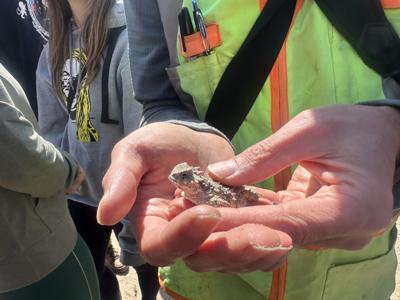
Kowalski managed to capture a horned lizard, which remained unusually calm as he showcased it to a crowd in awe. “These guys can squirt blood from their eyes if they’re really stressed,” he said. News to me.
Another tour will be offered July 25, this time via bus. The Fort Ord bus tour is part of the U.S. Army’s ongoing community engagement series, offering access to restricted areas where landfill remediation and groundwater treatment are ongoing before water is reinjected into the aquifer.
Care to join? Check out the upcoming events on the Fort Ord Cleanup website.


(0) comments
Welcome to the discussion.
Log In
Keep it Clean. Please avoid obscene, vulgar, lewd, racist or sexually-oriented language.
PLEASE TURN OFF YOUR CAPS LOCK.
Don't Threaten. Threats of harming another person will not be tolerated.
Be Truthful. Don't knowingly lie about anyone or anything.
Be Nice. No racism, sexism or any sort of -ism that is degrading to another person.
Be Proactive. Use the 'Report' link on each comment to let us know of abusive posts.
Share with Us. We'd love to hear eyewitness accounts, the history behind an article.