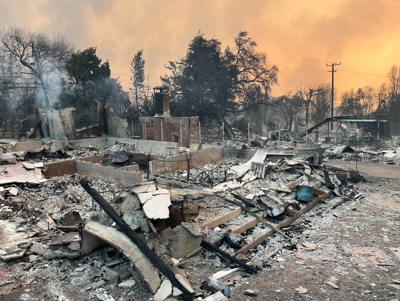

David Schmalz here. I write today with deep sadness. My younger brother, his wife, and their son—three of the people I love most on Earth—yesterday lost not only their house, but their entire neighborhood, as the Eaton Fire north of L.A. burned much, if not most, of Altadena to the ground.
They bought their house in 2019, and felt it was the perfect place for them—my brother is an avid hiker, and their house was just a few miles south of the San Gabriel Mountains, his playground, and one of his places to find peace.
Aside from their cars, pets and their own lives, essentially everything they had is lost, and their entire former neighborhood is a moonscape.
Altadena, which I loved (and which is an unincorporated town of over 40,000), is the most like Seaside out of any Monterey County city—it was a neighborhood borne out of red-lining decades ago, and had a vibrant Black population at one time, if no more.
Brian, my younger brother, and his family had rented in Altadena for about a decade before being able to save enough money to buy the house, and after they did, they put continuous improvements into it. They landscaped the yard with drought-friendly plants, put in a hot tub, etc. It had become what they hoped—and me too—their forever home.
It was sometime on Monday when I started seeing National Weather Service reports about fierce Santa Ana winds coming down off the San Gabriel Mountains and toward Altadena and the rest of greater L.A.
I texted Brian, and he was likewise concerned—he told me they hadn’t gotten rain in almost 250 days. For context, in Altadena—much like its southern neighbor Pasadena—most streets are lined with canopy-height trees, while the San Gabriels are steep like Big Sur and blanketed with chaparral, which has for many months been bone-dry.
On Tuesday, he texted me: “Fire above Altadena. Shit is really bad.”
The next morning—yesterday—after he woke, he texted me: “I think our house is going to be toast.” As it turned out, documented by my brother’s wife Marissa, who assessed their modest but once lovely property yesterday, all is lost, except for the chimney. She even sent me a photo of my nephew Owen’s karate school being burnt out.
When my brother and his wife bought the house, they believed it would be climate-resilient—it had enough distance from the mountains, they thought, that they’d be insulated.
But the winds that occurred in Los Angeles these past few days—Santa Ana Winds, which have been increasingly exacerbated by climate change—don’t play by the old norms, and got up to about 80-100mph.
This past summer, I started reading Canadian journalist John Vaillant’s extraordinary book Fire Weather, which documents the events leading up and during a wildfire that in 2016 swept through Fort McMurray—an oil hub in Alberta—that was likewise devastating.
The thesis of the book was essentially that the fire would never have happened absent climate change. Likewise, the city wouldn’t exist without fossil fuel.
You can say the same thing about greater Los Angeles (but it also has to import most of its water from the Sierra).
The question I have is: When will humanity decide climate change is a big enough problem to voluntarily change their behavior?


(3) comments
Thanks for sharing this story, David.
My deepest condolences. I can't imagine what your younger brother and his family must be going through right now. While we can be thankful that none of them were hurt, this is still a most painful and devastating loss.
I am shocked at how many homes and neighborhoods were lost from both the Eaton and Pacific Palisades fires in such a short time. The fires carried further than I would have expected. When looking at the aerial images of some of the impacted neighborhoods, I thought to myself, "Yeah. I would probably have assumed that the wildfire risk was low to none."
Even Dr. Kalmus, a climate scientist who used to live in Altadena, did not think that the city would be razed to this extent so soon. (https://tinyurl.com/ysc35ywr)
The world is changing and we may need to think twice. As Dr. Kalmus wrote, “No place is truly safe anymore.”
Bill's comments are well taken. When the area is built anew, we should not plant tall-growing highly flammable conifers such as Pines, but rather short dry-scape including agave, yucca, cactus, etc. Had the neighborhoods not had tall trees providing fuel and embers, lots of areas would have been spared. Roofing needs to be fire-proof; not asphalt shingle or wood shake. Neighborhoods need availabe fire hoses, not garden hoses. This was avoidable with minimal expense and proper city ordinances.
The fires in Altadena and Pacific Palisades were not just disasters of flames but disasters of choices—choices about priorities, preparedness, and leadership. First, let me begin by acknowledging the profound pain felt by your brother, his family, and the Altadena community. Losing a home is not just losing a physical space—it’s losing memories, safety, and a sense of stability. To everyone affected in both communities, my heart goes out to you.
But this tragedy demands more than sympathy—it demands clarity and action. The article attributes the worsening winds and fires to climate change, and while this framing feels urgent, it oversimplifies a far more complex issue. Fires like these don’t ignite simply because the planet is warming. They ignite and spread because of a hundred smaller failures—failures we can control if we have the courage to confront them.
Let’s look at the details. Santa Ana winds, which swept ferociously through Altadena and the Palisades, have been a part of Southern California’s natural rhythms for centuries. These winds are influenced not only by global temperature shifts but also by long-term cycles like the Pacific Decadal Oscillation. Blaming climate change alone is not only reductive but a distraction from the immediate steps we need to take.
In both Altadena and Pacific Palisades, the fires feasted on overgrown brush—vegetation that should have been cleared but wasn’t. The tinderbox conditions were predictable and preventable, yet the systems meant to address them faltered. What about the water infrastructure? In the Palisades, the reservoir, with its capacity of 359 acre-feet, sat offline during the fire due to poorly timed repairs—an oversight that left firefighters struggling without one of their most critical tools. And what about the proposed budget cuts to fire departments at a time when wildfires are growing more destructive every year? Mayor Bass’s and Governor Newsom’s decisions to reduce resources for the LAFD and Cal-Fire are emblematic of a broader failure in leadership—a failure to prioritize the safety of communities like Altadena and Pacific Palisades.
These failures are not just about money. They’re about values. Leadership, when done right, is not about making grand speeches about the climate or rallying behind abstractions. It’s about the nuts and bolts of keeping people safe: maintaining infrastructure, adequately funding firefighters, and managing the land with foresight. Fires like these are the result of leaders playing politics while their constituents watch their homes burn.
Let me be clear: climate change is real, and its consequences are urgent. But telling grieving communities in Altadena and Pacific Palisades that climate change is the sole culprit feels both hollow and misplaced. It’s like telling someone drowning that their problem is rising sea levels—it’s not wrong, but it’s far from the actionable solution they need. People will care about the climate when they see leaders take tangible steps that make their lives safer today—steps like clearing brush, repairing reservoirs, and ensuring firefighters have the resources they need to protect our homes.
The situations in Altadena and the Palisades are painful reminders of what happens when leadership falters. Fires are ancient, but they’ve become more destructive because we’ve stopped listening to the land. The hills whisper warnings when the brush grows too thick. The reservoirs stand silent when their water goes unused. The fire departments work overtime when budgets force them to do more with less. These are not mysteries; they’re choices.
This tragedy should not be a rallying cry for climate debate but a call to immediate, practical action. Cut the bureaucratic red tape that stalls brush management. Ensure water infrastructure is operational when it’s needed most. Fully fund and staff fire departments, recognizing that their work is not seasonal but essential.
The fires in Altadena and Pacific Palisades are painful reminders of what’s at stake. But they can also be turning points—a moment where we choose to act, not with excuses but with resolve. Fires will come again; they always do. But the next time, let us meet them not with finger-pointing but with readiness.
The earth will remember what we do next. Let’s make sure it remembers leaders who rose to the occasion and communities that chose action over abstraction. Let’s honor the losses in Altadena and Pacific Palisades not with rhetoric, but with change.
Welcome to the discussion.
Log In
Keep it Clean. Please avoid obscene, vulgar, lewd, racist or sexually-oriented language.
PLEASE TURN OFF YOUR CAPS LOCK.
Don't Threaten. Threats of harming another person will not be tolerated.
Be Truthful. Don't knowingly lie about anyone or anything.
Be Nice. No racism, sexism or any sort of -ism that is degrading to another person.
Be Proactive. Use the 'Report' link on each comment to let us know of abusive posts.
Share with Us. We'd love to hear eyewitness accounts, the history behind an article.