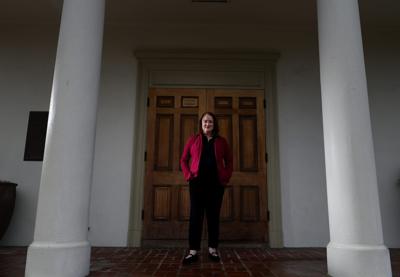

Sara Rubin here, my head spinning as soon as I attempt to keep up with the national news these days. Of course, the chaos is by design—flooding the zone, as they say.
The overlap between what happens in Washington and what happens here in Monterey County has been increasingly reflected in our coverage recently. (Check out recent coverage of federal funding concerns, a local legislative agenda, and recent protests in support of our immigrant community and a march in resistance to President Donald Trump, for just a few examples.)
Sometimes, the intersection between local news and national news comes into especially stark relief. That’s how it was back in November, when a story broke that now-Secretary of Defense Pete Hegseth, then a nominee, had been investigated on suspicion of rape in 2017—by Monterey Police, because the alleged crime took place in Monterey. Suddenly, our community was part of the fast-paced national news cycle.
That meant that local government leaders found themselves in the midst of a media frenzy. Our team at the Weekly regularly communicates with officials in the Monterey City Attorney’s Office and the Monterey County District Attorney’s Office. Suddenly, they were facing inquiries—by phone, by email, by handwritten note (“Please forgive my childish handwriting,” a Washington Post reporter scrawled), by showing up—from reporters all over the country. Then in December, the DA’s Office was presented with questions from the United States Senate, seeking information as confirmation hearings neared.
We know about this series of events thanks to the California Public Records Act. After the original uproar died down, I requested additional records from each agency, totaling hundreds of pages, that helped tell the story of their disclosures and nondisclosures in this high-profile case. These records form the basis of this week’s cover story.
But as I set out to investigate the local crossover with this national news, I discovered something else. The resulting story is only in part about public information and disclosure. It’s also about the history of how our culture perceives and responds to sexual violence.
Local leaders stepped up starting in the 1970s to change the way our society thinks about, prevents and responds to sexual violence. Their work is so ingrained that today, I think it’s easy to take for granted. But as the Monterey County Rape Crisis Center has seen, federal funding—and this is before the current frenzy—is not guaranteed.
Some of this is structural. (For example, federal revenue from white-collar crime prosecutions is down.) But it’s also about an underlying feeling as we watch men accused of sexual assault promoted to the highest offices.
As one original volunteer, who helped on the crisis hotline, told me: “In some ways society has gotten much more progressive in understanding. But the thing is, we are hearing from the men who are in power that they want to put us right back.”
Indeed, in times like these it can feel like two steps forward, one step back—or maybe one step forward, three steps back. Transparency is, I hope, one step toward remedying that.


(0) comments
Welcome to the discussion.
Log In
Keep it Clean. Please avoid obscene, vulgar, lewd, racist or sexually-oriented language.
PLEASE TURN OFF YOUR CAPS LOCK.
Don't Threaten. Threats of harming another person will not be tolerated.
Be Truthful. Don't knowingly lie about anyone or anything.
Be Nice. No racism, sexism or any sort of -ism that is degrading to another person.
Be Proactive. Use the 'Report' link on each comment to let us know of abusive posts.
Share with Us. We'd love to hear eyewitness accounts, the history behind an article.