



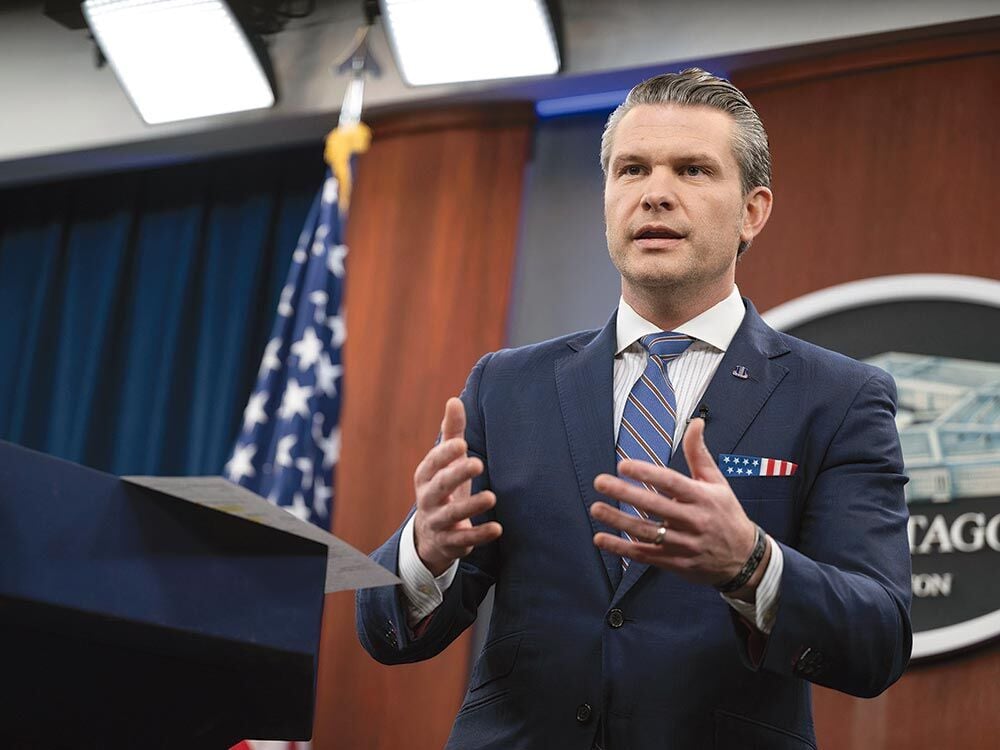
U.S. Secretary of Defense Pete Hegseth was confirmed for his leadership position by the Senate, on a vote of 51-50, on Jan. 24.
IN MARCH OF 2021, PETE HEGSETH WAS A FOX NEWS PERSONALITY, appearing as a political commentator and weekend co-host of Fox and Friends. It would be three-and-a-half years until he would become a household name across the United States as the nominee for Secretary of Defense.
His email to the Monterey Police Department’s records supervisor at the time went unnoticed by the press. “My name is Pete Hegseth, and I am personally requesting that the files related to my case #YG1705129 be emailed to me.” He attached a copy of his New Jersey driver’s license to verify his identity, but it was not needed. In California, police reports generally are not treated as disclosable records no matter who is doing the asking, even the alleged victim or perpetrator of a crime; they are exempt from the California Public Records Act.
But for reasons that remain unknown because of a citywide policy not to speak about the matter, Monterey city officials agreed to release a redacted copy of the 2017 police report to Hegseth. It details their investigation into allegations from a woman, identified as Jane Doe, that Hegseth raped her in his hotel room at the Hyatt in 2017.
Hegseth later told members of the U.S. Senate that he paid Jane Doe $50,000 in a nondisclosure agreement regarding the incident.
Back in 2017, the Monterey Police Department forwarded its findings to the Monterey County District Attorney's Office, which declined to file charges against Hegseth.
It must have seemed, four years later, that the whole episode might disappear. But after Donald Trump was elected for a second term as president of the United States and announced his intention to nominate Hegseth as Secretary of Defense, the Army veteran faced renewed scrutiny.
On Nov. 14, Vanity Fair first reported that Hegseth had been investigated for an alleged sexual assault in Monterey in 2017.
The media inquiries started coming, by the dozen. Reporters from national outlets called the city manager’s office and the police department, and stopped by in person. The city issued a press release to confirm the bare-bones facts.
“Date, time, and location of occurrence: Between 10/07/2017 at 2359 hours and 10/08/2017 at 0700 hours, 1 Old Golf Course Road,” it offered. “Name/Age of Victim: Confidential.”
Beyond that, city officials were firm: Police reports are exempt from the California Public Records Act, so those basics were all the public would get.
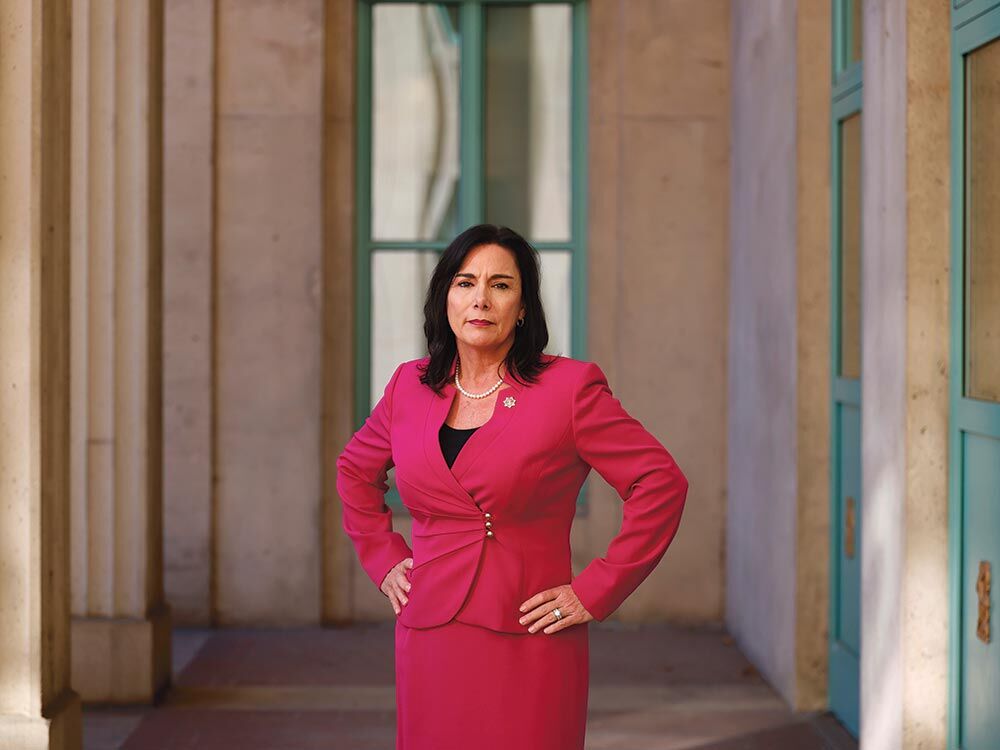
Monterey County District Attorney Jeannine Pacioni has served on the boards of the Monterey Rape Crisis Center, Child Abuse Prevention Council and other organizations.
By Nov. 20, six days after the initial flurry of inquiries, City Attorney Christine Davi realized that the city had already released the police report to Hegseth in 2021. “Therefore, the exemptions claimed in the City’s prior response are not applicable,” she wrote in her analysis.
In a Nov. 18 email, Hegseth’s attorney Timothy Parlatore asked the City Attorney not to release the report. “Mr. Hegseth does not consent to the release of this information,” Parlatore wrote. “Mr. Hegseth is not making any requests for copies of documents.”
But once a document is released to any member of the public – even if it’s to the future Secretary of Defense, or to the subject of an investigation – it is released to all members of the public. Hegseth is treated no differently than any other individual or organization, including the press. “If an agency voluntarily discloses a record to one person, it has to disclose it to anyone else who asks for it,” says David Loy, legal director of the First Amendment Coalition.
In this case, “anyone who asks” turned out to be pretty much the entire American press corps. Eventually, it was also the United States Senate.
MOST OF WHAT WE KNOW about what happened on Oct. 7-8, 2017 at the Hyatt Regency Hotel and Spa in Monterey comes from Incident Report #YG1705129 completed by Monterey Police Officer Brad Holden five weeks later, on Nov. 16.
Hegseth was a keynote speaker at a biannual conference hosted by the California Federation of Republican Women, and was staying at the Hyatt. The woman known as Jane Doe was attending the conference for work, and staying with her family at the hotel. She told police that she didn’t like Hegseth even before she met him, after observing him rubbing women’s legs during the event. When they were introduced in the evening as the afterparty was beginning, she “commented on how she did not appreciate how he treated women,” according to the police report.
In text messages exchanged with her husband – screenshots of which are included in the report – she indicated it was the first time she’d heard of Hegseth. “He is a Fox contributor,” she wrote. “Our ladies are drooling over him. He doesn’t look even remotely familiar. But apparently all the women know who he is.”
During the afterparty and book signing, she continued texting with her husband, who asked if he should wait to wind their kids down for the night; no, she said, she expected to be out late.
Late got later and later. Eventually her husband texted, after falling asleep and then waking up again. “Holy smokes lady… I don’t remember the last time you were socializing at nearly 2:00am,” he wrote.
That was shortly after two separate hotel guests called the front desk to complain about a disturbance near the pool. Following the afterparty, Hegseth and Jane Doe joined a group from the conference at what was then Knuckles sports bar, adjacent to the hotel lobby. It was there, Jane Doe told police, that things started to get fuzzy after hours of drinking.
After Knuckles, the two of them wound up walking to the pool. According to a description in the police report, hotel video surveillance footage showed the two walking arm in arm, seemingly pleasantly, at about 1:15am.
Around 1:30am the calls came in about people being too loud. A hotel employee walked over to ask them to quiet down. Jane Doe told police that Hegseth started cursing and said “that he had freedom of speech. Jane Doe intervened and told [the hotel staff member] that they were Republicans and apologized for Hegseth’s actions.”
After the poolside argument, the next memory for Jane Doe was being in Hegseth’s hotel room, where she said he blocked the door with his body. “Jane Doe remembered saying ‘no’ a lot,” according to the police report. “Jane Doe stated she did not remember much else.”
She next recollected Hegseth on top of her, his dog tags dangling in her face.
WHEN POLICE ASKED HEGSETH for his account of events, he said that he and Jane Doe had sex but that it was consensual. In his telling, she led the way back to his hotel room, and “there was ‘always’ conversation and ‘always’ consensual contact between the two of them.”
Jane Doe told police she had no memory of how she got back to her hotel room early on Sunday morning. Three days later, on Oct. 12, she was back home and went to Kaiser Permanente seeking a sexual assault exam, and told a nurse there she was not sure whether penetration had occurred. As a mandated reporter, the nurse called the Monterey Police Department at about 12:20pm, spurring the investigation.
MPD referred its findings to the Monterey County District Attorney for potential charges under Penal Code section 261(A)4, rape of an unconscious person. Three months later, on Jan. 18, 2018, the DA decided not to file charges. Any deliberations they made about how they arrived at that decision are documented in a declination memo, but the DA has not released that memo to Hegseth, or to the public at large.
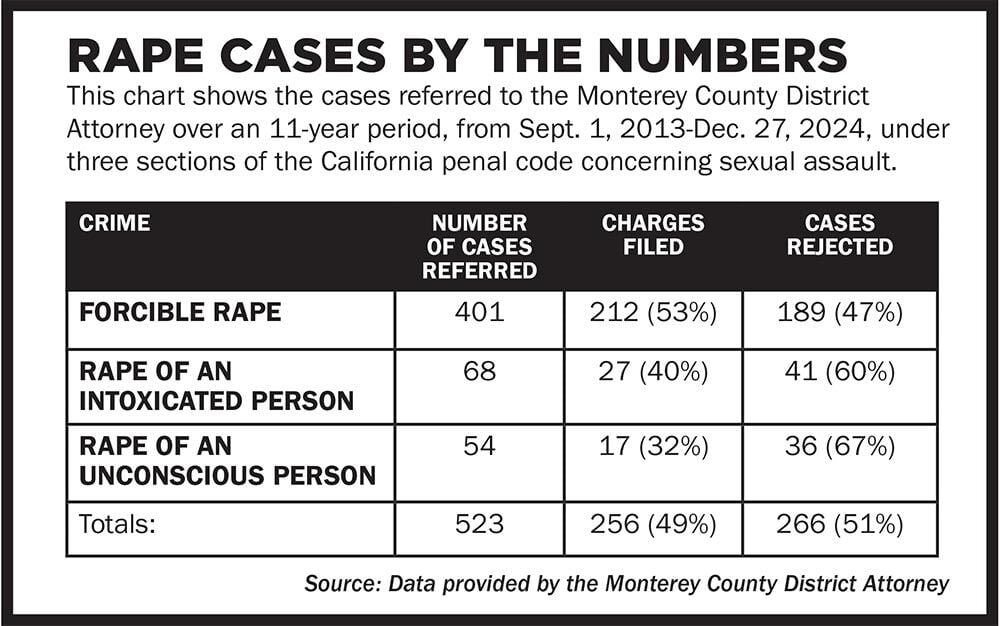
Hegseth and his attorney, Parlatore, have stated that he was cleared in the case. That is not quite true. Local prosecutors file in only about half of sexual assault referrals, and even fewer when the alleged victim is unconscious, according to data from the Monterey County DA obtained by the Monterey County Weekly via a Public Records Act request.
In the past 11 years, when the current tracking system began, the District Attorney filed charges in about half of sexual assault cases referred by local law enforcement agencies, and rejected about half. (See chart, below right.)
Most of those referrals, 401, were for forcible rape. The DA received far fewer referrals for rape on an unconscious person, the charge Hegseth could have faced. Of 54 referrals in 11 years, the DA filed charges in just 17 of those cases, or 31 percent.
Monterey County District Attorney Jeannine Pacioni, who was elected in 2018 about six months after this case came forward, has declined to be interviewed for this story. In a statement issued in November, she said simply: “No charges were supported by proof beyond a reasonable doubt.”
Lauren DaSilva, executive director of the Monterey County Rape Crisis Center, says it is typical that no criminal charges are filed in such a case – proof beyond a reasonable doubt is the threshold for prosecutors.
That does not mean the case should not be taken seriously, she adds.
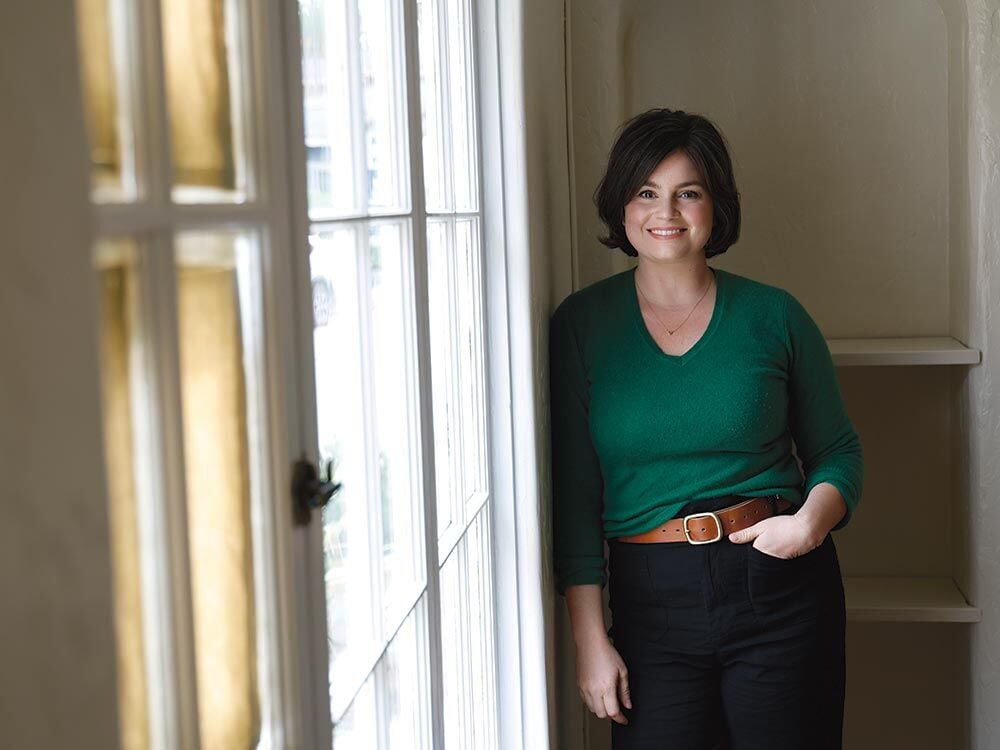
Lauren DaSilva, executive director of Monterey County Rape Crisis Center, in the nonprofit’s new Monterey office, set to open by the end of February. “We’ve been here for 52 years, and we’re going to continue to be,” she says.
“In general, sexual assault reporting is the lowest reporting of all violent crimes, and Monterey County is no different,” DaSilva says. “The vast majority of sexual assault cases do not have criminal charges filed.”
While she declines to speak about the specifics of this case, DaSilva says in general, “People who commit sexual assault can only say two things in their defense: That it was consensual or the other person was lying.”
She adds that understanding what happened afterward can be complicated for a survivor, especially if a perpetrator offers a clear alternative version: “If there’s a lapse in memory, they have to do so much sense-making,” DaSilva says. “That [offender] has a lot of power determining what the narrative is.”
ON TUESDAY, JAN. 14, Hegseth sat in front of members of the U.S. Senate Committee on Armed Services for his confirmation hearing. The matter of character flaws came up right away, starting with opening remarks from the chairman, Sen. Rob Wicker, R-Mississippi, even as he added a dismissive tone.
“Regarding his personal conduct, Mr. Hegseth has admitted to falling short, as we all do, from time to time,” Wicker said. He expressed doubt about the rape allegations, and allegations first reported by The New Yorker that Hegseth had a history of excessive alcohol consumption on the job. Later on Wicker said, “The majority of these have come from anonymous sources and liberal media publications.”
Throughout the hearing, Hegseth repeatedly dismissed claims about his personal conduct as “anonymous smears.”
When Sen. Mazie Hironi, D-Hawaii, questioned Hegseth, he flatly denied the assault in Monterey. “I was falsely accused in October of 2017. I was fully investigated and I was completely cleared,” he said.
Hironi responded, “I don’t think ‘completely cleared’ is accurate.”
(It’s not.)
Ten days later, on Jan. 24, the U.S. Senate voted 50-50, mostly along party lines with just three dissenting Republicans, to confirm Hegseth. Vice President JD Vance cast the tie-breaking vote, 51-50. Hegseth became the United States Secretary of Defense.
ACKNOWLEDGING A PERVASIVE ISSUE of sexual assault in the military, in 2005, the U.S. Department of Defense established the Sexual Assault Prevention and Response Office. The office’s vision statement: “A military free from sexual assault.”
The DoD provides annual reports to Congress on sexual assault data, and the most recent report (for 2023) shows that the rate of reporting increased from 20 to 25 percent, with 7,266 service members reporting sexual assault incidents while in the military. “The Department encourages greater reporting to promote more help-seeking by service members and to hold alleged offenders appropriately accountable,” according to the findings.
Reporting was up, but overall incidences were down. The DoD found that 6.8 percent of active-duty women and 1.3 percent of active-duty men experienced unwanted sexual contact in the year prior. For women, that marked an 8.4-percent decrease, and for men, a 1.5-percent decrease.
As of that report, published in March 2024, the DoD had implemented 32 of 82 recommendations from the Independent Review Commission on Sexual Assault in the Military. Implementation of the remaining 50 recommendations approved by former Secretary of Defense Lloyd Austin were in progress.
“Sexual assault and sexual harassment remain a persistent challenge across the Total Force,” the report concluded. “The Department continues to address these harmful behaviors holistically with a focus on prevention, addressing problematic culture, improving the skills of all leaders at all levels, and evaluating ways to make the reporting of these harmful behaviors easier for survivors.”
IT IS NOT JUST THE LEADER OF THE DEPARTMENT OF DEFENSE who has been accused of sexual violence and sought to discredit his accuser. President Donald Trump has also been repeatedly accused of sexual misconduct. Since the 1970s, more than two dozen women have accused Trump of groping them or other unwanted sexual contact. In 2023, a jury found Trump liable for sexual abuse and defamation and awarded $5 million to the writer E. Jean Carroll, who said Trump had raped her. Trump has publicly denied all allegations.
Of course, Trump has also flaunted such behavior. Back in 2016, before he was elected the first time, an Access Hollywood hot mic moment from 2005 revealed what seemed sensational at the time, with Trump saying, “Just kiss. I don’t even wait. And when you’re a star, they let you do it. You can do anything… Grab ’em by the pussy. You can do anything.”
(Representatives of Trump, Hegseth and the DoD did not respond to requests for comment for this story.)
“It’s a problem when we promote people who do sexual harm to positions of power and authority,” DaSilva says.
She is referring in part to a general sense of permissiveness – that instead of holding people to account for alleged sexual misconduct, we are ignoring the conduct, or worse, celebrating it.
Beyond normalizing a tolerance for sexual misconduct, DaSilva says organizations like the Monterey County Rape Crisis Center are bracing for hard times ahead.
Challenges for funding are not new. Groups advocating to end sexual violence have already faced tough times in recent years. In 1984, President Ronald Reagan signed the Victims of Crime Act (VOCA) into law, securing a funding stream for services for victims of sex abuse, human trafficking and domestic violence, thanks to revenue from successful prosecution of white-collar crimes.
The group VALOR is a coalition representing California’s 84 rape crisis centers, which rely on federal VOCA funds funneled to the state, then to the various nonprofits. In 2023, they were notified that a 45-percent reduction in VOCA funding was coming.
“It was going to be one of the steepest cuts we had seen thus far,” says Grace Glaser of VALOR. “The fund has just become relatively unstable.”
At the Monterey County Rape Crisis Center, “it’s our biggest single source of funding,” DaSilva says. “It was dicey there for a while.”
The State of California came through to backfill the federal cuts with $103 million in one-time funding in the current year, but VALOR leaders still see a need for a longer-term fix. The California Victims of Crime Act took effect Jan. 1, establishing a statewide fund similar to VOCA, but as Glaser says, “It will take time for that fund to build up.”
Meanwhile, since Trump was sworn in in January, there are new questions about the federal government’s support for sexual violence prevention work, when it comes to funding and beyond.
On the U.S. Centers for Disease Control website, some pages with information on various topics related to sexual assault prevention are no longer live. From the landing page “Preventing Sexual Violence,” people can click bullet points for resources on topics like “Bringing in the Bystander” or “Shifting Boundaries,” but those links now go nowhere. A banner on top of the site reads, “CDC’s website is being modified to comply with President Trump’s Executive Orders.”
“The sexual violence prevention information that we use every day – it’s just gone,” DaSilva says.
There are also concerns that will be familiar to organizations reliant on federal funds. The MCRCC just completed the first year of a five-year CDC grant, at $170,000 annually, for rape prevention education. What happens next is unknown.
“I don’t know what there is to do at this point other than continue to do our work to the best of our ability, until we can’t – and that point may not come,” DaSilva says.
“It’s going to be hard,” she adds, “but it was always hard.”
BACK IN THE EARLY 1970S, groups of mostly women were organizing what would become a vast infrastructure of rape crisis centers and similar organizations across the country. In those days, in Monterey County, it was just a group of people who saw a need and stepped in as volunteers, then began recruiting friends and neighbors.
They would meet in their living rooms to coordinate what started out as an all-volunteer hotline. During 12-hours shifts, volunteers would need to be near a landline at home, in the era well before cell phones. (At the time, the hotline might receive 10 calls a month. Today, it gets 95 calls a month.)
Soon after, Lynne White Dixon moved to town and quickly joined in as a volunteer on the rape crisis hotline. Meanwhile, in her job as a social worker, she was hired to set up a mental health clinic in Seaside as an outreach arm of Community Hospital of the Monterey Peninsula. In that role, she helped formalized a training manual for sexual violence prevention.
The team of volunteers coached police, doctors and nurses on how to respond to rape victims. They started offering workshops with information that is now, 50 years later, widely understood – with basics like just because you buy someone dinner doesn’t mean you are entitled to sex.
But even as their work gained traction, the team was frustrated.
They went repeatedly to Fort Ord to train a roomful of 100 or so young troops, but they found the audience might push back. Inevitably, four or five women would stay behind afterward. “They would linger behind and say, ‘I was sexually assaulted.’ We were starting to get pissed, we were very angry,” White Dixon says.
“We were watching Army police say horrible things to women in the course of interviewing them,” she adds.
The volunteers reached out to Leon Panetta, then their congressman, who said he would take action. “It turned around,” White Dixon says. “That was huge. At least when women had to go to the Army hospital, we saw less abusive behavior in the interviews and better treatment.”
Meanwhile, the volunteers continued their work, raising enough money through things like plant sales to keep the hotline going. In 1979, White Dixon was hired as the Monterey County Rape Crisis Center’s first executive director.
These days, the center runs on about $2 million a year from grants and donations. In 2022, the organization acquired a building space in Salinas, a century-old farmhouse, which serves about 70 percent of clients.
And thanks to a surprise donation of $1.2 million, the nonprofit last year acquired its own building in downtown Monterey. The former residence smells like fresh paint, before furniture is ready to be moved in, and it’s bright and airy. To enter, a visitor walks on a slate pathway through a lovingly landscaped garden. There’s space for therapy, for youth prevention groups to meet and for administrative offices.
Trainings twice a year bring on roughly 15-20 volunteers to support the 24/7 helpline and to respond in person to sexual assault forensic exams at hospitals as victim advocates. And law enforcement agencies have been trained on what to look for, and to take the issue seriously. (Pacioni recently served on the board of the Monterey County Rape Crisis Center.)
“It’s better now than it ever has been. When we first started, there was so much victim-blaming, and it was very hard to get things prosecuted,” White Dixon says. “As bad as it is, it has been worse.”
Panetta, who retired in 2013, went on to serve in a variety of leadership roles, including as Secretary of Defense from 2011-13. He remembers bringing the concerns of local volunteers to members of the Armed Services Committee.
“I continued to focus on that issue not only then but the time I spent in White House and then as Secretary of Defense,” Panetta says. “I felt strongly that women ought to be given the opportunity to participate in service in every area, including combat. For that to work, it was extremely important to make sure we were doing everything necessary to make sure that sexual abuse was not a problem.
“There is no question is has gotten better, but it can’t be taken for granted,” he adds. “The most important thing is that the leadership at the Pentagon have to continue to stress it in their roles.”
SOME OF WHAT WE KNOW ABOUT THE VIEWS OF CURRENT LEADERS comes from their public remarks and writings. In Hegseth’s case, at least when it comes to what happened between him and Jane Doe one night in Monterey in 2017, we know about it because of the California Public Records Act.
Since mid-November, the City of Monterey and the Monterey County District Attorney’s Office were inundated with dozens of requests for records. There were phone calls, emails and handwritten inquiries from a Washington Post reporter.
Parlatore, Hegseth’s attorney, also tried to get more information from the DA. “As the legal representative of Mr. Hegseth, who was the subject of this investigation, we seek this information to understand the basis for the decision not to prosecute,” he wrote. “This request is made in the interest of transparency and to ensure that our client is fully informed about the circumstances surrounding the investigation. Additionally, Mr. Hegseth needs this information to defend himself from public backlash from the release of the police report, as well as for potential litigation against the complainant.”
Chief Assistant District Attorney Berkley Brannon wrote back as he did to dozens of other requests: Investigative records are exempt from the California Public Records Act and would not be disclosed.
Even when Gavin Brendan, General Counsel to the U.S. Senate Armed Services Committee, requested information from the DA on Dec. 19 on behalf of the senators, the denial was the same. The DA’s Office possesses a declination-to-file memo and a brief case summary, but would not be releasing those documents.

Monterey City Attorney Christine Davi released a redacted version of the police report, drawing extensive coverage in national news outlets. Her office responded to 66 California Public Records Act requests from Nov. 14-Dec. 20, 2024.
Even in the City of Monterey, where Davi determined she was legally obligated to release the police report, there were continued requests for additional records. An attorney for CBS News persisted in seeking the Hyatt footage that was collected by police as evidence, but the city declined. The city’s objective, Assistant City Attorney Karin Salameh wrote, was to balance disclosure with privacy. “Disclosure of this information is likely to lead to the identification of Jane Doe. While recognizing the strong public interest in this case, the interest in maintaining the confidentiality of the identity of victims who report sexual assaults is paramount,” she wrote. “Therefore, the surveillance remains confidential.”
The police report, redacted for privacy of Jane Doe, her husband and their minor children, changed the narrative available to the public, including to members of the Senate Armed Services Committee. Whether or not those disclosures changed anything in reality is a different story.
“The press and public have a right to the full story and they got it,” says Loy, of the First Amendment Coalition. “Transparency doesn’t always lead to an outcome. It gets the information out for public officials to make their decisions fully informed. What they do with that is a political matter.”
If you are a victim of sexual assault, there is help available.
- The Monterey County Rape Crisis Center manages a 24/7 hotline at (831)375‑4357. Visit mtryrapecrisis.org for more information about available services or to get involved as a volunteer.
- Members of the military can call the DoD’s helpline at 877‑995‑5247 or visit safehelpline.org.
(0) comments
Welcome to the discussion.
Log In
Keep it Clean. Please avoid obscene, vulgar, lewd, racist or sexually-oriented language.
PLEASE TURN OFF YOUR CAPS LOCK.
Don't Threaten. Threats of harming another person will not be tolerated.
Be Truthful. Don't knowingly lie about anyone or anything.
Be Nice. No racism, sexism or any sort of -ism that is degrading to another person.
Be Proactive. Use the 'Report' link on each comment to let us know of abusive posts.
Share with Us. We'd love to hear eyewitness accounts, the history behind an article.