
With the Timber and Plaskett fires now more than 52,000 acres combined, it’s a safe bet many of us are spending a lot of time thinking about the “what ifs” of wildfires, should they ignite closer to home. Pam Marino here, contemplating just that.
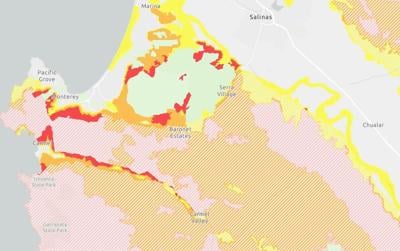
I live in what’s been designated as a very high fire hazard zone, announced by Cal Fire in March last year, and since then how to protect my home and my neighborhood has been very much top of mind. I’ve already trimmed back some landscaping, stayed on top of raking up dead leaves and have plans to replace wood mulch with gravel, among other changes.
Many Carmel residents are contemplating wildfire safety, too, including Hans Buder, a member of the Carmel City Council and mayoral candidate in the Nov. 3 election. Buder launched the city’s Wildfire Preparedness Committee last year in response to the Los Angeles fires, and has been advocating for changes to city design standards to allow for home hardening products that go against the old ways of doing things in the village.
Highly flammable wood mulch is one good example. It’s been the recommended permeable ground covering for Carmel yards for decades, in part because the city limits how much of a property can be covered by semi-permeable and non-permeable substances. Gravel counts as a semi-permeable item and by adding it around a home it can push the property over the city’s limit.
That’s likely to change after a vote tonight, Sept. 1 at the Carmel City Council meeting on a proposed urgency ordinance that will bring four changes to City code requiring the use of certain home hardening products and procedures, specifically for homes that engage in renovations or new construction. It will not apply to existing homes.
In addition to allowing for gravel within five feet of a structure, as recommended by Cal Fire to prevent ember ignition, it also regulates how firewood and other combustible materials are stored, calls for the addition of ember-resistant vents as well as the installation of fire-resistant, double-paned windows. The gravel, vents and windows will have to conform to the City’s design guidelines and standards. For gravel, that means earth-tone or muted colors.
And while not all of Carmel is in very high, high or moderate hazard zones, and only a portion is in what is known as a wildland-urban interface, or WUI, zone, the urgency ordinance would apply to the entire city.
When it was first discussed by the City Council in August, some suggested the city needed to go through the process of a permanent ordinance instead, including having the changes go through Planning Commission review. Buder pointed out that a permanent ordinance would also require review by the Coastal Commission, dragging out when preventative measures went into effect.
“So it’s not now versus two months from now. It’s now versus a year from now,” Buder said, adding that the urgency ordinance will sunset once a permanent ordinance is adopted.
As we are constantly reminded by living in a state now prone to burning, there may not be time to wait.
If you’re interested, the Council meeting started at 4:30pm inside Carmel City Hall on Monte Verde Street between Ocean and 7th avenues. It’s available for viewing on the City’s YouTube channel. For those that want to participate via Zoom, the instructions are on the agenda.


(0) comments
Welcome to the discussion.
Log In
Keep it Clean. Please avoid obscene, vulgar, lewd, racist or sexually-oriented language.
PLEASE TURN OFF YOUR CAPS LOCK.
Don't Threaten. Threats of harming another person will not be tolerated.
Be Truthful. Don't knowingly lie about anyone or anything.
Be Nice. No racism, sexism or any sort of -ism that is degrading to another person.
Be Proactive. Use the 'Report' link on each comment to let us know of abusive posts.
Share with Us. We'd love to hear eyewitness accounts, the history behind an article.