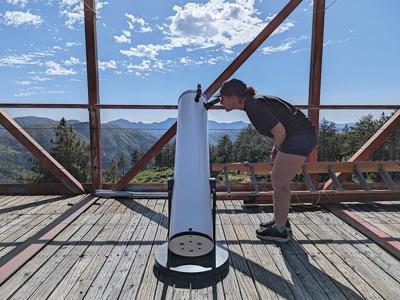

Sara Rubin here, stopping to appreciate something about Monterey County that perhaps I don’t appreciate often enough: darkness. So much of our developed world is so bright with light pollution that the night sky is washed out. Around here, it’s easy to get to a place that is dark, meaning the stars are well defined. On a clear night, you might find a quiet, dark spot and lie down on your back. Look up. Keep looking up until you see a shooting star—I promise, it won’t take as long as you think. And you need not wait for a special event like a meteor shower, any old night will do.
Maybe it’s this shooting star game I’ve played with myself for decades that made me naturally curious about the Monterey Institute for Research in Astronomy (MIRA). For years, I knew the nonprofit was there, headquartered in Marina—quite possibly the foggiest place on Earth and hence terrible for stargazing—and operating an observatory way up high on Chews Ridge in the Los Padres National Forest, where the sky is often clear, very dark and great for looking at stars.
But I didn’t really begin to know or appreciate what they did, until I called Dr. Bruce Weaver, an astronomer and the founder/director of MIRA. That was back in early 2024 when I interviewed him about a solar eclipse. My visit to MIRA in Marina and conversation with Weaver quickly made clear that there was much more to the story, so I decided to embark on a cover story about the institution and some of the astronomers who work there and their research.
You can read the resulting story, out in the Sept. 11 edition of the Weekly, to learn more about the research on asteroseismology that Dr. Jean Perkins is doing, or polarization that Dr. Daniel Cotton is studying—using a sophisticated polarimeter he helped invent.
But more than their astronomy research, I hope you get to learn a little bit about the brilliant people working in our community, quietly producing groundbreaking scientific research.
What’s more is that MIRA is the opposite of an ivory tower institution, accessible only to highly trained scientists (although its team of nine astronomers and physicists are that). It’s also very much about bringing astronomy to the people. The nonprofit hosts a series of free events; talks at the Marina campus, stargazing parties at night at Garland Ranch Regional Park or Laguna Seca Recreation Area, occasional tours of the observatory, and more.
“Really, we do astronomy because we want to know—because humans are curious,” Cotton told me. “We’re the lucky people who get to do that on behalf of everyone, which is a reason why I think it’s very important we try to involve the public as much as possible in what we do. If you’re working on behalf of humanity, then you should involve humanity.”
That means all of us. I encourage you to check out MIRA’s events. If you do, please drop me a line and let me know what you see and if it wows you.


(0) comments
Welcome to the discussion.
Log In
Keep it Clean. Please avoid obscene, vulgar, lewd, racist or sexually-oriented language.
PLEASE TURN OFF YOUR CAPS LOCK.
Don't Threaten. Threats of harming another person will not be tolerated.
Be Truthful. Don't knowingly lie about anyone or anything.
Be Nice. No racism, sexism or any sort of -ism that is degrading to another person.
Be Proactive. Use the 'Report' link on each comment to let us know of abusive posts.
Share with Us. We'd love to hear eyewitness accounts, the history behind an article.