



It requires a certain amount of audacity to be an astronomer at all, craning one’s gaze toward the sky, hoping to discover something in the vastness of our galaxy, or beyond.
It takes even more audacity to start an astronomy institute. But that is exactly what Bruce Weaver and a group of fellow PhD students at Case Western Reserve University set out to do, starting with a dream circa 1970.

Daniel Cotton opens the protective door in front of the 36-inch telescope at the Oliver Observing Station on Chews Ridge. The roof above the telescope is on wheels and rolls backward to open up visibility to the sky for observation.
Looking for a place that was sufficiently dark for their astronomical research, Weaver and company were drawn to the Santa Lucia Mountains. In 1972, they founded the nonprofit Monterey Institute for Research in Astronomy. (The acronym, MIRA, refers to the star Mira – aka omicron ceti – in the Cetus constellation, which resembles a whale.)
But the paperwork to register the organization was just one simple administrative step.
“If you’re going to run your own astronomy institute, you need a telescope. If you’re going to build a telescope, you need a mirror,” explains Daniel Cotton, now an astronomer at MIRA who was not even born at the time the organization was founded.
Weaver was early in his career, but he had already cultivated a habit of asking directly for what he wanted. Over breakfast at a conference hosted by the American Astronomical Society, Weaver approached Martin Schwarzschild, a celebrity in astrophysics (the Schwarzschild criterion, describing the stability of stellar gas in certain conditions, is named after him) and at the time, the director of the Princeton University observatory. Weaver asked Schwarzschild for a perfectly smooth, high-quality mirror – and Schwarzschild said yes.
The perfectly flat mirror was handed over from Princeton and NASA to MIRA on permanent loan, but immediately the team set to work on making it suitable to their telescope design – specifically, cutting a hole in the middle of it.
“They risked turning one of the best mirrors ever made into a hunk of glass – but it all turned out fine,” Cotton says.
In recounting the history of MIRA, both Weaver and Cotton offer a matter-of-fact play-by-play of events. Need a mirror, or funding to make that mirror into a telescope, or a dark mountaintop on which to place that telescope? Just ask and ye shall receive.
MIRA built its telescope over several years and it was first deployed in Cachagua in 1977. By the late ’70s, MIRA scientists were getting their own images, doing original astronomical research. But Weaver had even bigger dreams.
He says he simply asked the U.S. Forest Service for permission to build an observatory on top of Chews Ridge, near the lonely peak of Tassajara Road in the Los Padres National Forest. And the pattern repeats: The USFS said yes, and granted a permit.
“We hired a surveyor, and he and a couple of us with machetes cut a little path,” Weaver says.
In 1982, the MIRA team broke ground on the Oliver Observing Station, a remote outpost accessible by traveling on six miles of dirt road with 4,000 feet of elevation gain, about an hour’s drive from Carmel Valley Village.
To get the telescope and its special mirror up to the new site, it had to be disassembled, then reassembled with the help of cranes. Finally, by June 1984, the observing station was dedicated and the telescope was ready for action.
“Arguably,” Cotton says, “this is the best location in the continental United States.”
✷ THE BEST, ASTRONOMICALLY SPEAKING, means dark. By definition, that means isolated, free of light pollution from nearby civilization.
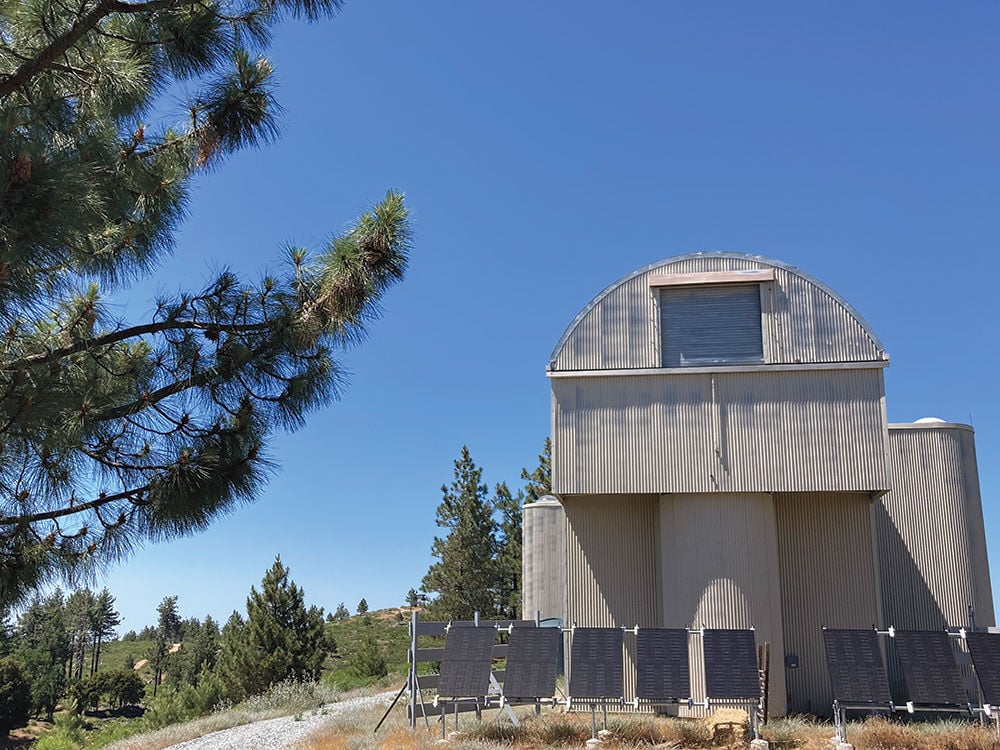
The exterior of the Oliver Observing Station on Chews Ridge
The top of Chews Ridge is remote. The base of the telescope is at exactly 5,000 feet above elevation. There’s Big Sur to the south, generating no light. The Salinas Valley to the east and the distant glow of the San Jose metro area to the north have brightened since MIRA moved in here in 1984, but the light is still negligible. And of course to the west is the dark expanse of the Pacific Ocean. This is beneficial not just because it’s dark, but because of climactic factors. Smooth air flows above the marine layer over the ocean, what Cotton describes as “really stable air, not turbulent at all.” That makes for sharper images.
Being in a remote place – a microwave dish provides high-speed internet – means the Oliver Observing Station must be self-reliant (and the property requires an onsite caretaker to manage it). Astronomers must be jacks of all trades; they spread gravel on the road (and encourage visitors to drive slowly, keeping dust down to avoid impacting the telescope). They are judicious with water usage, using rainwater collected in a cistern. They wear warm clothes; a giant insulated water tank heats the building interior if there is excess power generated by a solar array outside.
“Being out in the middle of nowhere, we have to generate all of our energy onsite,” Cotton notes.
When it’s his turn to operate the telescope, Cotton prefers to stay at the observatory for two to three weeks at a time. (Many of his colleagues, he says, prefer to drive to and from town every couple of days because, due to water conservation, they aren’t taking showers.)
While much of the work of astronomy takes place later, in a lab in Marina, the task of operating the telescope is a practice in patience and attention. It cannot be done remotely, requiring astronomers to stay awake overnight. It is lonely work. (When it’s his turn to observe, Cotton relies on Coca-Cola to stay awake, and tries to sleep during the day.)
The whole purpose for the observatory’s existence is the telescope – built around a 36-inch mirror so smooth it is invisible at first glance – and the building exists just to protect the telescope from the elements. The roof is on wheels, and slides back to expose the scope to the sky.
An astronomer on shift might spend a lot of time just across the deck in a modest control room, flanked by about 10 computers, including an ancient one that reads floppy disks, still relevant to one particular software. There are weather and air pollution updates, data on dust particles and utilitarian information like the solar array output. (Besides the computers, there are some amenities – a cot for resting, a few board games on a bookshelf. It’s sparse, but cozy.)
But the computers do only so much. The astronomer must not only stay awake but stay attentive to conditions.
“You have to be very careful you don’t get dew forming,” Cotton says. “The last thing you want is for your telescope to be rained on.”
At the first signs of dew – a slippery floor, for example – he rolls the roof shut.
✷ THE PERFECTLY FLAT, REFLECTIVE MIRROR does the heavy lifting of the telescope, but it’s the instruments that astronomers attach to it that makes it resemble what most laypeople might describe as a “telescope.” What we see otherwise is a giant tube with various wires dangling. Inside, the light is directed to instruments with specific tasks.
One possible attachment is an eyepiece so you can look through it at the sky – the easily identifiable part. Some astronomers attach spectrographs to measure the color of light. Some use a photometer to measure the position and brightness of stars. For his research on polarization, Cotton attached a polarimeter, one that he helped invent. “It’s the most precise stellar polarimeter anywhere in the world,” he says matter-of-factly.
It looks like a cube with a patchwork of wires and panels, and works similarly to polarized sunglasses, he says, racing against the atmosphere to grab multiple images of bright stars. “It is helping to understand the evolution of those stars and therefore, the evolution of the galaxy.”
He discovered that stars are indeed polarized – that two stars orbiting around each other are reflecting each other’s light. The previous prevailing belief was that stars absorb light from nearby stars and then readmit it; this instrument affixed to this telescope showed that actually, they reflect light.
The readings Cotton gets appear as numerical voltage readouts – numbers, not beautiful images of the expansive night sky. But like most astronomers, it was partly the awe of the night sky that drew Cotton to the field – but it was the telescope that drew him to MIRA.
✷ WHEN IT WAS FOUNDED IN 1972, MIRA became the first private astronomy institute established in the 20th century in the United States, in an era when universities had come to dominate the field. The independence is both a competitive disadvantage – Cotton says grants are often awarded for flashy projects – but also an advantage.
“We can do work that is unfashionable at universities, with larger telescopes that are usually looking at exoplanets and galaxies,” he says. “If you’re looking at stars, that is less fashionable.”
Less fashionable in this case means getting back to basics – but there are still plenty of unanswered questions in the realm of “basics” in astronomy.
While some bigger labs might be pursuing more ambitious projects, like looking for verification of alien life, MIRA astronomers are exploring stars. “You can set up, listening, waiting for the money shot,” Cotton says. “Or you go back to the fundamentals and understand how stars work.”
In Cotton’s case, that is polarization. He grew up in a dark area in Australia, where he could see the Southern Cross from his bedroom. He was a physics major first, and an astronomer second.
He planned to stay close to home. But when he started looking for jobs on online astronomy job boards, he found a home at one of the furthest-away possible points on the planet: Monterey County.
“The reason I am here at MIRA is because we have small and medium telescopes,” Cotton says. “I need lots of telescope time to help develop instruments.”
MIRA astronomers set out in the past two years to revisit questions about the atmosphere of Venus, which had been measured in the 1920s and 1960s and not since then. “By taking measurements last year and the year before, we’ve created a 100-year time baseline,” Cotton says. “And it’s definitely changed.”
The atmosphere of Venus polarizes light and features what is known as an unknown UV absorber – unknown because astronomers don’t know exactly what it is, just that it affects their readings; the amount of UV light is less than what it should be, and something is absorbing it. And in this case, it might reveal relevant information about a runaway greenhouse effect, characteristic of Venus’ atmosphere.
Even the essential, not-flashy parts of astronomy are helping enable humans to answer big questions.
“Really, we do astronomy because we want to know – because humans are curious,” Cotton says. “We’re the lucky people who get to do that on behalf of everyone, which is a reason why I think it’s very important we try to involve the public as much as possible in what we do. If you’re working on behalf of humanity, then you should involve humanity.”
✷ MIRA’S FIRST PUBLIC OUTREACH EVENT took place in 1973, drawing hundreds of people to view Comet Kohutek through an amateur telescope. This is the kind of telescope that you can pick up and move – no cranes required, no world-class 36-inch mirrors involved. And the idea of including non-scientists in the science of astronomy has remained essential to the work the nonprofit does in the 52 years since.
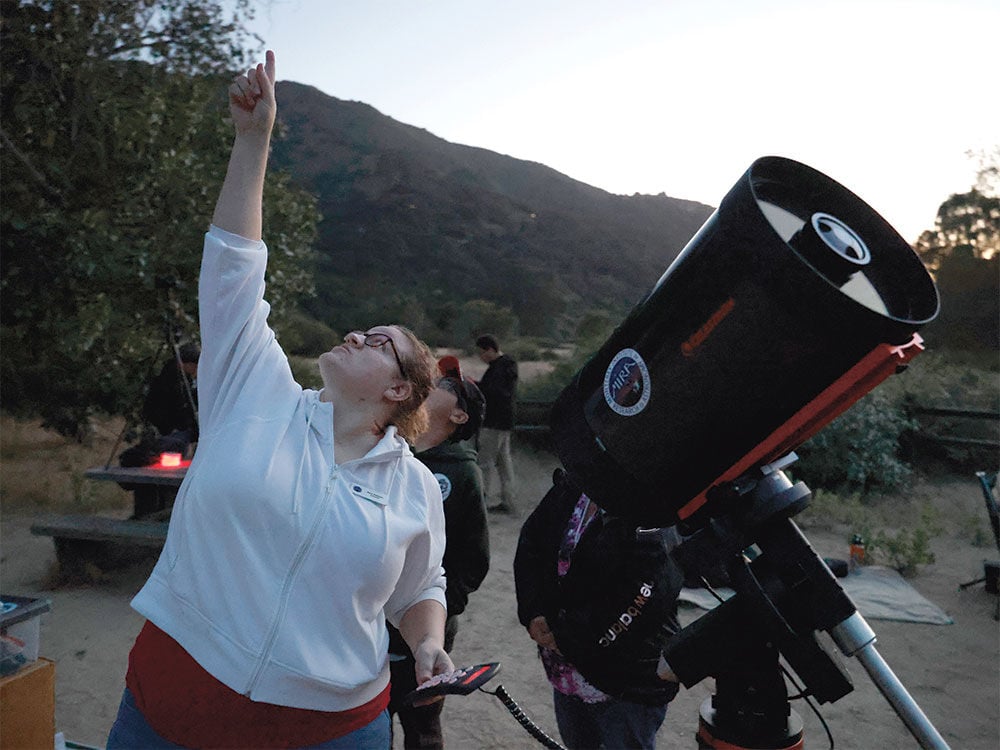
Astronomer Jean Perkins leads community stargazing events in addition to doing research.

Participants of all ages join in a star party hosted by MIRA at Garland Ranch Regional Park in June.
That commitment takes the form of star watch parties (not unlike the Kohutek viewing party), lectures, internships and classroom engagement.
“It’s easy to get interest, because space is a pretty science,” says astronomer Jean Perkins, who beyond doing her own research, is responsible for the nonprofit’s community outreach efforts. “The images are beautiful and inspiring, without having to understand all the physics,” she adds. “That makes it accessible.”
Perkins knows firsthand the impact one inspiring leader can provide to a young person. “When I was a kid I really liked rocks – it was rocks, rocks, rocks all the time,” she says. Then one influential role model – a physics professor early on while she was attending community college – inspired Perkins to change course away from plans to pursue geology.
Perkins’ research focus is asteroseismology, the study of starquakes (rather than earthquakes). Seismology on Earth has helped us understand the inside of our own planet – the same logic applies to stars, as Perkins looks for information in stellar pulsation that can reveal information about the age, size and the interior structure of stars.
That information is collected with photometers from space-based satellites, and spectrographs from the Oliver Observing Station. While the latter detects light in grayscale, producing a monochrome spectrum, Perkins works with a team of interns to process that spectrum, mapping it to the colors your eye (not the sophisticated instrument) would see. When they adjust it, they can see different colors of light spreading out into a rainbow – after analysis, Perkins’ data readings look beautiful, like a series of rainbow lines transitioning from dark to bright red, then to orange, then yellow, and so on.
Perkins and Cotton are two of nine astronomers and physicists on MIRA’s staff, each specializing in their own field of study. MIRA Assistant Astronomer Eric Haase recently presented on cometary dust at the American Astronomical Society’s conference in Washington, D.C.
They deliberately under-schedule time on the telescope at Oliver Observing Station so they can respond quickly to celestial events. But much of the work, particularly in winter, when clouds obscure the sky and rainy weather makes Tassajara Road a rougher drive, takes place indoors, in Marina. The main MIRA campus on the former Fort Ord at the Richard W. Hamming Astronomy Center includes extensive scientific libraries, a machine shop and electronics shop, and a student observatory with a 14-inch telescope. (Somewhat ironically, this main campus is based at sea level in one of the foggiest places, compared to the perfect location of the observatory at 5,000 feet in the Los Padres National Forest.)
All of these facilities and all of this research is funded by the nonprofit MIRA, supported by a Friends of MIRA group. (That group launched in 1978 at the home of an original Friends member, photographer Ansel Adams.) Perkins is optimistic about maintaining three federal grants from the National Science Foundation for research but worries about one from NASA for bilingual education, given the current climate in Washington. As of 2022, the organization reported $4.3 million in total assets – relatively small to be pursuing big questions of the universe. (The highest-value items are MIRA’s custom-made instruments, Perkins says.)
“Astronomy is a hard one to justify especially when you are writing grants,” Perkins says. “They always ask you, ‘Why is what you are doing important?’ It’s not like we are curing cancer or solving world hunger.
“But it scratches that itch humanity has to know where we came from, where we are going.”
✷ A BIG FOCUS OF PERKINS’ WORK is community events, and she finds that astronomy connects her not just to the community, but humanity more broadly. “As long as humans have existed, we have been able to look up at the night sky,” she says. “It’s one of the things that connects us to our early ancestors. When you take kids to see the Milky Way, it’s really awe-inspiring.”
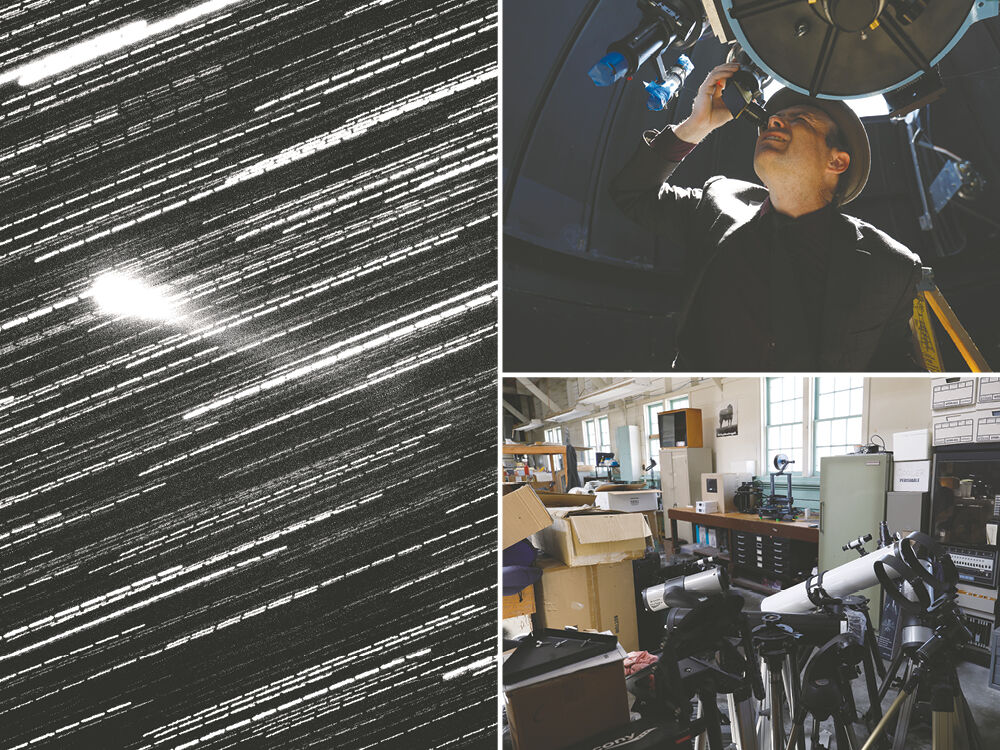
Left: MIRA interns helped produce this series of images of comet C/2025 K1 (ATLAS) stacked together, where the comet is kept as the central focus. It shows star trails as the comet moves in relation to stars in the background. This comet was discovered in May 2025. Right: MIRA is headquartered in Marina, where a team of nine astronomers (including Cotton, above) work most of the time, and equipment goes for storage and repairs.
Star parties – which take place only in clear conditions – are scheduled roughly once a month. A few months ago, Perkins describes a young girl checking out the telescope at a star party at Laguna Seca Recreation Area, with the lens focused on Saturn or Jupiter. “She was almost crying, ‘Oh my god, oh my god, is this real?’ That’s what we do it for,” Perkins says.
This is the scientific world that Cotton says is “unfashionable,” a world that focuses on igniting curiosity in regular people about stars, planets and other celestial objects. MIRA’s focus remains gathering data and answering questions about stars – the basics. As in, not seeking to answer questions about extraterrestrial life or other, perhaps more grandiose, matters of space.
As Weaver wrote matter-of-factly in the spring 2025 edition of MIRA’s newsletter: “With over 5,000 extra-solar planets at the time of this writing, is it time to start thinking about aliens living on distant planets? Probably not.”
Perkins explains that logic a little bit more, with her stock “nice, neutral answer” – it’s not that she is confident there are (or aren’t) aliens, it’s just that the time and effort to establish communication isn’t worth it, scientifically speaking. “I think we are not the only form of life out there, but it’s statistically unlikely we will ever talk to them,” she says. “It’s statistically likely it exists – and statistically unlikely we will find it, just based on the speed of light.”
Maybe we send a signal out there, and it takes 50,000 light years to reach an entity capable of receiving and understanding and responding to it. Then they would send a signal back that would take another 50,000 light years to return to Earth. Will anyone be here to receive or comprehend it? Unlikely.
“Perhaps there was an alien civilization when dinosaurs roamed, but there was no technology to detect it then,” Perkins offers by way of an example. “The universe is long lived, and very big.”
Long lived in that the universe is 13-and-a-half billion years old. That duration gives astronomers like Perkins context, and also a sense of humor as they do their work, angling experimental instruments out toward the vastness of the night sky.
“We are a tiny insignificant speck of dust on a tiny insignificant speck of dust in the universe,” she says. “Nothing we do really matters, but I am having fun doing it.”
(0) comments
Welcome to the discussion.
Log In
Keep it Clean. Please avoid obscene, vulgar, lewd, racist or sexually-oriented language.
PLEASE TURN OFF YOUR CAPS LOCK.
Don't Threaten. Threats of harming another person will not be tolerated.
Be Truthful. Don't knowingly lie about anyone or anything.
Be Nice. No racism, sexism or any sort of -ism that is degrading to another person.
Be Proactive. Use the 'Report' link on each comment to let us know of abusive posts.
Share with Us. We'd love to hear eyewitness accounts, the history behind an article.