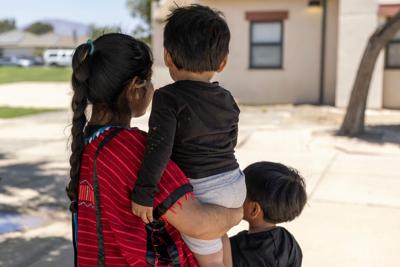

Celia Jiménez here, thinking about the cover story I wrote for this week’s edition of the Weekly about immigration and how current policies have impacted people’s lives.
This story took me down memory lane. From my mom’s immigration story (she obtained her legal permanent residency during the Reagan Administration), to the anxiety and panic we felt in the early 2010s, when immigration enforcement was active in San Diego, to how outspoken people were about immigration before and during President Donald Trump’s first term when I was a student journalist at San Diego City College, this is on one level a personal story for me.
The latter is what strikes me the most. Why? Because in this country, freedom of speech is a quintessential element of our identity as a nation.
As a student journalist years ago, I interviewed students and professionals, many of them DACA recipients, and they were outspoken about the threats against the DACA program and their immigration status. Reporting on this story, I encountered the opposite. Several people, regardless of their immigration status, are afraid of retaliation or harassment. (As such, in the cover story, we protected the identities of those who trusted us with their stories and helped us uncover how the current immigration narrative is impacting their everyday lives.)
I find myself wondering if this country is moving forward, or falling backward into a past where immigrants and U.S.-born citizens were subjected to xenophobic policies.
Thousands of Japanese and Japanese Americans were locked up during World War II because they were considered a security threat. Over a million of Mexican Americans were deported to Mexico during the Great Depression during the so-called Mexican Repatriation. The reason? They were allegedly taking away resources and jobs from white Americans (sound familiar?).
Even now, people of color, especially Latinos, are being detained and reportedly racially profiled by ICE agents and some U.S. citizens have spent days to years incarcerated at a detention center.
These actions are the reason why everyone, whether you agree or disagree with the current immigration policies, should make sure the law is being followed every step of the way.
In announcing proposed immigration legislation, U.S. Rep. Zoe Lofgren, D-San Jose, pointed out that agriculture, the largest industry in Monterey County, would crumble without an immigrant workforce. “The Central Coast economy is rooted in agriculture. More than half the farmworkers are undocumented. If they are disappeared, the economy of this area will collapse," she told me.
If you still don’t believe that, industry leaders can fill you in.
Immigrants are key individuals in our communities. This isn’t a personal belief, but a fact—and there is data to back it up.


(1) comment
It occurs to me that we all live in fear of the law if we are not adhering to the law. The title of this article is very misleading as it suggests all immigrants live in fear of the law. Law abiding immigrants have no reason to live in fear of the law. Being in the US undocumented is not legal and people that fit that category have a right to be afraid. I was raised in an agricultural setting. At the time the Bracero program was in operation (most of the people writing these articles are most likely too young to remember it). The program worked very well but the then corrupt Mexican government was the fly in the ointment that basically ended that program. The H2A program is now in effect and as I understand it the Department of Agriculture is in the process of trying to modify the program to make it more affordable for the Ag operators. I know very little about the program except that it is quite expensive for the farmer to qualify for its use. It night be good if the journalist that lament the plight of the farm workers also take a good look at what the farmers go through to be able to stay in business. It isn't an easy career. It is very difficult and must be a real labor of love to remain in the business of supplying the nations food. Unfortunately Zoe Lofgren is a city dweller that knows very little about agriculture. This is what gerrymandering does for us. I question many of the "statistics" she uses in many of her claims.
Welcome to the discussion.
Log In
Keep it Clean. Please avoid obscene, vulgar, lewd, racist or sexually-oriented language.
PLEASE TURN OFF YOUR CAPS LOCK.
Don't Threaten. Threats of harming another person will not be tolerated.
Be Truthful. Don't knowingly lie about anyone or anything.
Be Nice. No racism, sexism or any sort of -ism that is degrading to another person.
Be Proactive. Use the 'Report' link on each comment to let us know of abusive posts.
Share with Us. We'd love to hear eyewitness accounts, the history behind an article.