

Este artículo también está disponible en español. Léalo aquí.
EARLIER THIS SUMMER, ACCOUNTS OF IMMIGRATION RAIDS IN LOS ANGELES SPREAD QUICKLY, followed by images of protesters clashing with armed officers in the city. Then came raids in Southern California agricultural fields.
Even as those confrontations fade from recent memory, there is a thought that lurks in many Monterey County residents’ minds: “We are next.”
Immigrant residents are silently disappearing from public spaces. Going out and spending money on events, goods or dining has become a second thought for many families. Being out of the public eye reduces the chances of immigrants being a target, and it also helps them to save money in case they choose to self-deport or U.S. Immigration and Customs Enforcement detains them.
Monterey County hasn’t experienced a major raid since the 1990s, although it has experienced targeted detentions, including at least eight since April. Still, with some residents having strong ties to farmworkers detained in Camarillo and Carpinteria in July, and continued rhetoric from the White House about immigration, it is instilling fear for many.
Monterey County’s main industries, agriculture and hospitality, heavily depend on an immigrant workforce. Both industries continue humming, half a year after Trump was sworn in.
Industry leaders say they haven’t seen significant changes. Norm Groot, executive director of the Monterey County Farm Bureau, anticipated widespread workforce shortages but says the outcome has been better than anticipated. “Occasionally, we do see a crew or somebody not show up, but it’s not as widespread as what we fully expected in the beginning,” Groot says.
Groot adds sharing information with growers and employees and distributing red cards – which give people a script to follow, reciting their rights to ICE officers – possibly contributed to low no-show rates.
During his campaign, President Donald Trump promised “the largest deportation program of criminals in the history of America.” And now, for the 2025-2026 fiscal year, ICE’s budget for enforcement tripled to $29.9 billion.
In January, the administration rescinded a Joe Biden-era policy that discouraged immigration enforcement actions at schools, hospitals and places of worship, meaning no place is “off-limits” anymore.
On June 12, Trump said immigration crackdowns would pause at farms, hotels, and restaurants, but that policy change was later reversed.
“What comes out of Washington, D.C. is very disappointing,” Groot says. “They flip-flopped on policy related to agriculture and hospitality several times. It’s very confusing and it’s very frustrating.”

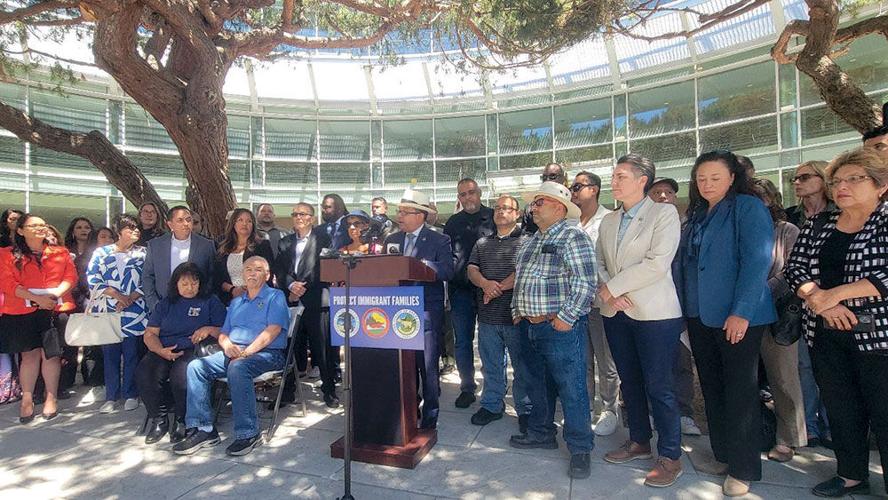
Elected officials and community leaders from Monterey, San Benito and Santa Cruz counties held a joint press conference on June 16 to demonstrate their support for immigrant residents.
Beyond frustrations, some business leaders report more tangible, if subtle changes. Both Alejandro Chavez, Salinas United Business Association’s executive director, and Colleen Bailey, president of Salinas Valley Chamber of Commerce, say business owners report slower foot traffic. In recent days, “Alisal was about as empty as I’ve seen, probably not since Covid-19,” Chavez says.
They cite factors including immigration policy and tariffs, and business is down as much as 30 percent. “Many long-standing businesses are talking about shutting down this year,” Chavez says.
At Taqueria Las Fuentes in Greenfield, a business that has been running for 23 years, sales are down at least 20 percent, says owner Carmen Barron. She notes current sales are lower than during pandemic times, when restaurants could only sell takeout. “This time is worse,” she says in Spanish. On Sundays they sell menudo, a soup that used to sell out regularly; now, they sell just 50-70 percent of the 70 pounds they prep every week.
Barron adds that along El Camino Real, where there are various businesses including hair salons, markets, bakeries and restaurants, foot traffic is slower than usual. She has asked customers about it, and they say their relatives don’t want to go out because they are afraid of ICE being in their community.
Adela Álvarez works in early childhood education with Door to Hope across the county, including in King City, Greenfield and Pajaro. She says in Spanish that her groups, usually 10-12 moms and their children, have dwindled to two or three moms. “Sometimes I get to work and there is no one,” Álvarez says. In Pajaro, she says that instead of moms bringing their children, older brothers and sisters who are U.S. citizens are now bringing their younger siblings to the play group.
It’s hard to quantify fear. But in interviews, immigrants (whose names have been changed in this story at their request to protect them from possible repercussions) in Monterey County share the ways in which their lives have changed, both big and small.
ISABEL, 21, AN UNDOCUMENTED INDIGENOUS FARMWORKER, has lived in Greenfield with her husband and two sons, 2 and 6, for the past three years. Only the younger son is a U.S. citizen.
Isabel and her husband have previously worked six days a week in the Salinas and Pajaro Valleys and Gilroy harvesting lettuce. Their commute begins around 1am or 2am when the sky is still dark. “We leave early. We don’t feel comfortable leaving our children at home and seeing if we would come back or not,” Isabel says in Spanish. “We go with fear to work.”
The fields are now no longer just her workplace, but the last place Isabel might see if she’s taken away from her family. Working in darkness and in an open field makes her feel like an easy target.
“It’s difficult,” she says. Instead of focusing on work and family, she says her mind is full of fear.
Since the new administration started and ICE detentions have drawn public attention in Monterey County, Isabel and her husband stopped commuting further than Watsonville, fearing possible raids. She adds that sometimes only one-third of the workers come to work for the same reason. “A lot of people don’t show anymore,” she says.
Their family routine has also changed. They now stay home instead of going out on weekends. Before, Isabel and her family had picnics at Lake Nacimiento or the beach in Monterey or Carmel. “The kids want to go out,” Isabel says. “We explain to them what’s going on and they understand.”
Isabel and her husband have discussed possible self-deportation. One idea is for her to return to Mexico with both kids; that way they can leave on their terms.
Isabel isn’t fond of that option, because their kids won’t have the same opportunities to succeed in Mexico. (Nearly 20 percent of Mexicans identify as Indigenous, but only 1 percent attend college. According to the National Council for the Evaluation of Social Development Policy, known as CONEVAL by its Spanish acronym, 4 out of 10 Indigenous people of school age don’t go to school.)
Her oldest, who was born in Mexico, will start first grade this year: “I want him to study. To get a good job.”
CATALINA IS A LONG-TIME SEASIDE RESIDENT AND BUSINESS OWNER, WITH STORES IN SEASIDE AND WATSONVILLE.
Her husband, formerly a day laborer who would get gigs at Home Depot, now manages the Watsonville store. They both work seven days a week, and are the parents of three children, ages 23, 18 and 12.
Catalina says her life hasn’t changed despite current immigration enforcement policy. But her account of some regular habits, like grocery shopping, show subtle ways in which it has.
In July, a man in uniform came into the store and looked at the crafts on display. “Son of a gun! It is going to be someone from immigration,” she says she thought of the customer. “I wanted to run away or ask him, ‘Are you leaving?’” It turned out the uniformed man was a teacher at the Presidio of Monterey.
Catalina adds that she only goes out when necessary, such as buying groceries, and she never goes at the same time – she may shop in the morning one week, in the evening the next.
Many immigrants migrate to the U.S. looking for the American Dream and to provide a better future for themselves and their families.
“All the undocumented people who are here, they come to work. We didn’t come to take anything from anyone,” Catalina says. “I assure you, this country wouldn’t be anything [without us]. Undocumented workers are the ones who do the work.”
In June, the Bay Area Council released a report noting mass deportation could have a $275 billion economic impact in California, affecting different industries.

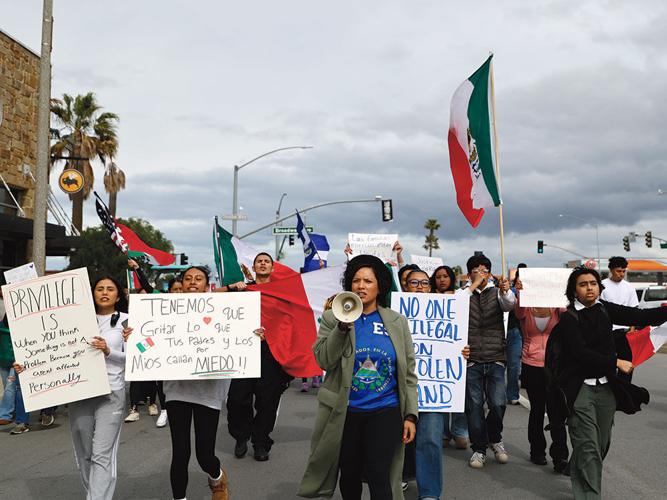
About 200 people marched in Seaside on Feb. 3 in support of “A Day Without Immigrants,” a nationwide movement that encourages immigrants to skip work, school or shopping to highlight the importance of immigrants’ contributions in the United States, and to protest against President Donald Trump’s immigration policies.
Over 25 percent of agricultural workers are undocumented, and 26 percent are construction workers, and according to the report, those industries would contract by 14 and 16 percent, respectively.
According to the same report, 1 out of 5 immigrants in California are undocumented, roughly 2.3 million people accounting for 8 percent of all workers in the state. They also contribute about 5 percent of California’s gross domestic product and contribute over $23 billion annually in local, state and federal taxes.
In Monterey County, nearly 128,000 immigrant residents paid $850 million in taxes and have $2.5 billion in spending power, according to the American Immigration Council. There are 6,764 immigrant entrepreneurs.
As of 2013, the most recent date when such estimates were released, 62,000 immigrants in Monterey and San Benito counties were believed to be undocumented.
Even unconfirmed rumors about the presence of ICE have caused panic. Adriana Melgoza is executive director of the Watsonville Law Center and a leader of the Solidarity Network, a volunteer-led rapid response group of legal observers who monitor immigration enforcement activities in Monterey County. She says rumors affect workers emotionally and financially. In one case, when ICE was not even present, she says a farmworker spent 45 minutes hiding under strawberry boxes.
“That is really heartbreaking,” Melgoza says, “to hear that a worker who’s just working, who is out there trying to make a living, is hiding under boxes because of fear.”
AS ICE RAIDS SHOOK LOS ANGELES EARLIER THIS SUMMER, the response to anti-ICE protests in Los Angeles was militarized. Then U.S. Senator Alex Padilla was forcibly removed from a U.S. Department of Homeland Security press conference in Los Angeles on June 12.
A few days later, more than 40 officials from Monterey, San Benito and Santa Cruz counties and business industry leaders gathered for a press conference to express support for the immigrant community locally.
“ICE operations have torn families apart and targeted immigrant workers, including farm workers. These actions are not just unjust, they are often unconstitutional, violating due process and civil rights in ways we simply cannot accept,” County Supervisor Luis Alejo said. “If it’s happening there, it can happen here, and it could happen to any of us.
“Immigrant workers are the backbone of our local economy, from our fields to our hotels, our restaurants, our construction sites and our child care and elder care facilities. Their contributions are essential in so many ways.”
Last year, anticipating the rollout of Trump’s policies, the Monterey County Board of Supervisors approved an ad hoc committee focused on immigrants’ rights, focused on providing information and resources to the undocumented community in Monterey County.
“When this issue is talked about on the national scale, they’re talked about as if these are just people somewhere else. But when local residents start seeing this could be our neighbors, our coworkers, friends or your family members, the perception from the public on this issue will change dramatically,” says Alejo, who serves on the committee.
After ICE arrests, ICE media officials send out press releases via email with detainees’ photos and alleged crimes and strongly worded headlines such as “ICE Arrests Worst of Worst Criminal Illegal Aliens” or “ICE Arrests Murderers, Pedophiles, and Rapists Over the Weekend.”
In reality, most immigrants who are detained don’t have criminal records. According to the Department of Homeland Security’s own data, of 56,945 detainees, only 28 percent have a criminal conviction.
According to tracreports.org, a database created by Syracuse University, the top five nationalities with the most deportation orders are from Latin America; Mexican immigrants lead with 77,935 deportation orders as of June. (ICE officials did not respond to a request for comment.)
“This administration’s deportation policy is beyond targeting violent criminals and now is sweeping up immigrants who contribute to our economy and communities,” says U.S. Rep. Jimmy Panetta, D-Carmel Valley. “Not just on the Central Coast of California, but also throughout the nation, there are many immigrants who have taken risks to come here, contribute here, do jobs here that few, if any, Americans will do in agriculture, construction, hospitality, nursing care and more, and help make our community.”
The immigration court’s backlog consists of 3,461,637 cases as of June; of those, 2,209,097 have filed an asylum application and are awaiting a hearing.
PABLO, A FORMER STUDENT-ATHLETE, works as a freelance photographer and is a DACA recipient (Deferred Action for Childhood Arrivals). He’s been in the States since he was 4 years old and his memories from Mexico are of his grandma, who took care of him since he was a baby, and blurred images of his goodbye party before moving to California from the Mexican state of Hidalgo. He lives with his parents, both undocumented farmworkers, and his two siblings in a two-bedroom home in Salinas.
Pablo was in high school when he applied for a work permit and first learned about his immigration status. “I knew I was born there [in Mexico], but I just didn’t know that I didn’t have that freedom as a citizen to work or to have all the benefits,” he says.
Having a work permit motivated him to pursue higher education and study at a university out of state with a full-ride scholarship. It was his first time on a plane.
Pablo has completed his DACA application paperwork multiple times. His most recent permit expired in July and his new permit hasn’t arrived yet; that means currently he is undocumented and more vulnerable to deportation.
He applied two months prior to the expiration date, while U.S. Citizenship and Immigration Services recommends allowing four to five months. “I made a mistake there,” Pablo says of the timing.
“This is how it feels with my parents. Now I’m afraid, so now I know what it feels like,” he adds. (If his DACA renewal application is still pending after 105 days, he can inquire about his application or request congressional intervention if it’s delayed.)
After the raids in Southern California were followed by a scare about a possible ICE raid when multiple agencies served a search warrant on a cannabis farm near Pajaro (an investigation that turned out to be purely focused on alleged state crimes), Pablo is more attuned to risk. He now calls his parents every workday if they aren’t home by 6pm.
His first language was Spanish but it’s no longer his primary language. Despite living in the U.S. most of his life and speaking primarily English, he says it doesn’t feel like home. “I don’t feel welcome because of the color of my skin,” he says.
“I don’t know where I’m from, to be honest. If I go to Mexico, I have no clue. I haven’t been there since I was 4… I feel like I would feel more welcome, because I would be free to go out and not be detained by ICE or anyone. I don’t feel free.”
On July 29, he drove to Southern California for unpaid photography gigs in San Diego and Los Angeles (both hot places for ICE activity). He hopes this assignment opens the door for paid work.
“I am scared, but I did my research. Chat GPT is usually my lawyer,” Pablo says. He’s bringing his driver’s license, which expires in 2027, along with his receipt showing his DACA application is pending and letters showing he’s a good citizen.
“I was about to say no to this opportunity that came. I feel like those opportunities are hard to get, and I don’t want to be that person who changes because of a fear of something. I still want to live my life.”
Despite not being in Mexico since he was 4, Pablo isn’t too scared of potential deportation. He has family there and a bachelor’s degree. “I could probably get a job being an English teacher. I don’t know how hard it is,” he says. “I have experience with food photography. I can go to restaurants and maybe just ask for a few bucks.”
Pablo has stopped paying attention to proposed legislation to provide pathways for citizenship and legal permanent residency. When he was younger, he used to check the news regularly, hoping for immigration reform and felt disappointed when nothing materialized. “When you’ve seen it so many times, it doesn’t even hurt anymore,” he says.
THE LAST COMPREHENSIVE IMMIGRATION REFORM HAPPENED NEARLY 40 YEARS AGO. Since then, lawmakers have introduced several bills for a path to legal status and citizenship, but none have moved forward.
“People are surprised if you’re married to an American citizen, people just assume that you can get your legal residence. Not always the case. If you entered the United States without inspection at the land border, you never get your residency,” says U.S. Rep. Zoe Lofgren, D-San Jose, who was previously an immigration lawyer.

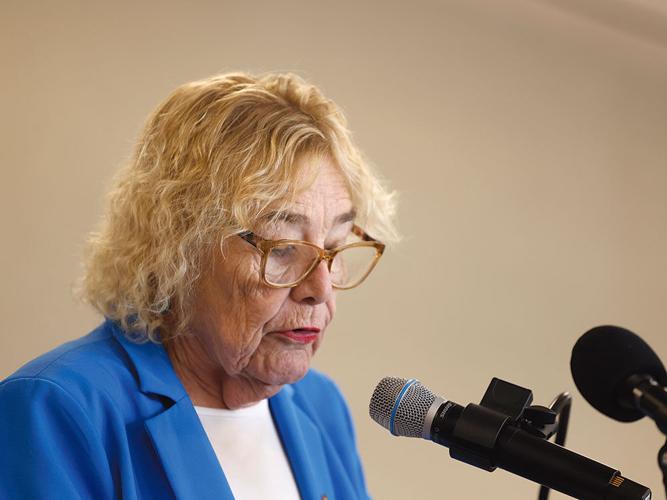
U.S. Rep. Zoe Lofgren, D-San Jose, announced a proposal to create a pathway to citizenship on July 25. The bill, unveiled at the Watsonville Civic Plaza, aims not to reinvent the wheel, but rather to update existing legislation.
This year, lawmakers have introduced two options to obtain legal status: work permits for undocumented workers and a path to legal permanent residency, or a path to citizenship.
The Dignity Act of 2025 is a bipartisan bill introduced by Rep. Maria Elvira Salazar, R-Florida, on July 15 and co-sponsored by Rep. Veronica Escobar, D-Texas. It seeks to increase border security and it would provide a path to legal permanent residency. It would give undocumented immigrants a work permit and protection from deportation. Dreamers/DACA recipients, who entered at 18 or younger by Jan. 1, 2021, could apply for a 10-year permit with a path to legal permanent residency; DACA is a two-year permit. It would benefit about 2.5 million Dreamers; 525,000 of them are DACA recipients. It also criminalizes illegal crossing with prison time of up to 10 years, and 20 years for individuals deported three or more times.
The other option is to create a path to citizenship. On July 25 Lofgren, along with representatives Grace Meng, D-New York; Adriano Espaillat, D-New York; and Rep. Jesús “Chuy” García, D-Illinois, reintroduced the Renewing Immigration Provisions of the Immigration Act of 1929, or H.R. 4696. It would update the Immigration and Nationality Act, also known as the registry, by changing the cutoff date for permanent residency. Padilla also reintroduced a similar bill in the Senate.
The registry provision would allow immigrants who have resided in the U.S. for several years to apply for residency if they have a clean record.
The last time this provision was updated was in 1972. Then during the Reagan administration, nearly 2.7 million people obtained legal permanent residency through the Immigration Reform and Control Act of 1986.
“It has not been updated since that time, which is very problematic for the United States,” Lofgren says. “We’re seeing armed, masked agents, refusing to identify themselves, tackling and disappearing people all over the United States. That’s having an impact on families, on communities… [on] the economy.
“The Central Coast economy is rooted in agriculture. More than half the farmworkers are undocumented. If they are disappeared, the economy of this area will collapse.”
The bill would provide a path to citizenship for people who have various immigration statuses and skill sets, from youth, farmworkers and professionals.
The renewal would allow immigrants who have lived in the United States for seven years to apply for a green card and the law would have a rolling date, meaning it would update itself without needing new legislation.
Lofgren says the bill would benefit residents of various immigration statuses and it would prevent the U.S. from shrinking its workforce in key industries like healthcare and agriculture.
WHILE ALL OF THIS LEGISLATION IS PENDING IN A PARTISAN CONGRESS, people in Monterey County continue living and working. Nearly 30 percent of the population is foreign-born. The new normal for many of them is carrying around their documents, especially if they fit ICE’s perceived target: brown people.
While there aren’t many cases of people detained randomly in Monterey County – the Solidarity Network reports at least two people have been detained randomly, rather than in targeted ICE actions – some people are taking preventive measures in case they cross paths with ICE agents.
“Since this is racially motivated, I’m carrying my passport with me,” Natalie Portillo says in Spanish. Portillo’s husband, Juan Carlos “JC” Portillo, long worked as a manager at Wild Fish restaurant in Pacific Grove. He was detained by ICE during a regular immigration check-in in June. (According to an update on July 11 on a GoFundMe page to aid his family, Portillo Contreras was deported to El Salvador and is staying with extended family.)
Carmen, 35, is a DACA recipient and mother of five who has lived in California for 23 years. She works with undocumented farmworkers across Monterey County.
Carmen, who is Mixteco, says she feels a little more protected because she has a work permit, but she worries her brown skin increases her chances of being detained. “I always try to bring my ID and if I forget it, I’ll go back for it,” she says. She now brings her driver’s license, work permit and Social Security card everywhere.
ELENA IS A NATURALIZED CITIZEN WHO LIVES IN SEASIDE AND WORKS IN EDUCATION. Her family has mixed immigration status. Her husband, Mateo, is undocumented and their three kids, all under 10, are U.S. citizens.

Protesters at the No Kings rally in Monterey in June had a message about immigration enforcement.
She says she never thought the path to fix her husband’s status would be so lengthy.
They started the process to regularize his immigration status as soon as they got married 10 years ago; after talking to different lawyers, the only option they have right now is for him to wait 10 years in Mexico before continuing with the process (Mateo has a clean record and has crossed the border illegally twice.)
“‘I didn’t get married to be a single mom,’ is what I always say. And we don’t think going back is the safest thing for our family,” she says. “We’re just kind of in limbo, hoping the law changes at some point for him to be able to avoid that step.
“My husband didn’t do it the right way, but I think the circumstances make people make decisions sometimes that aren’t necessarily thought out,” she says, noting her husband was just 17 when he crossed the border, on foot, through the desert. “I don’t think he ever really thought he would be living here permanently.”
They have kept their kids in the dark about his immigration status. “My kids are not of age to really understand the situation, so they don’t know that he’s not here legally. That adds another layer to the complexity of the topic,” she says.
While the couple has discussed potential options in case ICE detains him, they currently don’t have a plan in place.
If he is deported, Elena says her life would be more challenging, but “I have a support system here. I have my family,” she says.
While many aspects of their daily routine remain the same, they are staying away from crowded places, including community events, street markets and avoiding visiting cities, like Salinas, that are predominantly Latino.
“I look as Mexican as it comes. I have an accent. I speak mostly Spanish everywhere I go. I would be a target for being picked up on the street,” she says. “Whether this administration wants to admit it or not, we are a target.”
(4) comments
One of the key issues Trump ran on was deportations. He won for a reason. Time to leave
Immigrants have nothing to fear. They applied for entry into our country at an Embassy or Consulate located in their country. Migrants on the other hand who snuck into the country do have legitimate fears. Once caught they face a ten year ban on returning for their first offense. There is a way out and without fear, self deportation. The government will give you and each family member $1,000.00 dollars and a plane ride home. Once home you too can apply for the American dream. To live in fear is a terrible thing. Take advantage of what America is offering you. Take advantage of the self deportation.
Thanks for this thorough article. Folks can find Child Safety Plans on the Sus Derechos website: https://susderechos.info/en/recursos/
Immigration is a touchy subject, but to me it boils down to following the law. Legal immigrants that are not in trouble with the law have nothing to worry about. Immigrants here that have avoided the proper path are breaking the law and certainly have a right to be afraid as well as green cards that have a criminal record. I people are here legally have nothing to worry about. Some people in the article even admit they didn't do it right, but still for some reason think the USA owes them the right to stay. Norm Groot and Jimmy Panetta need to get on board with the law. There have been and still are successful programs for bringing in farm workers from Mexico. It is unfair to the legal workers to allow them to be infiltrated with ones that are illegal. That's obviously going to make everyone uncomfortable.
Instead of fighting ICE why not cooperate with them? If local law enforcement cooperated they might find the atmosphere would be a little calmer. As former President Ronald Reagan one said "a country without borders is not a country." We should, and do, welcome legal immigrants. Afterall, almost all of our ancestors were legal immigrants.
Welcome to the discussion.
Log In
Keep it Clean. Please avoid obscene, vulgar, lewd, racist or sexually-oriented language.
PLEASE TURN OFF YOUR CAPS LOCK.
Don't Threaten. Threats of harming another person will not be tolerated.
Be Truthful. Don't knowingly lie about anyone or anything.
Be Nice. No racism, sexism or any sort of -ism that is degrading to another person.
Be Proactive. Use the 'Report' link on each comment to let us know of abusive posts.
Share with Us. We'd love to hear eyewitness accounts, the history behind an article.