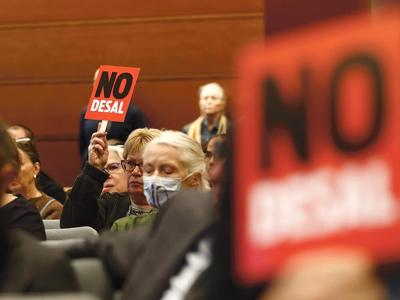

David Schmalz here. Having reported on water on the Monterey Peninsula for the better part of the last decade, it’s remarkable to reflect on what has transpired in that time: A political movement for public water, a political movement to stop Cal Am’s desal project in Marina, an innovative recycled water project and its expansion, and a conditional approval for Cal Am’s desal project, which is still being litigated on multiple fronts.
The Peninsula’s water demand has steadily dropped over that time while its legal supply continued to increase. Cal Am was finally able to stop its illegal overpumping of the Carmel River, and with the completion of Pure Water Monterey’s expansion coming later this year, the Peninsula’s annual supply will be over 12,000 acre-feet, according to the Monterey Peninsula Water Management District’s estimates.
How much supply there is, and how much demand there will be by 2050, are among the things still being debated regarding Cal Am’s desal project (per a condition of approval from the California Coastal Commission). It was finally scheduled to be voted upon by the California Public Utilities Commission at a meeting in Sacramento tomorrow, June 12. Late yesterday, Commissioner Darcie Houck, who’s presiding over the proceeding, pulled it from tomorrow’s meeting and rescheduled it for June 26.
To circle back to what the CPUC is being asked to approve regarding the supply and demand: On May 9, after about a year of deliberation and analysis of public testimony, CPUC Administrative Law Judges Robert Haga and Jack Chang issued a proposed decision that largely sides with Cal Am’s estimates, and that puts the annual water demand for Cal Am’s service area at 13,732 acre-feet in 2050 and the current supply at 11,204 acre-feet.
The Peninsula’s demand in the last water year was shy of 9,000 acre-feet. If our current demand is at least 2,000 acre-feet less than our current supply, why build a desal project?
The judges, in their proposed decision, believe the Peninsula’s annual water demand will grow nearly 5,000 acre-feet—from just under 9,000 acre-feet now—in the next 25 years. Plenty of observers are skeptical about that growth projection, including Public Water Now Managing Director Melodie Chrislock, who submitted testimony asking the commission to adopt a lower projected demand figure of 10,500 acre-feet.
“Growth happens slowly over decades,” she wrote. “It is not realistic to expect that 49,400 people or 52-percent more population will be added to the 95,000 that currently live and work on the Peninsula in the next 25 years. This simple observation should serve as a reality check on Cal Am’s inflated 2050 demand forecast.”
Watchdog groups are encouraging people to call in to the CPUC’s meeting tomorrow—even though considering supply and demand has been moved to June 26—to speak up during general public comment to oppose the proposed decision’s estimates (English: 1-800-857-1917, passcode: 9899501#; Spanish: 1-800-857-1917, passcode: 3799627#, queue starts at 10:30am).
The whole purpose behind these efforts has been to lift the state’s cease-and-desist order that prohibits Cal Am from setting new water meters. But it’s the State Water Control Board that decides that, and maybe the supply and demand proceeding will impact that somehow.
Who knows. I’ll just say, that as someone who’s covered this for so long, the layers of bureaucracy, and all the twists and turns, don’t become less confusing over time, and it’s perhaps even the opposite.


(1) comment
David, thanks again for tracking this long and winding water saga. But let’s be honest: while Cal Am’s desal project keeps lumbering forward — bloated, litigated, and tied to a demand forecast that reads like fiction — there’s a better solution already being developed from the ground up. It’s called the Brackish Groundwater Restoration (BGR) Project, and it’s being led by the Salinas Valley Basin Groundwater Sustainability Agency.
Here’s what makes it different — and better:
* It’s publicly led, publicly funded, and accountable. No private shareholders. No investor payouts buried in your water bill.
* It uses existing brackish aquifers — not pristine coastal waters — turning a degraded resource into a sustainable supply.
* It’s part of the region’s SGMA compliance plan, targeting the collapsing 180-400 Foot Aquifers — where seawater is already intruding inland from Davis Road toward the ocean.
The project is already state-funded through DWR’s SGM Round 2-S grant, and it’s being developed to match federal Title XVI standards — a smart move for future funding.
It’s now moving into CEQA environmental review — not cleared yet, but under way. This isn’t fantasy. It’s real planning.
And it’s built for the right communities: Salinas, Marina, Castroville, with the potential — if scaled right — to serve the Peninsula, South Santa Cruz, or anyone else who wants to connect.
Contrast that with Cal Am’s project:
* It depends on a 52% population boom that nobody credible expects.
* It has no benefit to Marina, the community it disrupts.
* It’s been rejected locally, challenged legally, and built on decades of public distrust.
The BGR project could be a win-win — solving today’s groundwater crisis and building regional resilience for decades. But we don’t need to wait 15 years. With urgency and political will, it could be built in 3 to 6.
Let’s deep-six the desal plant that solves a political problem and support the project that solves an ecological one.
Welcome to the discussion.
Log In
Keep it Clean. Please avoid obscene, vulgar, lewd, racist or sexually-oriented language.
PLEASE TURN OFF YOUR CAPS LOCK.
Don't Threaten. Threats of harming another person will not be tolerated.
Be Truthful. Don't knowingly lie about anyone or anything.
Be Nice. No racism, sexism or any sort of -ism that is degrading to another person.
Be Proactive. Use the 'Report' link on each comment to let us know of abusive posts.
Share with Us. We'd love to hear eyewitness accounts, the history behind an article.