
David Schmalz here. There’s a lot going on in the world right now, and in the chaos it can be hard to focus on the brass tacks.
But ultimately, it’s the details that matter when it comes to governance, and that’s very much the case when it comes to our local water supply, regardless of where you live in the county.
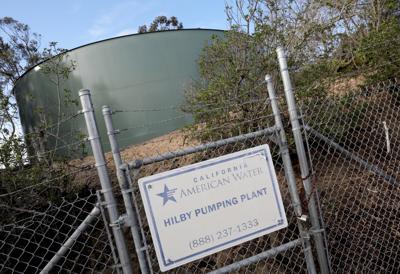
Those brass tacks have long been a contentious issue on the Monterey Peninsula. Since 2009, the Peninsula’s private water utility, investor-owned Cal Am, has been unable to set new water meters because of a State Water Board imposed-cease-and-desist order related to Cal Am’s illegal overpumping of the Carmel River.
Meanwhile, the housing crisis has worsened considerably in the years since, as there’s mostly been a freeze on building new housing.
Cal Am ratepayers have long been paying some of the highest water rates in the country, so much so that those rates inspired a political movement, Public Water Now, that ultimately led to voters in Cal Am’s service area, in 2018, empowering the Monterey Peninsula Water Management District to buy out Cal Am’s local system and take over as the water provider.
As someone who’s reported on this topic for a decade, it’s been interesting to see who supports what side, whether it be public ownership or the continued ownership by Cal Am. They’ve somehow broken down along partisan lines—Democrats for public water and Republicans for Cal Am. Why? I still don’t fully understand it.
Reporting on water over the years, particularly on the Peninsula, has been a continual challenge because there are always things playing out behind the scenes but little happening in public, except for hearings held by various government agencies or in the courts.
Right now, before there’s any decision on whether to lift the cease-and-desist order against Cal Am as the expansion of the Pure Water Monterey recycled water project comes online—which will arguably provide the region with enough water for decades—the California Public Utilities Commission, which regulates Cal Am, is considering whether to approve Cal Am’s proposed rate structure.
Because Cal Am is a utility operating in the absence of competition for the product it delivers—water—the CPUC must approve any sort of rate increase, and on Aug. 27, Administrative Law Judge Jacob Rambo filed a proposed decision that would reject Cal Am’s proposal, which seeks to increase its revenues for water service by $55,771,300, or 18.71 percent, in the year 2024, by $19,565,300, or 5.5 percent in the year 2025, and by $19,892,400, or 5.3 percent, in the year 2026.
Here’s the rub: all that money would be passed on to ratepayers regardless of how much water they use. Surcharges would be added to bills to make up for the difference in how much water Cal Am projects its ratepayers will use and what they actually do use.
So, there’s a perverse incentive built into the model to make outsized projections in demand and then collect the difference later. Why wouldn’t Cal Am—a business in pursuit of profit—overestimate the future water demand if doing so is profitable?
On Oct. 3, the CPUC’s Public Advocate Office—an independent branch of the agency that advocates for consumers—put out a statement in support of the proposed decision, highlighting the perverse incentives.
But after talking today with Dave Stoldt, general manager of the Monterey Peninsula Water Management District, he’s hearing from the MPWMD’s legal counsel that a similar rate case with another private utility, Golden State Water, is up for consideration on Dec. 2, and coupled with lobbying from Cal Am, he thinks the scales may have tipped to continue allowing private water utilities to not suffer financially for making outsized projections in water demand—that they can still tell the state how much water ratepayers are going to use, and whether or not Cal Am is right, the company will still get paid in full.
Judge Rambo, therefore, might change his decision.
“It has all the flavor of a regulator that finally does something that might finally benefit the ratepayer, but then it’s going to get overturned anyway,” Stoldt says. “The man wins another one.”
Welp.


(0) comments
Welcome to the discussion.
Log In
Keep it Clean. Please avoid obscene, vulgar, lewd, racist or sexually-oriented language.
PLEASE TURN OFF YOUR CAPS LOCK.
Don't Threaten. Threats of harming another person will not be tolerated.
Be Truthful. Don't knowingly lie about anyone or anything.
Be Nice. No racism, sexism or any sort of -ism that is degrading to another person.
Be Proactive. Use the 'Report' link on each comment to let us know of abusive posts.
Share with Us. We'd love to hear eyewitness accounts, the history behind an article.