


“Who thought they would go into the San Andreas Fault today?”
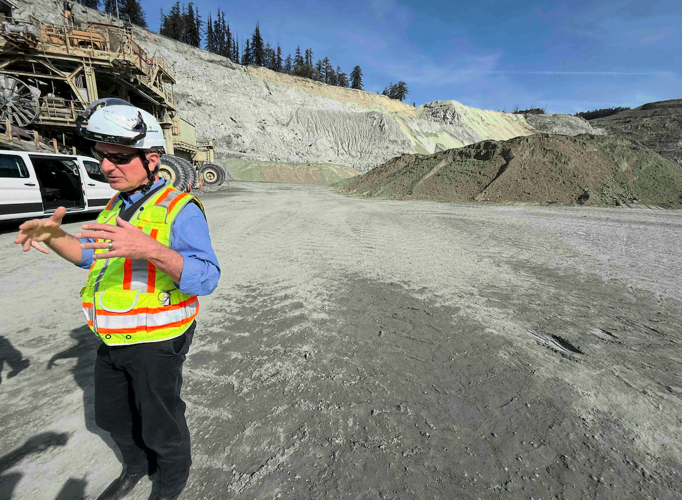
Erik Chalhoub here, thinking back to this question Keith Severson, marketing director at Graniterock, posed as he drove a van with myself and other members of the media into “The Pit,” the affectionately named area of the A.R. Wilson Quarry in Aromas where the main mining activities take place.
After alerting workers of our presence via a walkie-talkie, Severson steered the van down a road, 120 feet below sea level, into a world that resembles the moon more than the Earth.
Graniterock invited the media on Friday, Feb. 21 for a tour of its quarry, situated near the convergence of Monterey, San Benito and Santa Cruz counties, to celebrate the 125th anniversary of the company’s founding, right on this chunk of land.
Arthur R. Wilson founded what was then a small granite quarry in Aromas on Valentine’s Day in 1900, which has since become the largest crushed rock quarry west of the Mississippi River that supplies the company’s work in building highways, bridges, airports and other public infrastructure throughout the state. About 100 people are employed at the quarry.
Before we hopped into the van, Severson and Graniterock’s communications director Shanna Crigger handed us a hard hat, reflective vest and safety goggles before turning on a safety video—it’s important for visitors to stick with their tour guide “like a school of fish,” Severson says, and not wander off on their own.
Safety is “before all else,” according to Graniterock’s primary objective, and a large sign at the entrance to the quarry notes how many days the site has gone accident-free. In this case, it was 54 days, and Severson says prior to that it was more than two years (an “accident” is referred to an incident that requires a worker to miss time).
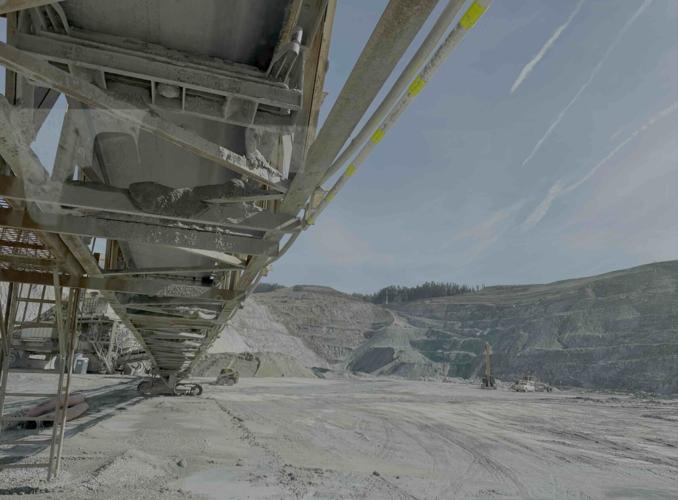
As we passed by stacks of massive earth-mover tires (about $40,000 a piece, according to Severson) and more than a mile of a conveyor belt that transports mined rocks to the processing facility, we parked by Graniterock’s primary crusher, known as The Krupp that sits in The Pit, a four-story piece of equipment that can consume 3,000 tons of rock per hour. Manufactured in Germany in 1985, it was at one point the largest mobile rock crusher in the world.
It’s here where Graniterock mines a vein of granite used to make hundreds of different products, as well as concrete and asphalt. If you’ve driven on a paved road or walked on a sidewalk in Monterey County, you’ve likely touched the granite pulled from Aromas.
Severson says blasts happen in the quarry about once a week, using ammonium nitrate. Blasts, which register about a 1.0 on the Richter scale, happen so far below sea level that neighbors likely won’t feel it.
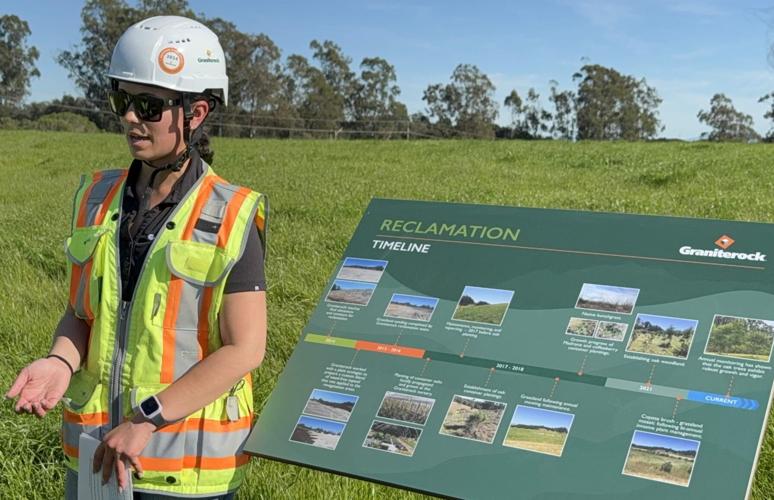
Our tour ended at a much more peaceful area on the other side of the quarry, where native grasses and oak trees thrive on a 22-acre portion of land adjacent to the 15,000 humming solar panels that powers 60 percent of the mining operations.
In 2022, Graniterock celebrated the completion of its $15 million, 5.3-megawatt solar farm, which came about from a conversation with local environmental activists, combined with an existing 1-megawatt farm.
Across from the solar panels, the land where native grasses grow was once a site for spreading “overburden,” which was the material removed from the quarry to get to the granite underneath. Jacquie Borges, an environmental engineer for Graniterock, says work to reclaim the land started in 2007, with most of the plants grown in the company’s greenhouse in Aromas.
Aromas may seem like a sleepy town to a visitor, but dig deeper (pun intended) and you’ll find that it’s been at the center of what keeps the state moving for 125 years—and for decades to come.


(0) comments
Welcome to the discussion.
Log In
Keep it Clean. Please avoid obscene, vulgar, lewd, racist or sexually-oriented language.
PLEASE TURN OFF YOUR CAPS LOCK.
Don't Threaten. Threats of harming another person will not be tolerated.
Be Truthful. Don't knowingly lie about anyone or anything.
Be Nice. No racism, sexism or any sort of -ism that is degrading to another person.
Be Proactive. Use the 'Report' link on each comment to let us know of abusive posts.
Share with Us. We'd love to hear eyewitness accounts, the history behind an article.