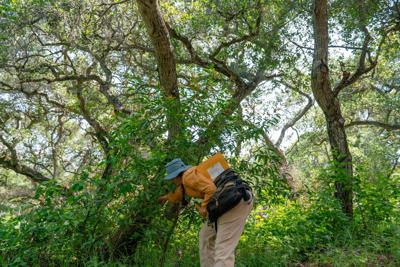

Sara Rubin here, trying to see the forest for the trees, quite literally. Reading a news story by Staff Writer Katie Rodriguez in the April 23-29 edition of the Weekly made me think about each individual oak tree and bay tree in context.
Rodriguez’s focus is on the impacts of a pathogen called Phytophthora ramorum, more commonly known as sudden oak death (although, as she notes, the name is somewhat misleading—it is neither sudden nor certain death). It is a big, regional, forest-scale problem, one that has killed some 60 million oak trees already, and a new, more aggressive variant of the pathogen known as NA2 emerged a couple of years ago.
But her story is not just about this deadly disease; it’s also about how citizen science has helped advance our understanding of SOD. Rodriguez joined a team of volunteers, led by researcher Kerri Frangioso of UC Davis and Cal Poly, when they dispersed throughout Carmel Valley last weekend to look for evidence of SOD.
After Frangioso guided volunteers on what to look for as they went out to various points to collect samples, she invited Rodriguez to follow her on her own collection route in Garland Ranch Regional Park. Rodriguez describes accompanying the Big Sur resident on a beautiful hiking route, slower than a typical hike due to scanning constantly for damaged bay leaves. Of course Frangioso, the expert, knows what to look for so can move quicker than a new volunteer.
Of past samples collected this way, Frangioso said, “We’ve learned so much from this data. Citizen scientists are also so good at collecting data. There’s no way that scientists can collect all that every year on their own.”
Even when what the data reveals might be rather depressing, I am reminded by reading this story of something broader (hence the forest for the trees—this topic begs me to belabor the metaphor!). All of us can be active participants in scientific inquiry. It is not limited to white-coated experts in ivory towers. Sometimes science is conducted by ordinary people in their walking shoes, who can help us understand the world we live in.


(0) comments
Welcome to the discussion.
Log In
Keep it Clean. Please avoid obscene, vulgar, lewd, racist or sexually-oriented language.
PLEASE TURN OFF YOUR CAPS LOCK.
Don't Threaten. Threats of harming another person will not be tolerated.
Be Truthful. Don't knowingly lie about anyone or anything.
Be Nice. No racism, sexism or any sort of -ism that is degrading to another person.
Be Proactive. Use the 'Report' link on each comment to let us know of abusive posts.
Share with Us. We'd love to hear eyewitness accounts, the history behind an article.