
Katie Rodriguez here, reflecting on a conversation I had with a man named Reggie Austin, a talented pianist who was performing at Mac’s at 19 Broadway, a jazz bar in Marin, in 2021. The bar had a speakeasy feel—quiet chatter, low light, an excellent Manhattan. After his set finished we got to chatting about his life, which I had learned a bit about from a documentary I saw a few days earlier.
After serving 35 years at San Quentin State Penitentiary, Austin was granted parole in 2015 and spent tough years following trying to build a new life. He succeeded, thanks to determination, those who saw promise in him and his deep love of music. I still think often about that conversation and the documentary, Life & Life, about issues with the prison system and how music became his bridge to the future. He spoke of relearning basic things—cooking, paying bills, booking appointments—while navigating a world with no family and a tainted past.
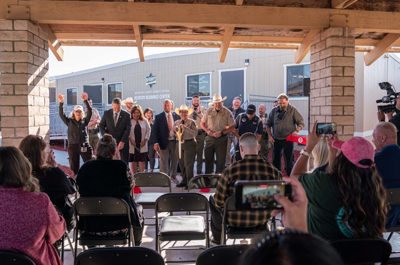
Austin’s story is one of many, and came to mind this morning, Oct. 23 as I attended the grand opening of the new Re-Entry Resource Center at the Monterey County Jail. Though Austin served decades in prison, and most in jail serve far shorter terms, the challenge of returning to society follows similar themes.
Charles De Silva, director of programs at the Monterey County Sheriff’s Office, opened the ceremony, saying, “This is a big day for the Sheriff’s Office,” standing before the new center. The Sheriff’s Office was able to complete this project with a $5 million CalAIM JI grant and an additional $1.66 million from its approved budget.
“Today’s ribbon cutting is much more than a ribbon cutting—it’s the beginning of breaking down barriers people face when returning to their communities,” adds Sheriff Tina Nieto.
Before the center opened, De Silva explains that reentry preparation existed but lacked structure and comprehensive support. Now, those within 90 days of release receive personalized assessments and reentry plans—help with addiction recovery, housing, and help with connecting to external services via the resource center.
“[Before] they’d walk out with a plastic bag, their clothes, and 10 phone numbers,” Nieto says. “The resource center gives you one phone number to call. It’s a one-stop shop to help people reenter society.”
Following the ceremony, a job and resource fair brought together nonprofits to assist with employment, accessing food and clothing, and addiction support to a group of inmates, some nearing discharge and others still serving time but showing promise.
“Please take advantage of this. I don’t want to see you in here again,” Nieto said with a warm but stern undertone to the group inside the Monterey County Jail. “I want you to go back into the community and be a good aunt, uncle, neighbor. Whether you like it or not, you are part of the Monterey County community.”


(0) comments
Welcome to the discussion.
Log In
Keep it Clean. Please avoid obscene, vulgar, lewd, racist or sexually-oriented language.
PLEASE TURN OFF YOUR CAPS LOCK.
Don't Threaten. Threats of harming another person will not be tolerated.
Be Truthful. Don't knowingly lie about anyone or anything.
Be Nice. No racism, sexism or any sort of -ism that is degrading to another person.
Be Proactive. Use the 'Report' link on each comment to let us know of abusive posts.
Share with Us. We'd love to hear eyewitness accounts, the history behind an article.