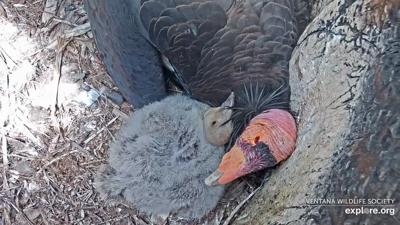

On June 18, a radio transmitter attached to a very special condor named Iniko began sending a mortality signal, prompting biologists to search for her last Wednesday, July 8.
Katie Rodriguez here, writing to share what happened on that mission after speaking with one of the biologists, Joe Burnett.
“When the bird doesn’t move for eight hours, it starts to beep twice per second,” Burnett explains. “Not what you want to hear.”
Burnett, the program coordinator and senior biologist for Ventana Wildlife Society's Condor Program, spent 12 hours in the field with fellow biologist Kara Fadden to try and locate Iniko. The best-case—but unlikely—outcome when responding to a mortality signal is finding the bird alive and getting it to emergency treatment.
Iniko’s story amassed a huge following over the years as she endured a series of extraordinary setbacks. A few months after hatching, she survived the 2020 Dolan Fire hiding away in a cavity of a redwood tree while her parents—dubbed the matriarch and the Kingpin of the Central California flock—perished. Then, she barely survived a fall from that tree after it was taken by a young male condor. After rehabilitation at the Los Angeles Zoo, she appeared to have thrived in the wild.
Condors can live 50-60 years. Iniko began breeding (although unsuccessfully) at the earliest age possible for a condor—6 years old. Based on her GPS data, she would fly far and wide, spanning hundreds of miles across San Luis Obispo up to the Bay Area.
But she called Big Sur’s backcountry her home. Ideal for a condor, less so for humans.
“Where Iniko was nesting, that’s no man’s land. You’re off the grid,” Burnett says. “I look at those condors and go, man. No wonder they're out here, it's really only a place a condor could go.”
Reaching her took weeks of planning. Their team had to secure access permission from property owners, coordinating with the U.S. Forest Service, and map possible routes that could get them to where Iniko was last detected.
I regret to say this story ends with the loss of Iniko, likely to lead poisoning although that has not been confirmed as they were not able to retrieve the body. Eight condors, including Iniko, have died this year—a high number for this point in the year.
Average mortality rates total around three a year. “We’re experiencing a number where they can’t sustain themselves,” Burnett says. More than half of those deaths are linked to lead poisoning, usually after condors consume carcasses of animals shot with lead-based ammunition.
There is a silver lining: Each mission is an opportunity to connect with new ranchers and hunters about the impacts of lead ammunition, something the Ventana Wildlife Society has conducted for years through its non-lead ammunition program. Generally the response from ranchers is positive, through this program they can receive free alternatives that can protect these keystone species and other raptors.
Still, Iniko’s loss continues to ripple for those who followed her story.
“We all rallied around her. I rallied around her as much as anybody,” Burnett says. “We looked at each other and were like, ‘What a great place. You know, if this is going to be her resting place, it’s pretty awesome knowing she was in her spot—that’s her territory.’”


(0) comments
Welcome to the discussion.
Log In
Keep it Clean. Please avoid obscene, vulgar, lewd, racist or sexually-oriented language.
PLEASE TURN OFF YOUR CAPS LOCK.
Don't Threaten. Threats of harming another person will not be tolerated.
Be Truthful. Don't knowingly lie about anyone or anything.
Be Nice. No racism, sexism or any sort of -ism that is degrading to another person.
Be Proactive. Use the 'Report' link on each comment to let us know of abusive posts.
Share with Us. We'd love to hear eyewitness accounts, the history behind an article.