
It’s within the 60-plus-year lifespan of a California condor that the entire species was on the brink of extinction.
In 1967, the first time the U.S. released a list of endangered species, the birds were critically endangered. By 1982, just 22 of them remained in the wild. Hoping to save North America’s largest flying bird from disappearing entirely, biologists began capturing the wild birds and by 1987, all known California condors were in captivity at zoos. Scientists began breeding them and a decade later, started releasing those young condors into the wild. Another decade after that, condors again started nesting in the wild in Central California.

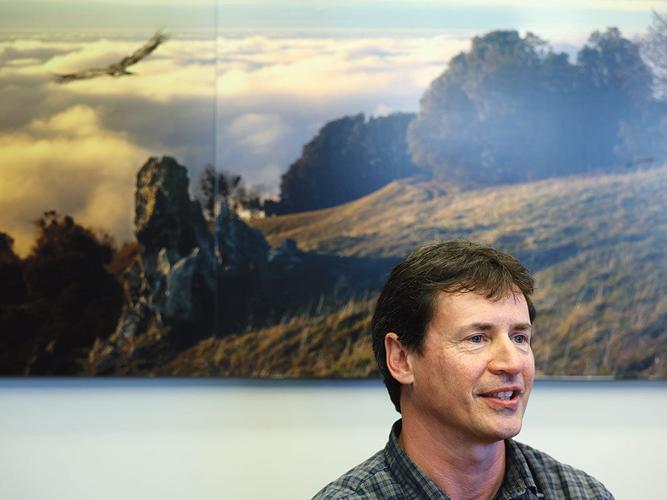
“I want to get to a point where we can say the population is growing on its own now,” Ventana Wildlife Society Executive Director Kelly Sorenson says of California condors. He believes that goal is within reach.
It was the beginning of a remarkable comeback story. Today, there are 117 condors in the wild on the Central Coast. (In three other populations, Arizona, Baja and Northern California’s Yurok tribal area, there are another 247 California condors.)
That is a success story that conservation organizations love to tell. But scientists see another milestone within reach – getting the California condor to be self-sustaining in the wild, instead of relying on human intervention of breeding in zoos and then releasing chicks as a continuously conservation-dependent species.
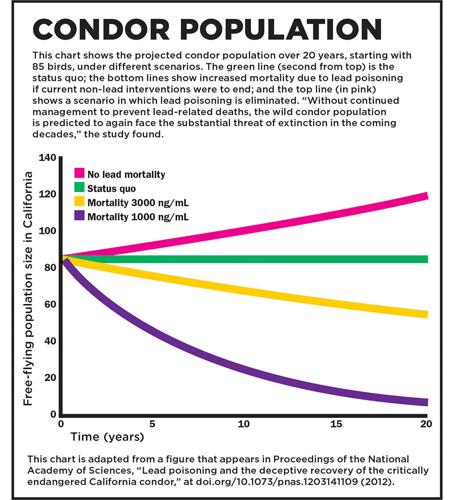
“It’s all about overall mortality. You want the population to be sustainable – you want more chicks in the wild to be born than to die,” says Myra Finkelstein, a professor of microbiology and environmental toxicology at UC Santa Cruz.
The condor success story so far has relied on the birth part of the equation. The death part is in the works, but solutions are surprisingly attainable. “Just reducing mortality by 1 percent could take the population from declining to slightly growing,” Finkelstein says.
Even modest growth could tip the scale for the species from reliant on human intervention to sustaining itself in nature, and being able to withstand catastrophic events like wildfires. (The 2020 Dolan Fire killed 12 condors.)
Even more encouraging for advocates is that there is a clear way to tip the scales, and the Monterey-based nonprofit Ventana Wildlife Society is leading the charge to get more non-lead ammunition to hunters.
BACK IN PREHISTORIC TIMES, CONDORS FLEW AND SCAVENGED ACROSS MOST OF NORTH AMERICA, feasting on the carcasses of big animals like woolly mammoths. The first recorded sighting by a European, Father Antonio de la Ascension, was documented in 1602. Two-hundred years later, Lewis and Clark saw a condor on their western expedition and described it as a “beautiful buzzard.”
Gymnogyps californianus outlasted other species by hundreds of thousands of years, but suffered in modern history from human-caused pressures. DDT damages condor egg shells, particularly precious in a species that usually lays one egg per year, and takes about six to eight years to reach sexual maturity and be able to reproduce at all. (The average life span of a condor in the 1980s was six to eight years, not long enough for them to reproduce. Turkey vulture populations are a bit more resilient because they start breeding younger, at age 2 or 3, and hatch two or three chicks at a time.) Power lines, habitat loss and shooting condors also all contributed to the species’ demise throughout the 20th century.
Conservation efforts to mitigate all of these factors have unfolded over decades. But condors need to eat, and they eat dead things. The scavengers, with a wingspan up to 9.5 feet, can fly 200 miles a day (or more) looking for a meal.
They do not need to eat every day, and depending on the size of their food source, a California condor likely consumes somewhere between 75 and 150 animal carcasses per year. A dead gray whale could be a food source for more than a month; a dead squirrel does not last so long.
Some of the food condors eat died naturally. But if the food source was shot with a lead bullet, the condor is at risk of lead poisoning from the simple act of eating lunch.

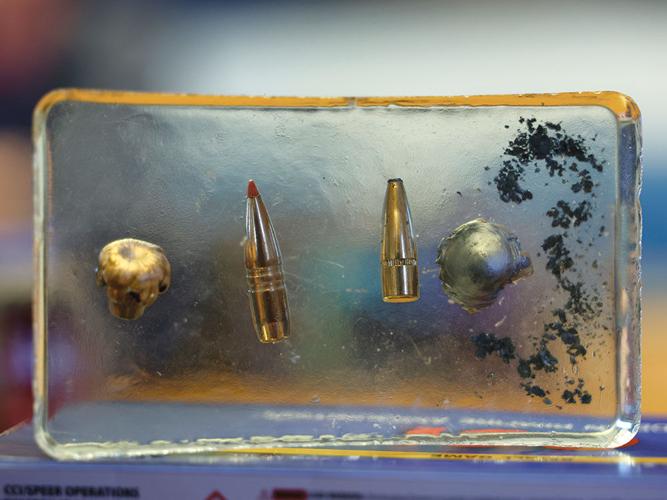
This demonstration piece at VWS shows the difference between a copper bullet (left) and a lead bullet, with the lead fragmenting as it mushrooms, increasing the probability that a scavenger will encounter a piece of the toxic metal. “Just the smallest little fragment can be deadly,” Kelly Sorenson says.
“It takes a very small fragment – the size of a couple grains of sand,” Finkelstein says, to produce potentially deadly lead poisoning in a condor. They are opportunistic animals that like to start eating where the access is easy – such as a bullet entry wound in a carcass – increasing their potential exposure to lead.
Lead poisoning is the single biggest cause of death to condors in California. Finkelstein and Joe Burnett, a biologist at VWS, were among the co-authors of 2024 paper published in the journal Biological Conservation looking at models to get condors to become a self-sustaining species. They analyzed 158 condor deaths between 1996-2017 and lead, at 25.9 percent, was the single biggest cause of death. (The next largest cause of death, 24.1 percent, is unknown, and it is reasonable to assume many of those were also due to lead poisoning.) Another 25 condors in Central California died from lead poisoning between 2020-2024.
That lead ammunition is still used for hunting at all is technically illegal. The Ridley-Tree Condor Preservation Act, approved in 2007 by the California Legislature, banned lead ammunition for hunting in condor range. “Hunting is a valued tradition in California and hunters play a critical role in wildlife management and conservation,” the bill read.
A 2013 law followed that phased in non-lead ammunition for hunting anywhere, effective July 1, 2019. And yet the use of lead bullets remains widespread today, over a decade later. The reason is a seemingly simple problem of supply and demand.
In July, Kevin Kreyenhagen, chair of the Monterey County Fish and Game Advisory Commission, wrote to three state agencies—the Department of Fish and Wildlife, Fish and Game Commission and Department of Natural Resources—sounding the alarm about lack of availability of .22LR ammunition. “In recent months, non-lead .22LR ammunition has become increasingly difficult to obtain,” Kreyenhagen wrote. “As of now, it is unavailable for purchase among online retailers, and the vast majority of California stores. The scarcity raises a critical compliance issue: If hunters and ranchers are required by law to use non-lead ammunition when shooting wildlife, how can they reasonably comply when one of the most popular cartridges is not reliably or affordably available?”
Six months later, Kreyenhagen still has not gotten an answer.
BURNETT AND HIS COLLEAGUES AT THE VENTANA WILDLIFE SOCIETY ARE BIOLOGISTS. But the nonprofit is now a licensed ammunition dealer and senior wildlife biologist Mike Stake spends much of his time on the road, driving through condor county and visiting gun stores and property owners to hand out free non-lead ammunition. Since the nonprofit started its non-lead ammo program in 2012, it has handed out more than 18,535 boxes of bullets. (The initiative was inspired by a similar concept in Arizona, where the use of non-lead ammunition remains voluntary, not mandatory, for hunters. California is the only state where it is required.)

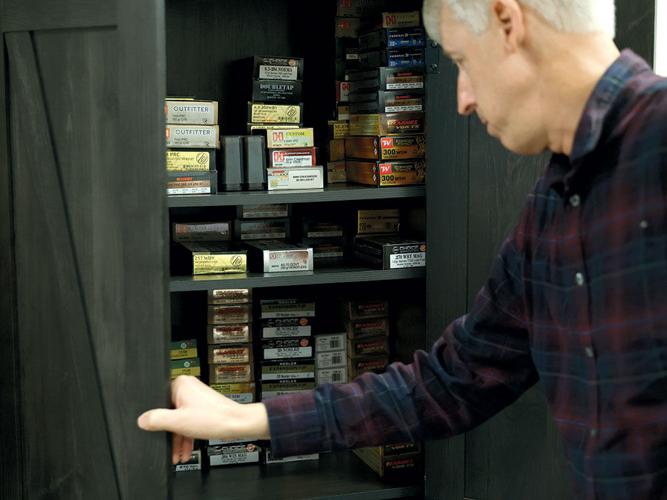
Mike Stake opens the ammunition closet at Ventana Wildlife Society’s Monterey office. Due to limited availability of rimfire, the nonprofit’s free ammunition program prioritizes regions where condors are known to forage.
All condors are tagged with radio transmitters and about half with GPS devices, enabling the VWS team to look at a GIS map of where they are landing and likely foraging. Stake looks at those pings on a map then compares them to property owners, prioritizing owners whose land is popular among the birds, with an emphasis these days on San Benito County. For interested property owners in condor hotspots, Stake will drive to them and deliver the ammo. (All others can show up at the VWS office next to Ryan Ranch in Monterey to pick it up.)
“Everyone is generally interested in free ammunition and that makes my job fairly easy,” Stake says. “It’s not too difficult to give things away. The challenge is the idea of, ‘Nothing’s free.’ That’s the initial reaction, so we rely quite a lot on word of mouth. We don’t want to lose the reputation of being only givers, not takers. It is a barrier that we need to break down a little bit with people who are not familiar with our program.”
The trust has been a long time in the making. When the state first banned non-lead ammo for hunting, hunting groups were skeptical. “The signing of AB 711 signals the unfortunate end of a unified effort by the sportsmen’s community and professional fish and wildlife managers to oppose this unnecessary effort to chip away at hunters’ rights in California,” the Congressional Sportsmen’s Foundation wrote in a statement in 2013. The group was one of a coalition of 23 that signed a letter opposing the bill. CSF dismissed proponents as “well-funded anti-hunting groups.”
In the years since, VWS has been trying to flip that perception, handing out free ammo. But tighter regulations mean that for vendors, VWS included, ammo distribution has gotten a little less conversational – there’s no more rolling up to a ranchers’ meeting and handing out bullets from the tailgate of a truck. Instead there are IDs and mandatory background checks.
“It’s so unfortunate this issue started with a ban,” says Kelly Sorenson, executive director of Ventana Wildlife Society. “It didn’t start with education or a dialogue. Ever since, we’ve been playing catch-up to build trust and respect. We’ve been doing that one by one, face to face, after all these years.”
He is hopeful that now they’ve earned that trust. And increasingly, VWS is stepping into a realm beyond traditional wildlife conservation and advocating for easier access to ammunition.
IT IS NOT ILLEGAL TO BUY OR SELL LEAD AMMO IN CALIFORNIA, just to hunt with it. But the buying and selling part – the supply chain – is a problem when it comes to the hunting part.
Plenty of manufacturers now make large caliber bullets in copper, and the ballistics are good – hunters report they fire accurately and fast and mushroom consistently upon impact, with less fragmenting. (There is plenty of disagreement and chatter about the relative ballistics online, given that lead and non-lead behave differently.)

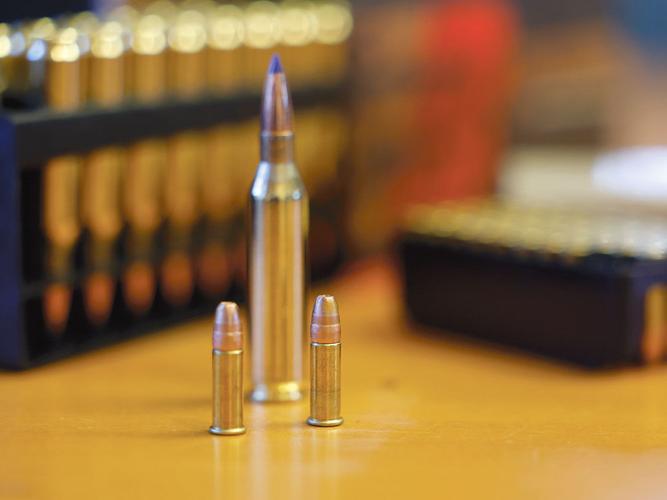
Bullets for smaller rimfire cartridges, like the two shown in the foreground, are much harder to source in non-lead material than larger centerfire calibers used for big game.
For people stocking up on ammo to hunt large game, like pigs or deer, there is a competitive marketplace and multiple options. But there is limited availability for lower-caliber cartridges, specifically .17 and .22 long rifles. These rounds generally are rimfire, rather than centerfire, referring to the location of the primer in the cartridge. Hunters use rimfire for smaller animals like ground squirrels. Unlike large game, which might take just a few bullets, controlling many smaller animals can require a lot more shots. It’s also much harder to find in the marketplace.
VWS created a webpage dedicated to non-lead rimfire, rimfireroundup.com, with a chart listing availability at stores from Big 5 in Coalinga to Turner’s in Salinas to Uncle Ed’s Outfitters in Atascadero, and beyond. As of this writing, no store out of 22 listed has .22LR ammo in stock. The .22 is the most commonly used rifle in America.
“Right now it’s not available at any of the stores we’re monitoring,” Sorenson says. “We think that’s a big problem.”
In 2024, the two major manufacturers of non-lead .22 LR bullets – CCI and Norma – discontinued those calibers. (Neither company responded to the Weekly’s questions.)
On its website, Norma promotes its non-lead options such as zinc, and specific ammunition for taking down unauthorized drones. The Swedish company calls itself “the microbrewery of the ammunition industry.”
There are currently just three non-lead products available in .17 from Hornady, Winchester and CCI. The only .22 option by Cutting Edge Bullets is not available, leaving VWS as one of the only sources of non-lead .22 rounds that exists, as they distribute from a precious stockpile.
Some local hunters, like Cody West, who lives in the foothills above Gonzales, say there is enough non-lead ammo to go around. He relied on VWS’ free distribution, and says it’s enough for his needs (he’s using .17 HMR, not the hard-to-get .22) and that the copper bullets work great as far as speed and accuracy. He shoots roughly 10 ground squirrels each spring. “It seems like when I put that pressure on them, they move out,” he says. Otherwise, he says, “They’re almost impossible to keep out of our garden and our orchard. They eat the fruit, they chew the bark – they cause a lot of damage.”
He knows there are some arguments about copper or steel bullets offering inferior ballistics, but to West it works just fine: He’s shooting squirrels from 100-plus yards away and pigs from over 200 yards without issue. And he usually gets enough ammo to do so through VWS’ free giveaway. “A box of large-caliber and small-caliber every year is all I need,” he says. “I’m sure other guys use more.”
It’s those other guys who could potentially drive demand for .22LR non-lead bullets, persuading manufacturers to get back into making it.
Sorenson is hoping they do, and VWS will be a ready buyer. Now, during California’s budget season, Sorenson is lobbying state lawmakers to support the non-lead ammunition program. He’s asking for $4.6 million over the next five years to help the nonprofit get more non-lead bullets to hunters. Currently VWS’ program distributes about $500,000 worth of ammo per year and Sorenson wants to double that, hopeful that by handing out $1 million worth of free bullets, condors can get to a sustainable population. If VWS is ready to buy bullets, he hopes that someone will be standing by to manufacture them.
“If we don’t solve this, the condor is always going to be dying more than it can keep up breeding-wise,” Sorenson says. “Now we are faced with this huge gap knowing [lead ammunition] is the number-one threat to the species, and the number-one problem we can fix.
“I know what needs to be done to save this species and at the same time keep the traditions of hunting and ranching alive. I want to scale our non-lead program up to a whole new level so we can once and for all solve this problem.”
SORENSON REMEMBERS WHEN HE FIRST FLOATED THE IDEA among VWS donors of the organization getting involved in distributing non-lead ammunition. “It was a lukewarm response,” he says. But he understood that distributing and popularizing non-lead bullets was critical to the species’ survival. “We are much more aligned with the hunting and ranching community than the typical advocacy group,” he says. (It seems to be catching on; VWS recently received a $200,000 gift for its non-lead ammunition program from an anonymous donor.)

In a paper set to be published this year by the California Fish and Wildlife Journal, Stake and Sorenson recount the plight of rimfire availability. “If non-lead ammunition for one of the most widely-used rifle calibers, the .22 67 LR, remains off the market, as it has been recently, it would not be surprising if some shooters are still shooting lead,” they wrote. “These shooters might otherwise follow the law if their local stores were able to stock non-lead .22 LR…
“This absence is highly concerning, given that .22 LR is widely considered the most commonly used rifle caliber. We conducted a survey of local hunters in 2017 which confirmed widespread use of .22 LR in Central California.”
In the paper, they propose several possible solutions to make rimfire more available and cost-effective. The state could exempt non-lead ammunition from an 11-percent excise tax on ammo, for example. “Instead of compounding the challenges hunters and ranchers face switching to non-lead ammunition through excise taxes and sales restrictions, efforts should focus instead on the main problem of how to improve availability of non-lead rimfire on the market,” they wrote.
There’s also the barrier of California’s required background checks for every ammunition purchase, the rule that makes Stake’s old days of tailgate distribution a relic of the past. Stake needs to enter information into a California Department of Justice portal to run a background check for every ammunition acquisition, even if it’s a repeat customer (VWS pays the $5 fee each time). “Hunters liken it to presenting their driver’s license every time they fill up their car with gas,” Stake says. “It’s not a bad comparison.”
Those 2016 rules, approved by voters as Prop. 63, also require vendors to provide ammo only face-to-face, rendering online ammunition sales in California all but impossible – shutting down a major channel for local hunters to acquire non-lead options.
In 2018, Kim Rhode (an Olympic gold medalist in trap and skeet shooting), the California Rifle & Pistol Association and several other gun owners and out-of-state vendors sued California Attorney General Rob Bonta, arguing the policy violated their Second Amendment rights. In 2020, a federal court granted the plaintiffs an injunction, prohibiting California from enforcing the rules.
Various facets of the case have since gone through appeals, with the most recent decision in 2025 upholding the lower court ruling to overturn California’s rules. But pending a further appeal – possibly to the U.S. Supreme Court – the circuit court granted the state’s request to stay the court’s own injunction, keeping the existing regulations in effort.
Sorenson wrote a letter to the U.S. Court of Appeals for the Ninth Circuit, urging judges to issue a mandate implementing its ruling in favor of Rhode and the other plaintiffs.
“Your court’s ruling recognized that the state’s face-to-face ammunition purchase requirement is unconstitutional under the Second Amendment,” he wrote. “Until the mandate issues, however, that unconstitutional barrier remains in effect – impeding lawful commerce and undermining conservation progress.”
WE KNOW THAT LEAD IS HIGHLY TOXIC because of longstanding efforts to remove it from our environment. Leaded gasoline was banned in the U.S. in 1975. Lead-based paint was banned in 1978. “We’ve regulated other major sources,” Finkelstein says. Today, ammunition is the largest unregulated source of lead into the environment. (Other sources, such as batteries, are regulated, and not spread around in the environment.)
That matters not just for condors, but to other wildlife – hawks, eagles, mountain lions, any animal scavenging has the potential to consume lead ammunition.
It also matters for human health. The World Health Organization estimates that lead exposure has resulted in 21.7 million years lost to disability and death worldwide, due to the lasting effects of lead on health. It is toxic to the nervous system and brain, the kidneys, the reproductive system, the immune system.
The science is not new. In 2013, Finkelstein joined a group of 30 scientists all over the country in issuing a consensus statement on lead ammunition in the environment. “Based on overwhelming evidence for the toxic effects of lead in humans and wildlife, even at very low exposure levels,” they wrote, “… we support reducing and eventually eliminating the introduction of lead into the environment from lead-based ammunition.”
Finkelstein spends her time studying toxics in the environment yet still, 12 years after that statement was issued, she is optimistic. “I am an environmental toxicologist and I feel like this is something we can actually fix in my lifetime, which is incredibly encouraging,” she says.
Stake first heard the word ornithology on a bird field trip when he was in the sixth grade. “My teacher was the one who told me that condors were about to go extinct,” he remembers.
Now, one box of bullets at a time, he is helping enable the species to soar again.
(1) comment
It's unconscionable that people still use lead bullets for hunting. I understand it's better for self-defense, but it's not required to target practice. While proving free ammo might help, stores that sell ammo should have prominent signs advising that people should not use lead bullets for hunting, and that they are endangering the condors. Thank you for an excellent, well researched article.
Welcome to the discussion.
Log In
Keep it Clean. Please avoid obscene, vulgar, lewd, racist or sexually-oriented language.
PLEASE TURN OFF YOUR CAPS LOCK.
Don't Threaten. Threats of harming another person will not be tolerated.
Be Truthful. Don't knowingly lie about anyone or anything.
Be Nice. No racism, sexism or any sort of -ism that is degrading to another person.
Be Proactive. Use the 'Report' link on each comment to let us know of abusive posts.
Share with Us. We'd love to hear eyewitness accounts, the history behind an article.