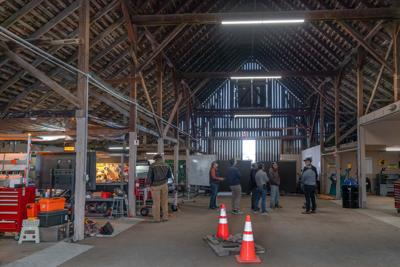

It’s been about three and a half months since Reservoir Farms, an ag tech incubator spearheaded by tech entrepreneur Danny Bernstein, opened its doors in Salinas. A dozen startups are working in some capacity at the location, four of which have set up shop with a dedicated office space. All companies are aiming to assist growers with two big challenges: chemical reduction and labor.
Standing in the 100-year-old barn that serves as the prototyping space for the companies and sits adjacent to fields owned by Tanimura & Antle, Bernstein points to a troubling statistic from a recent American Farm Bureau Federation Market Intel report: Of the 400,000 H-2A positions advertised nationally in 2025, less than 0.04 percent received a domestic applicant.
“These are jobs that domestic workers are just not interested in,” Bernstein says. “So we are looking at systematically, what are the hardest-to-fill jobs, and pursuing technologies that are automating [those] jobs.”
Reservoir Farms has been expanding quickly, with an incubator in Santa Rosa wine country, a third location in Yuma, Arizona, and another facility in Merced County in the Central Valley. Unlike the Salinas location, the Merced facility will include both prototyping and manufacturing capabilities. The Yuma site, developed in partnership with the University of Arizona, is slated to be fully operational by Oct. 1, while the Merced facility is expected to open sometime in fall 2026.
Back at the flagship facility in Salinas, each office space in the barn Bernstein refers to as akin to a “tiny home,” separated by a wall but more or less connected by a shared central space. One of those offices is occupied by AgTom, a Hong Kong-based company focused on what it calls “agentic farming.” They’ve been prototyping ways to automate tasks like irrigation, fertigation, and cultivation, as well as placing sensors across the field that collect and compile data on things like temperature, humidity and pressure.
“One of the issues that I’ve been seeing with a lot of this ag tech is communication constrictions,” says Luis Blas, an intern with AgTom who’s been working on developing a “data mule” to go through the rows and collect information about the crop. “You need Wi-Fi, and often a farmer doesn’t have that additional infrastructure, or sometimes it’ll only cover certain acreage.”
Reducing and replacing chemical inputs has been a focus for the startups working at Reservoir Farms, both for environmental and health reasons, but also because chemical costs continue to rise for growers, Bernstein says.
Industry groups such as Western Growers Association, one of Reservoir’s partners, say that even larger conventional players like Driscoll’s and Taylor Farms are looking to reduce their reliance on agricultural chemicals. In response, Reservoir has made chemical reduction and replacement two of its three core innovation priorities.
Another startup called High Degree has been prototyping machines that use steam to replace chemical fumigation. The machine generates steam at temperatures high enough to kill bacteria and pests without chemical inputs, an approach particularly well suited for strawberries, says Austin Bowie, High Degree’s founder and CEO.
“We have been building our next machine here from the ground up, and we’ve been using the shop here as the core of that program to build the new cars, to manufacture the systems, integrate them and test them,” Bowie says. He adds that being able to build, test and demonstrate the technology at the Salinas location has been invaluable so growers can see firsthand how it works locally under regional growing conditions.
High Degree is currently working with more than 10 growers in the Salinas Valley, Bowie says.
While Reservoir Farms doesn’t broker sales between growers and startups, it hosts events that bring the two together. Next week the company plans to host a strawberry producer day, where more than 30 growers are expected to meet with ag tech companies developing new solutions.
“We're more focused on helping that company grow up, get ready, learn the context, get to know the area,” Bernstein says. “That’s our focus.”


(0) comments
Welcome to the discussion.
Log In
Keep it Clean. Please avoid obscene, vulgar, lewd, racist or sexually-oriented language.
PLEASE TURN OFF YOUR CAPS LOCK.
Don't Threaten. Threats of harming another person will not be tolerated.
Be Truthful. Don't knowingly lie about anyone or anything.
Be Nice. No racism, sexism or any sort of -ism that is degrading to another person.
Be Proactive. Use the 'Report' link on each comment to let us know of abusive posts.
Share with Us. We'd love to hear eyewitness accounts, the history behind an article.