
On the day he was evacuated from his home due to the River Fire, Monterey County Air Pollution Control Officer Richard Stedman was trimming trees for fire safety. Three weeks later, he's back home and has just ordered an air purifier due to ongoing smoky conditions—something Stedman anticipates he's likely to need for a long time as the Dolan Fire burns and, more broadly, the ongoing climate crisis makes fires both more extreme and routine. (He recommends searching the California Air Resources Board's list of approved air purification units.)
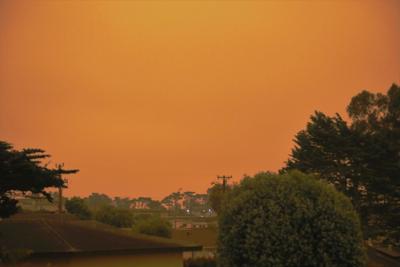
In the weeks in between, the air quality has been intermittently clear and terrible. This week, since the Dolan Fire blew up, more than doubling in size in a single day, the sky has been various shades of orange and gray.
Early in the week, the sky was tinged orange, though air quality measurements came in as decent, and the Monterey Bay Air Resources District's air quality monitors didn't detect unhealthy air. It seemed like a contradiction.
"The air quality monitors were good, but it looked like we had just arrived at Mordor or Middle Earth or something," Stedman notes.
His explanation is that dense fog settled in, and smoke has more loft, easily rising above the fog—it meant the smoke was in the upper atmosphere where it wasn't so bothersome for breathing, but filtered the light, creating an orange tint. Then thick fog further filtered the light along the coast.
Then that marine layer started to break down, at the same time the fire began smoldering more than burning super-hot as it spread to new material.
"When fires are really hot, they drive pollution way up because hot air rises really fast," Stedman says. "Then when they start to cool down, and go into a smoldering phase, the smoke hugs the ground.
"As the fire calmed down, the smoke wasn’t going as high, and it mixed up with fog. It’s a little less orange now and more smoky-foggy."
Once it started changing, air quality changed fast, moving into the unhealthy range.
The sky color is the result of light scattering—normally the sky appears blue because shorter-wavelength blue light travels more readily. But the short wavelengths don't penetrate the thick smoke layer, and longer wavelengths of orange and red do.
The current air quality conditions are forecast to continue through the weekend.
While air quality forecasting is a challenge, air quality monitoring in the present is a science. MBARD maintains six stationary air quality monitors, and recently due to the wildfires, has placed five more in Big Sur, Monterey, Gonzales, Greenfield and Soledad.
The data from those monitors is viewable on MBARD's website, where as of Saturday morning Sept. 12, all are showing air quality in the "unhealthy" range" except in Carmel Valley, which has dropped to "moderate." That's based on a 24-hour average, measuring for tiny particulate matter the size of 2.5 microns or smaller—the stuff that's small enough that your nose hairs won't catch or that you won't cough out. (Read more about the air quality index here.)
The health risk is that the tiny particles are inhaled, and can go into the lungs and ultimately into the bloodstream, where they cause inflammation—particularly hard on people with heart or lung disease.
Smoke is the product of combustion and makes not just particulate matter but also a range of chemicals including carcinogens, like benzene, and poisonous NOx gases. Particulate matter tends to be a good indicator of how much of all the other smoke material there is in the air, Stedman says, so that's the reliable material to measure for air quality.
The monitors MBARD uses are high-end devices that cost roughly $10,000 apiece; they're calibrated on a weekly basis.
There are more readily available monitors, like those sold by Purple Air and that users can choose to connect to a publicly viewable map that represents real-time data. Purple Air's sensors cost from $199-$279, and there are thousands more of them as a citizen science initiative. But Stedman cautions against relying on those for accurate data.
"We have found that Purple Air runs pretty high," he says. "In some instances, it may be three times higher."
(Purple Air representatives were not immediately available for comment.)
To stay safe during unhealthy air quality conditions like these, health experts recommend avoiding exertion so your lungs don't have to work extra hard, and staying indoors. If possible, considering getting a CARB-approved air purifier like Stedman.


(0) comments
Welcome to the discussion.
Log In
Keep it Clean. Please avoid obscene, vulgar, lewd, racist or sexually-oriented language.
PLEASE TURN OFF YOUR CAPS LOCK.
Don't Threaten. Threats of harming another person will not be tolerated.
Be Truthful. Don't knowingly lie about anyone or anything.
Be Nice. No racism, sexism or any sort of -ism that is degrading to another person.
Be Proactive. Use the 'Report' link on each comment to let us know of abusive posts.
Share with Us. We'd love to hear eyewitness accounts, the history behind an article.