
Poet Robinson Jeffers was not only talented, but also very lucky, it turns out.
There was easily another path that would have left this important regional poet undiscovered. That was one of the most interesting things I heard at the 2024 Robinson Jeffers Fall Festival, organized by the Robinson Jeffers Foundation every year.
The main fun took place on Saturday, Oct. 5 with lectures on Jeffers starting at 9am and going through the late afternoon. I very much enjoyed placing and discussing Jeffers as a classic modernist, a man of his era. We heard from experts from Robinson Jeffers Association, such as Gere diZerega, James Karman and the association’s president Tim Hunt, who is also a poet and a professor of English.
Other speakers were Andrew Schelling (a Jaime de Angulo scholar who talked about the de Angulo-Jeffers relation), Susan Shillinglaw from the Center for Steinbeck Studies in San Jose (also a docent in Tor House) and the Robinson Jeffers Foundation director poet Elliot Ruchowitz-Roberts.
The experts placed Jeffers’ career in a historical and literary context. The poet moved into the future Tor House in 1919, without ever being published. The following year his work was rejected by Macmillan Publishers, which led to his time of depression and suicidal thoughts. In 1924, Jeffers self-published his poems, but they were not selling and most of the copies were sent back to Tor House.
He was struggling until Carmel’s George Sterling offered to use his poem in an anthology, which led to another offer of submission and finally an interview with The New Republic that made Jeffers a known poet overnight. Between 1927 and 1929 he published four well-received volumes of poetry.
The 1920s were a great decade for new literature. In 1922, T.S. Eliot published The Waste Land and James Joyce published Ulysses. A year later Thomas Mann released The Magic Mountain and Hemingway published his first volume of poetry. The Great Gatsby was published in 1925, as well as Virginia Woolf’s Mrs. Dalloway.
Jeffers identified as a modernist. During his trip to England, he visited Virginia and Leonard Woolf, who published his poems in their little imprint. He was fascinated by towers after Yeats and Rilke; the tower functions also in Ulysses, as an opening.
The modernists’ goal was to find a new language after the aggressive experience of bloody WWI. The new language turned out to be muscular. The new way of seeing was not limited to writers, it seems that photographer Edward Weston was also battling everything in the 19th century. The new way led Jeffers to his most important discovery in his poetry: that human violence is part of human nature, that war is a natural language and that the bravest thing we can do as humans is to face nature in ourselves.
But the lectures were only part of the festival that involved poetry, music, birdwatching and field trips to Point Lobos State Reserve and Carmel River State Beach.
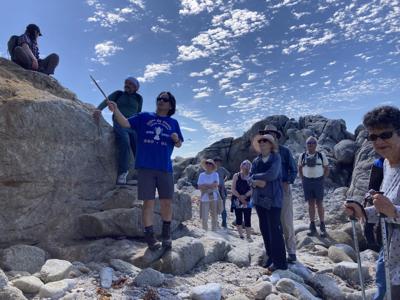
The field trips were led by Aaron Yoshinobu, a professor of structural geology and tectonics at Texas Tech University (and a Tor House Foundation board member) who led back-to-back geology tours for about 20 participants on Sunday. The group spent the morning in Point Lobos, then the afternoon on Carmel Point.
The afternoon walk started on the sandy beach at the Carmel River mouth, then wrapped around the rocky point, with participants scrambling along. The group looked at different features—such as narrow strips of younger, faster-cooling rock that juts out in stripes through big slabs of granite, and layers of sediment likely deposited by Carmel River flooding—along the way. The tour concluded just below Tor House, where Jeffers quarried his rock starting more than 100 years ago. He collected pieces of granite from the rocky shore below his home.
The festival is one of the regular events in the menu of The Robinson Jeffers Foundation that has been operating since 1978. The mission of the Tor House and the foundation is to endure Robinson Jeffers’ legacy.


(0) comments
Welcome to the discussion.
Log In
Keep it Clean. Please avoid obscene, vulgar, lewd, racist or sexually-oriented language.
PLEASE TURN OFF YOUR CAPS LOCK.
Don't Threaten. Threats of harming another person will not be tolerated.
Be Truthful. Don't knowingly lie about anyone or anything.
Be Nice. No racism, sexism or any sort of -ism that is degrading to another person.
Be Proactive. Use the 'Report' link on each comment to let us know of abusive posts.
Share with Us. We'd love to hear eyewitness accounts, the history behind an article.