
Early on the morning of July 22, two women hiking in Garrapata State Park witnessed the start of the Soberanes Fire. In the subsequent months, it became the costliest wildfire to fight in U.S. history.
They were walking on a trail through Soberanes Canyon when they saw flames about 50 feet wide. Immediately after, they ran toward the top of the mountain; they later told fire officials they were trying to find cell phone reception to call 911.
That first call to report the fire came in at 8:48am, but it remains unclear how long the fire had been burning by the time officials were alerted.
What is known is that the fire started small—a 2-foot-by-2-foot illegal campfire—and after it got out of control, it grew into a 132,127-acre wildfire, four times the size of San Francisco. It burned for nearly three months before being contained, and the cost to put it out was of least $262 million and counting. (For more on the cost of fighting the Soberanes Fire, read the Weekly’s Nov. 3 cover story.)
At least four fire officials representing state, local and federal agencies interviewed by the Weekly believe relying on 911 calls are a sufficient means of reporting wildfires. But when conditions are just right for a fire to grow quickly, combined with limited cell service, at least one expert is calling for a different kind of fire detection system.
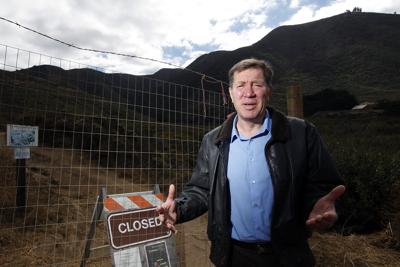
Michael Siracuse, a retired veteran who worked as a U.S. Navy aviator for 23 years starting in the late ’70s, says he has spent over a thousand hours researching a technology, that if applied, could help catch fires in real time.
Post-9/11, Siracuse became involved in developing a threat-detection model to track terrorists with the Defense Advanced Research Program Agency (DARPA), an agency of the U.S. Department of Defense.
“[Back then] there were limited detection systems for terrorists. They barely existed,” Siracuse says. “There were people trying to do something about it, but not as far as a national effort to say, ‘Hey we need a virtual buffer around our country…and let’s start making sense of things that may happen in the future’.”
In 2014, after attending a Lake Tahoe summit around the theme of confronting the effects of climate change, Siracuse decided to create a similar detection model to fight a different type of warfare, one increasingly affecting California thanks to climate change and ongoing drought: domestic wildfires.
He envisions a type of control room that is constantly being fed information from social media, 911 calls, lightning models and satellite maps and cameras, from a specific perimeter. In this control room, a person would be tasked with watching for human activity that could spark a fire, or be immediately alerted after a fire does start.
“You really can’t predict human behavior, but you can estimate where [an act] will be more prone to happen,” Siracuse says. “But wildfires are easier. They are not hiding.”
Say a person is lighting an illegal campfire at night, and no park rangers are around. The idea is that the person staffing the control room would see it, and alert fire officials to the threat, rather than wait for someone to see it or smell it and then report it. Or in the case of the Soberanes Fire, wait for a couple of hikers to get cell reception to make a 911 call.
“All I am saying is that if you have an unplanned fire, I want to be able to tell you about it and detect and localize it in real time,” Siracuse says. “The conversation about detection gets lost in the prevention and suppression portion of fire management efforts.”
Siracuse is advocating for Cal Fire, the U.S. Forest Service or a local jurisdiction to adopt a detection system as a pilot program to see if it can be fully implemented. He estimates a system like this would cost about $350 million to implement nationwide, and that it could save 10 percent of fire suppression costs nationwide.
“If you are not looking for wildfires proactively, we are going to see them late and the cost is going to be more,” Siracuse says.


(1) comment
“At least four fire officials representing state, local and federal agencies interviewed by the Weekly believe relying on 911 calls are a sufficient means of reporting wildfires.”
I believe it’s time for these four folks to identify themselves and explain their position. It is clear that an operational layer of detection is required that blankets the state.
“Only a system can detect a wildfire”
Aimee the Eagle
Welcome to the discussion.
Log In
Keep it Clean. Please avoid obscene, vulgar, lewd, racist or sexually-oriented language.
PLEASE TURN OFF YOUR CAPS LOCK.
Don't Threaten. Threats of harming another person will not be tolerated.
Be Truthful. Don't knowingly lie about anyone or anything.
Be Nice. No racism, sexism or any sort of -ism that is degrading to another person.
Be Proactive. Use the 'Report' link on each comment to let us know of abusive posts.
Share with Us. We'd love to hear eyewitness accounts, the history behind an article.