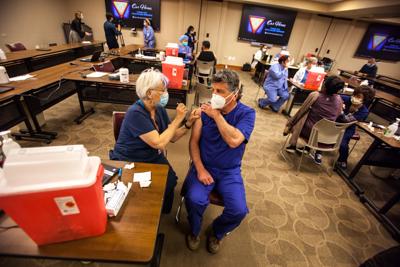

There is an apt analogy for the current situation that is the Covid-19 vaccine rollout: We’re building the plane as we fly it.
While there have been past pandemics and large-scale vaccinations before, like the H1N1 pandemic of 2009, Covid-19 is impacting a larger portion of the U.S. population and presenting complicated supply chain issues.
Decisions made at the top about who should be vaccinated and when take time to trickle down to the local level. It makes for confusing times for those who want to be vaccinated yesterday.
California Gov. Gavin Newsom’s announcement on Wednesday, Jan. 13 that everyone age 65 and up should be vaccinated ahead of the previous schedule is a prime example. It sounds wonderful, but in practice counties like Monterey may not be able to act on it right away.
“It would be a challenge for us if the state and federal government does not give us more vaccine,” Monterey County Health Officer Edward Moreno told reporters shortly after Newsom’s announcement. “Hopefully the state will take that into consideration,” he said, because a lot of people who think they’re getting vaccinated right away are going to be disappointed.
One big issue for the county is that the Health Department does not know from one week to the next how much vaccine will be made available locally, according to Moreno. He told the Monterey County Board of Supervisors on Jan. 12 that the Health Department gets an idea on Tuesdays how many doses might be available from the state. The department then has two days to plan exactly how it will distribute vaccines to “points of distribution,” or PODS, and other locations. The department places an order by 5pm Thursday for vaccines it will receive the following week.
The numbers of doses available are not consistent—the state has its own planning to do based on what it’s getting from the federal government in the case of Pfizer, or what is coming directly from Moderna—which Moreno said makes it impossible to plan vaccination clinics more than a week out.
That all may change now that President Joe Biden is in office. Biden announced before his inauguration he wanted 100 million shots in the first 100 days of office. On Jan. 21, he released a 200-page plan that includes strategies for increasing production of vaccines and creating vaccination centers around the country. One of the administration's big jobs will be to ensure that more vaccine is manufactured and distributed.
That kind of massive distribution of vaccines will take a lot of planning and resources at the federal, state and local levels. Monterey County Office of Emergency Services Director Gerry Malais told reporters in a briefing call on Jan. 13 that his office is working with the Health Department on plans for vaccinating more people as they move through the phases and tiers.
UPDATE: The county's mass vaccination plan was shared with the Board of Supervisors on Jan. 26. A video of the presentation is available here.
In the meantime, members of the public are anxious to know more, and in the absence of a clear plan, there have been major hiccups. Consider the recent kerfuffle over email invites to vaccination clinics that were supposed to be for health care workers only, but like a 1990s viral email your aunt forwarded, they went to a lot of people who never should have received them.
Given the confusion, many readers have reached out with questions. The Weekly started looking for answers. The list below is not complete and more questions (and answers) will be added as information is uncovered or as conditions change; it’s important to remember that this is a fluid and rapidly changing situation.
This post will be updated as new information is made public. Other sources of information include:
Monterey County vaccine information web page: bit.ly/mococovidvaccinepage
California State vaccine web page: covid19.ca.gov/vaccines
Centers for Disease Control vaccine information: cdc.gov/vaccines/covid-19
For senior citizens, a good local source of Covid-19 information is the Alliance on Aging: allianceonaging.org/covid-19
UPDATE: The county hosted a Covid-19 vaccine town hall meeting from 5:30-6:30pm on Thursday, Jan. 14. Here's a link to a recording: youtu.be/L2bVNJ87FAk.
UPDATE: Check out the Weekly's guide to vaccinations.
How will I know when it’s my turn to get a vaccine?
As of the week of Jan. 11, county officials say they will be relying on pushing information out through the media, online, and via county social media accounts. As the rollout continues, people with primary care physicians may hear directly from those offices when the vaccine is available to them. Nonprofit agencies that the county contracts with, like the Visiting Nurses Association of the Central Coast, will in turn partner with places like senior centers and large employers who will make their clients or employees aware of upcoming clinics.
On Jan. 13, Gov. Gavin Newsom announced that a new system letting people know they are eligible to receive vaccines will be launched possibly the week of Jan. 18. People will be notified by email or text.
UPDATE: A pilot site was launched, at my turn.ca.gov.
Starting in early January, county officials were reaching out to health care employers to have their employees register for vaccination clinics, but only those workers in Phase 1a, tiers 1, 2 and 3.
People in those tiers include: health care workers in a variety of settings; skilled nursing facilities; assisted living facilities; long-term care settings; paramedics, EMTs and other emergency medical personnel; dialysis centers; intermediate care facilities; home health care and in-home supportive services; community health workers; public health field staff; primary care clinics, including federally qualified health centers, correctional facility clinics and urgent care clinics; specialty clinics like optometry, cardiology, outpatient surgery, physical therapy; laboratory workers; pharmacy staff not working in the higher tiers.
If any health care worker believes their job places them in one of these tiers, the county is encouraging them to ask their employers to contact the health department.
UPDATE: The county launched an online vaccine registration web page on Jan. 26 for those age 75 and up, plus health care workers. The initial appointment slots filled up quickly. The page is located online here.
UPDATE: New eligibility requirements were begun on Feb. 17. See the Weekly's vaccination guide for those requirements found here.
I'm over age 65 and Gov. Gavin Newsom said I'm eligible for a vaccine now. Why isn't Monterey County vaccinating my age group yet?
Unfortunately, Newsom made the announcement before the state had enough vaccine to distribute to all of the counties. Before Newsom's announcement, the CDC had already announced those age 65 and up should be vaccinated as soon as possible. At that time the former Trump Administration's Operation Warp Speed was saying there was vaccine in the nation's reserve. A few days later the head of the initiative admitted there was nothing in reserve.
State Health Officer Erica Pan told the San Francisco Chronicle on Jan. 20 that it could take the state four to five months to administer two doses to those age 65 and up.
UPDATE: The Biden Administration has been working on getting more vaccines manufactured and distributed as quickly as possible. The timeline is shortening. The goal is to have enough vaccine distributed enough to vaccinate 300,000 million people by the end of July.
Will I be able to sign up for an appointment when it is my turn?
It’s possible that as the county moves through the tiers, people will be able to sign up for appointments through a website or by some other means. A press release from Newsom's office on Jan. 13 announced that the second phase of the new statewide notification system (see above) will include a way for counties to run mass vaccination events. The governor's office promised it would include a way for people to schedule appointments at the events.
In Phase 1b, people age 75 and up may be able to make reservations by phone, if they do not use a computer or smartphone, for example, as has been done for flu vaccine clinics set up at senior centers by the VNA. (People age 65 and up in Monterey County may be included in this phase, depending on how much vaccine the county is receiving. See above.)
Pay attention to the county’s website for updated information and watch for news reports on potential signups.
UPDATE: The Weekly's vaccination guide is a good source of information on how to sign up.
How long will it take for the people in each phase and tier to be vaccinated?
At this time there is no way to gauge how quickly the county will move through the tiers. The amount of vaccine available to the county differs from week to week, making advance planning for clinics impossible, which in turn makes it impossible for the county to say just when people in subsequent tiers will be able to be vaccinated.
Will I need to show some kind of proof that I am eligible for a certain tier?
In Phase 1a, the county is requiring people to bring a pay stub or some form of ID to show they are health care workers. It is possible that as people in different age groups are vaccinated they will need to show a driver’s license or some other form of ID with a birthdate.
Medical privacy rules prohibit people being asked about their medical conditions so in the case of people with underlying conditions (people ages 16-74 who have underlying conditions that make them vulnerable to Covid-19 are currently in Phase 1c), they will most likely be on their honor.
Monterey County Epidemiologist Kristy Michie told the Weekly that during the H1N1 pandemic, workers vaccinating did not ask people if they had underlying conditions. “People in general do the right thing,” she adds.
I’d like to know how many vaccines the county has received and how many shots have been given. Ideally, of course, the county would provide a dashboard.
Moreno reported to the Board of Supervisors on Jan. 12 that the county has received 24,150 doses of the vaccine. (How many have been vaccinated is still being sorted out. The figure from the state as of the same date was 7,649, but it appears not every vaccination that's taken place to date is reflected in the California Immunization Registry (CAIR2).
The county is looking into the possibility of a dashboard but said Moreno told supervisors the Health Department needs reliable information from CAIR as to how many people have been vaccinated in order to make a dashboard happen.
UPDATE: On Jan. 20, Moreno told reporters the county has received 31,525 doses. The number of doses administered reported to the county by CAIR2 was 13,402. The county states on its vaccination website that it will update the numbers each Monday by 5pm.
UPDATE: The county is keeping a dashboard on its Covid-19 vaccines web page found here.
Why is the county’s vaccination timeline not the same as the state’s?
Changes are happening very quickly at the national and state levels. Michie says the Health Department is following the state’s guidelines, but only after receiving an official communication from the CDPH advising the county of the change. It’s possible that the state will announce a change ahead of sending a notice to county health officials.
My employer says that our profession is now cleared to receive vaccinations but the county isn’t vaccinating us yet.
See #6 above. County officials wait for an official statement from the CDPH, and sometimes that statement comes after someone at the state has communicated with employers or trade associations.
Where do essential workers, like grocery store employees and farmworkers, fall on the vaccination list?
After health care workers in Phase 1a are vaccinated, essential workers in the food and agriculture industry will be able to be vaccinated under Phase 1b, Tier 1. Although it’s important to note that only those considered at highest risk of exposure will be vaccinated, Moreno told reporters on Jan. 13. That means some workers in those industries will have to wait.
What about teachers and child care workers?
The county is in talks with the Monterey County Office of Education to organize how vaccinations will occur throughout the various districts and schools. Those considered at greatest risk for exposure fall under Phase 1b, Tier 1.
UPDATE: Anyone working in childcare or education will be eligible beginning March 3.
Where will vaccinations occur?
This depends on who is administering/receiving the vaccines. For example, pharmacists from Walgreens and CVS are visiting long-term care facilities, under a contract with the state of California. Recently the Monterey Fire Department held “Point of Distribution” clinics for other firefighters and paramedics at its main station in Monterey. Drive-through clinics for health care workers have been taking place in a parking lot at CSU Monterey Bay and at Community Hospital of the Monterey Peninsula. Other clinics have taken place at Hartnell College and through Clinica de Salud. Primary care and urgent care clinics are also being used to vaccinate health care workers in Phase 1a.
As the vaccinations spread out to more people, we’ll see clinics at senior centers for seniors and large scale employers, for example, as well as other locations.
UPDATE: On Jan. 21, President Joe Biden announced his administration's Covid-19 plan, which includes the creation of federal vaccination centers throughout the country. It also includes mobile units to reach rural areas. He will need Congressional approval of monies to pay for the plan.
What will the vaccine cost?
The vaccine is provided at no cost to recipients, paid for by taxpayers through the federal government. The agency, physician or pharmacy administering the vaccine may charge someone an administration fee, which in turn may be covered by health insurance. For uninsured people, the entity giving the vaccine can get the fee reimbursed through a federal fund.
Once we have reached substantial vaccinations through Phase 1c (the last phase) are we less concerned with community spread and can restrictions be relaxed?
This is another big unknown at this time. Health experts, including Dr. Anthony Fauci of the National Institutes of Health, say even after being vaccinated, we will likely need to continue wearing masks and practice social distancing until it's known if people who get the vaccine cannot transmit the virus. There is also a portion of the society that is "vaccine hesitant," or even resistant to getting vaccinated, which could hamper efforts to achieve herd immunity, which is about 80 percent of the population.
Have a question you want considered for inclusion in this list? Email Staff Writer Pam Marino, pam@mcweekly.com.


(0) comments
Welcome to the discussion.
Log In
Keep it Clean. Please avoid obscene, vulgar, lewd, racist or sexually-oriented language.
PLEASE TURN OFF YOUR CAPS LOCK.
Don't Threaten. Threats of harming another person will not be tolerated.
Be Truthful. Don't knowingly lie about anyone or anything.
Be Nice. No racism, sexism or any sort of -ism that is degrading to another person.
Be Proactive. Use the 'Report' link on each comment to let us know of abusive posts.
Share with Us. We'd love to hear eyewitness accounts, the history behind an article.