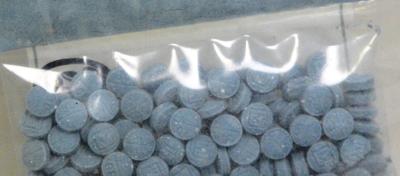

Three adult men still in their teens from Carmel and Monterey are suspects in distributing deadly fentanyl to high school students on the Monterey Peninsula, including in at least two cases where students accidentally overdosed and survived, U.S. Attorney Stephanie M. Hinds and Drug Enforcement Administration Special Agent in Charge Wade R. Shannon announced in a press release on Monday, May 9.
Criminal complaints were filed by the Office of the U.S. Attorney against Benjamin Reily Bliss of Carmel, 18, and Louis Alexander, aka “Lulu,” and Brandon William Carranza-Arthur, both 19 and from Monterey, with crimes related to the distribution of fentanyl to high school students in Monterey County.
Alexander and Carranza-Arthur appeared before U.S. Magistrate Judge Nathanael Cousins on Friday, May 6, to face charges of using the internet to advertise or offer to sell a controlled substance. Bliss appeared before Cousins on Monday on charges of aiding and abetting distribution of fentanyl, which comes with a mandatory sentencing of 20 years in prison if convicted.
The investigation into drug distribution to students on the Peninsula began last October, but “took a turn” after a 15-year-old Pacific Grove student suffered a fatal overdose on or about March 5, according to the press release. Evidence at the scene showed that the teen overdosed while inhaling smoke from a pulverized counterfeit blue “M30” pill. The announcement does not directly link the three men charged to the teen's overdose.
The continued investigation by the DEA with assistance from Homeland Security Investigations, the FBI, local police departments and the Monterey County Sheriff’s Office, as well as the Monterey County Probation Department, led investigators to suspect the three older teens each played a role in distributing drugs to high school students.
Bliss was discovered after interviewing a second teen who overdosed but survived. Text messages from the teen’s phone showed that on March 20, Bliss gave the teen a ride to San Francisco, where the teen purchased a baggie containing fentanyl in the form of a multicolored powdery/rocky substance. The teen allegedly paid $250 for the drugs which, after using, resulted in a non-fatal overdose on March 23.
The complaint against Alexander alleges that he used Snapchat to advertise and sell fentanyl-based counterfeit oxycodone and Xanax pills to high school students. One of the juveniles he is believed to have supplied suffered a non-fatal overdose last October. While the victim was recovering in the hospital, his mother discovered Snapchat messages on his phone. The Snapchat messages were about drug sales and were between the juvenile and a person named “lulu,” which law enforcement personnel later identified as Alexander, according to the criminal complaint.
The complaint filed against Carranza alleges that law enforcement officers obtained text messages between Carranza and a juvenile showing that Carranza played a role in supplying drugs, including one student who said he was suffering intense cravings and offered to pay $60 for $50 worth of pills if Carranza would front the money while the teen was trying to sell a phone for cash. According to the complaint, Carranza ultimately arranged for the teen to obtain the drugs.
If convicted, Bliss faces a maximum statutory sentence of 20 years in prison. Alexander and Carranza face a maximum term of four years in prison. As a part of any sentence handed down after conviction of any of the three defendants, the court may order a fine of up to $250,000 restitution each, and up to three years of supervised release.
In another recent fentanyl-related case, the U.S. Attorney’s office announced on May 4 the arrest of Mario Jose Villagrana on charges of federal drug distribution and firearms charges. Investigators said they found over 13,000 counterfeit “M30” pills containing fentanyl, along with two AR-15 style and two AK-47 style rifles, four handguns and a 30-round extended magazine, among other items, in Villagrana’s Pacific Grove apartment.
The complaint against Villagrana, 27, charges him with intent to distribute 40 grams or more of a mixture or substance containing fentanyl, and being a felon in possession of a firearm. If convicted he faces a mandatory minimum sentence of five years in prison and a maximum mandatory sentence of 40 years on the drug charge and 10 years for the firearm charge. The court may order a maximum $5 million fine for the drug charge and a $250,000 fine for the firearm count, a term of supervised release.


(0) comments
Welcome to the discussion.
Log In
Keep it Clean. Please avoid obscene, vulgar, lewd, racist or sexually-oriented language.
PLEASE TURN OFF YOUR CAPS LOCK.
Don't Threaten. Threats of harming another person will not be tolerated.
Be Truthful. Don't knowingly lie about anyone or anything.
Be Nice. No racism, sexism or any sort of -ism that is degrading to another person.
Be Proactive. Use the 'Report' link on each comment to let us know of abusive posts.
Share with Us. We'd love to hear eyewitness accounts, the history behind an article.