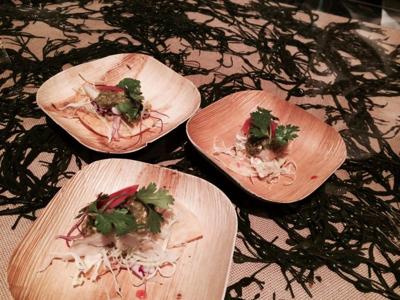

Before Monterey Bay Aquarium's landmark Cooking for Solutions weekend, which splashed celebrity chefs and their ocean-sensitive creations across Cannery Row May 16-18, there was the Sustainable Foods Institute: a two-day series of speakers and events bringing journalists together with scholars, chefs and farmers to talk ocean science, farming policy and food.
The panels and keynotes I was able to attend, along with some enlightening mingle sessions, left me with a few profound takeaways this year. The highlights:
- Choosing sustainable seafood isn't so much about memorizing a bunch of green-listed species as it is about learning to follow the Seafood Watch updates. Fisheries jump categories all the time as ocean conditions, fishing regulations and aquaculture technologies change.
- Sustainable sourcing is harder for big chains than it is for small operations. That can be blamed on a number of logistical hurdles, from rigid non-seasonal menus to bulk buying. But Arlin Wasserman, founder and principal of consulting firm Changing Tastes, told me the biggest blocker to sustainable sourcing among big food purveyors is an old-school mentality: "guys over 55" who think their patrons demand red meat.
- When it comes to aquaculture, it's the farming more than the fish that matters. FoodChain Executive Director Rebecca Self, who runs an aquaponics operation (a lot like the Watsonville-based Viridus) out of an old bread factory in Lexington, Kentucky, tells me tilapia tends to get a bad rap because it's sturdy enough of a fish to survive in some pretty gross conditions. That means a lot of tilapia farming operations are stomach-churning, but others, like hers, set high bars in sustainability. "It's not the animal to blame," she told me. "It's the farming method."
- Arlene Birt of Background Stories made a compelling case for how to inspire people to change their behaviors: through a strategic mix of emotion and knowledge conveyed visually. For example, Birt placed counters along a bike routes in Minneapolis. When bikers rode past, they'd see a projection counting them among the day's cyclists, and also calculating their collective impact. That kind of info isn't just interesting; it's empowering.
- Farming is a brave new world for hipsters, but they might be the face of the next generation of American small farmers. Rebecca Thistlethwaite, formerly of the local Tastes Like Chicken Ranch, wrote a book she intends as a guide for beginning farmers, many of whom migrated away from cities to try their hands at small-scale, sustainable agriculture. Take Nikiko Masumoto, a ridiculously hip peach farmer working side-by-side with her farmer father. She's bringing a degree in women's studies and a love of performance and writing to the gig. ("I actually lead a radical life by going back to the farm," she told the rapt audience. "Art is integral to farming.") Or Leah Penniman of Soul Fire Farm, who's working to take down food-system oppression by introducing urban black and Latino kids to farming. (Singing and murals and hip-hop are involved.)
The cherry on top was the May 16 Cooking for Solutions Gala, featuring 90-plus chefs, all dishing delicious morsels sourced to the Aquarium's sustainability standards, alongside 70 wineries and breweries.
I'd hoped to see a little more dot-connecting at each station, particularly those dishing seafood: signs identifying the species being served, how and where it was caught, which category it falls under on the Seafood Watch guide and why it's a responsible choice.
But when they weren't doing octopus moves—chopping, dressing and serving dishes with all eight arms—the chefs and their assistants were pretty enthusiastic about answering those questions. The whole point, after all, was to showcase culinary leaders who marinate their choices in sustainability.


(0) comments
Welcome to the discussion.
Log In
Keep it Clean. Please avoid obscene, vulgar, lewd, racist or sexually-oriented language.
PLEASE TURN OFF YOUR CAPS LOCK.
Don't Threaten. Threats of harming another person will not be tolerated.
Be Truthful. Don't knowingly lie about anyone or anything.
Be Nice. No racism, sexism or any sort of -ism that is degrading to another person.
Be Proactive. Use the 'Report' link on each comment to let us know of abusive posts.
Share with Us. We'd love to hear eyewitness accounts, the history behind an article.