One victim prayed with her attacker, and then accompanied him to speak to a social worker after he kidnapped her and raped her twice. Another victim laid face-down and counted to 20 after she was raped, only getting up and fleeing when her attacker was out of range and yelled "Bye!" signaling to her that she could go.
And decades after both women were dragged into bushes, strangled and raped by Charles Holifield, who ambushed them while they were teenagers out for walks on the Monterey Peninsula, they testified about the tactics they used to survive.
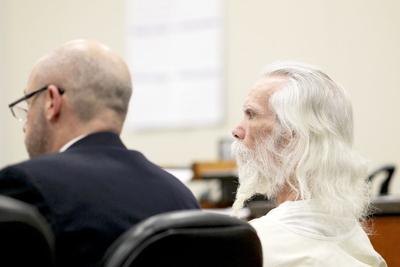
Their testimony came on Monday, March 2, the first day of Holifield’s trial in the rape and murder of Christina Williams, one of the most notorious cases in Monterey County history. Williams, 13, had left her family home to walk the dog she had received as a birthday present just a month earlier. She never returned; about six months after her June 12, 1998 disappearance, her remains were found in a remote, wooded area miles from where she was last seen.
Testimony began with the first victim, a woman identified in court by her first name and last initial. In 1979, the woman, then a senior at Seaside High School, left her home in Marina to walk to Seaside. She was walking on the Rec Trail when she was jumped from behind and dragged into the underbrush.
In court on Monday morning, she took a long pause, gasped and cried as she described the attack.
"He threw me to the ground and I landed, got a mouthful of dirt. He was choking me," she said. "I said I couldn't breathe and he let me spit out the dirt, he said he gave me 60 seconds to spit out the dirt…he was lying on top of me with his knee in my back, holding me down."
She said she asked him if he had any weapons and he brandished a knife at her. "I was afraid he was going to kill me," she testified. She asked him to throw it to the side, and he did. After raping her, he asked her to help him find the knife. She took a book of matches out of her purse and lit them, one by one, so there was light for him to see.
"I told him that I wouldn't go to the police, just let me go," she testified. "He wanted me to walk with him a little ways…he asked me if I liked the Beatles [and said] I should, because they're really good. He asked me if I'd gone to Fitch Junior High and Seaside High. He asked me if I knew certain teachers."
After walking a short distance, Holifield told her to lie down again, and not to get up until he yelled at her that she could go. When he did yell, she fled toward Fort Ord, called the police and went to the hospital.
Days later, she looked at her Fitch Junior High School yearbook and found his picture in it.
The second victim was 14 and a Pacific Grove resident who regularly took long walks around town and to Monterey, trying to memorize the streets, she said in her testimony on Monday. In April 1983, she had walked down to the coast near Hopkins Marine Station and was sitting on some rocks when the sky began to darken, a signal that she needed to make her way home.
She was near Ocean View Boulevard when Holifield grabbed her from behind, strangled her and dragged her away from the road into a brushy, wooded area, where he raped her.
"I didn't feel like I had an option," she said in court. "I felt like he was going to kill me if I didn't [comply]."
After raping her once, he tied her shoelaces around her neck and hands, dragged her to his car, fastened the shoelace around her neck to the car door and drove her to a remote area near Seaside High School, where he raped her again.
She said she had engaged him in conversation, telling him about her faith and asking him to pray with her.
“I had been sharing about my faith in God and I had asked him if he would be willing to pray the sinner’s prayer and have Jesus in his heart," she testified. "After he prayed the prayer he seemed happy and unsure what to do with himself.”
The victim told him there was a social worker at Salvation Army who could help. "I didn't want him to drop me off at my house," she said. She accompanied him to the Salvation Army; there, the social worker called her mother, and her mother arrived with the police.
Holifield was convicted of both of those assaults, but released after serving brief prison sentences. Those convictions made him a "Three Strikes" felon, meaning a third conviction would result in a life sentence.
Prosecutor Matthew L'Heureux in his opening statement to Judge Pamela Butler on Monday, said Holifield was aware of that status.
"He had vocalized his concern about the Three Strikes law and its application to him," L'Heureux said. "A girlfriend called to report a domestic dispute and when the deputy came out, [Holifield] said, 'You know this will get me a third strike, don't you?"
The parents of Christina Williams both testified Monday morning as well, with her mother, Elice, describing her last hours with her daughter. They had just moved to the neighborhood six months before; Christina's father, Michael, was a chief petty officer in the U.S. Navy, assigned to Fleet Numerical Meteorology and Oceanography Command, and Elice was working as a housekeeper at the Hyatt.
When Elice came home that night, she prepared dinner for Christina and her brother, also named Michael. Then Christina asked her to prepare her favorite dessert, which she did.
After dinner, before 7pm, Elice went to lie down on the couch and Christina told her she was going to take Greg, her new dog, for a walk around the neighborhood. Just before 8pm, her son woke her up from a nap to tell her Christina hadn't returned—an unusual occurrence because her daily walks with the dog usually only lasted 15 to 20 minutes.
The family began looking for her, and Greg was found a few houses away, unattended and with his leash still attached to his collar. That's when worry turned to panic. Her husband arrived home from an oceanography conference that ran until 8pm that night and upon hearing his daughter was missing but that the dog was found, he went immediately to police on base.
On Monday in the courtroom, prosecutor Lindsey O'Shea led Elice through a series of questions that painted a picture of the kind of kid Christina Williams was: shy, quiet and loving. Thoughtful. A good student. Never ran away, never spoke of harming herself, never used alcohol or drugs. She wasn't allowed to date.
As Elice Williams spoke, a school photo of Christina, taken while the family was living in Japan, was shown on a courtroom screen. She had a big smile on her face, her dark hair down to her shoulders.
Asked if she saw her daughter alive again after their final meal, Elice Williams said, "No, no. Not anymore."
Michael Williams, who has since retired from the Navy, said his daughter was not the kind of kid who would willingly get into a car with a stranger. When he arrived home that night, and found that Greg had returned trailing his leash, he immediately knew something was wrong.
After going to the police, who told him to return home and wait for officers to come to his house, he called his command, and several colleagues came out to begin searching the area. The first night passed in a nightmarish scenario, and as first light came up, he went out into the fog and saw police driving through the area.
"Nothing much seemed to be happening," he said. "My wife called a friend of hers who mentioned she should contact the National Center for Missing and Exploited Children…the main one that really assisted was the National Center.
"They asked me maybe 10 questions and said, 'This is not right, there should be something much more significant happening,'" Michael Williams testified. He went to CSU Monterey Bay security, and they knew nothing about it. He went to Seaside PD and found out later that they had Christina listed as a runaway.
His base commander contacted the FBI, and the FBI became the lead investigative agency on the case.
"Cuttings [from her underwear] were examined for the presence of sperm cells and that was confirmed," L'Heureux said. "A DNA profile was extracted, a full profile was made and it was compared to a swab taken from the defendant and it matched on every location tested."
Prosecutors agreed to take the death penalty off the table if Holifield waived his right to a jury trial and instead allow Judge Butler to hear the case. If convicted, he will spend the rest of his life in prison.


(0) comments
Welcome to the discussion.
Log In
Keep it Clean. Please avoid obscene, vulgar, lewd, racist or sexually-oriented language.
PLEASE TURN OFF YOUR CAPS LOCK.
Don't Threaten. Threats of harming another person will not be tolerated.
Be Truthful. Don't knowingly lie about anyone or anything.
Be Nice. No racism, sexism or any sort of -ism that is degrading to another person.
Be Proactive. Use the 'Report' link on each comment to let us know of abusive posts.
Share with Us. We'd love to hear eyewitness accounts, the history behind an article.