
Surprise! Pumping seawater at the coast can slow the the creep of seawater inland.
That’s one of the findings in the draft environmental impact report (EIR) for California American Water’s proposed Monterey Peninsula Water Supply Project, which the Weekly reports on in this week’s print edition.
A quick hydrology lesson: Freshwater is stored under the earth's surface in groundwater basins, or aquifers. When people pump that water out to use it for things like agricultural irrigation or city water systems, the water level in the groundwater basin drops, and the pressure drops with it. That invites more water to flow in, a process called groundwater recharge.
Seawater intrusion happens when ocean water flows into a pumped groundwater basin near the coast, mixing with the freshwater and making the aquifer a lot less useful for agriculture or cities. (Plants generally don't like drinking saltwater any more than people do.)
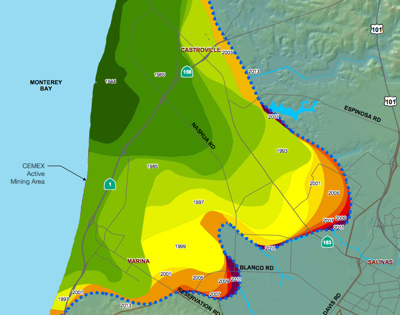
That's what has been happening in the Salinas Groundwater Basin, which supplies fresh water to much of the Salinas Valley. As farmers pump from the basin, ocean water creeps in, threatening the future of an agricultural region so productive, it's known as the "Salad Bowl of America."
Salinas Valley farmers are understandably territorial about their groundwater. And county law seeks to protect it by forbidding any freshwater from the Salinas Basin from being used anywhere else. So Cal Am is under enormous pressure to prove its proposed desalination intake wells along the north Marina coast won't pull up any Salinas Basin freshwater—or that if it does, to figure out a way to give that water back.
Early studies on Cal Am's Water Supply Project offer good news/bad news on that front. The bad news: The test well chugging away on the Cemex property, where Cal Am hopes to site some of its intake wells, is indeed drawing up some freshwater: 19-21 percent in the first few weeks, according to Martin Feeney, a member of the project's Hydrogeologic Working Group.
The good news: The EIR suggests pumping at the coast can actually reverse seawater intrusion by lowering the groundwater level there, causing the ocean water to drop down instead of flowing east toward Salinas Valley.
For the gadflies out there, this is from the draft EIR, Section 4.4, p.80:
"With the implementation of the proposed project, a portion of the intruding seawater would be removed from the coast through pumping at the seawater intake system. Once removed, the pressure on the seawater flowing landward at the coast would be reduced within the localized area affected by the proposed project pumping. The pressure reduction would interrupt the inland flow of seawater instead of allowing the seawater to continue to migrate inland. This would cause the seawater/freshwater interface to migrate back towards the ocean, thus reducing the extent of the area currently affected by seawater intrusion.
Feeney, a hydrogeologist, says that's no surprise to him.
As farmers pump Salinas Valley groundwater, he says, 6,000 acre-feet of seawater is rushing eastward into the aquifer every year. The Water Supply Project would lower the coastal groundwater level, causing the incoming seawater to sink down instead.
Feeney was appointed to the working group by the Monterey County Farm Bureau and Salinas Valley Water Coalition, ag interests critical of the Water Supply Project. But his conclusion boosts Cal Am.
“The water wants to go from the ocean down the drain, if you will,” he says. “Regardless of [the ag industry’s] opinion, you can’t fight the physics.”
Nancy Isakson of the Salinas Valley Water Coalition says she's still in the process of combing through the EIR. But if Cal Am's desal project would reduce seawater intrusion, she says, that only raises more questions.
“Does that mean Cal Am’s project wells will be actually pumping more freshwater over time?" she asks. "And then what does that do to the Salinas Basin? What about water rights? That is something we’ve asked in the past, and that is something we’ll be looking at.”


(0) comments
Welcome to the discussion.
Log In
Keep it Clean. Please avoid obscene, vulgar, lewd, racist or sexually-oriented language.
PLEASE TURN OFF YOUR CAPS LOCK.
Don't Threaten. Threats of harming another person will not be tolerated.
Be Truthful. Don't knowingly lie about anyone or anything.
Be Nice. No racism, sexism or any sort of -ism that is degrading to another person.
Be Proactive. Use the 'Report' link on each comment to let us know of abusive posts.
Share with Us. We'd love to hear eyewitness accounts, the history behind an article.