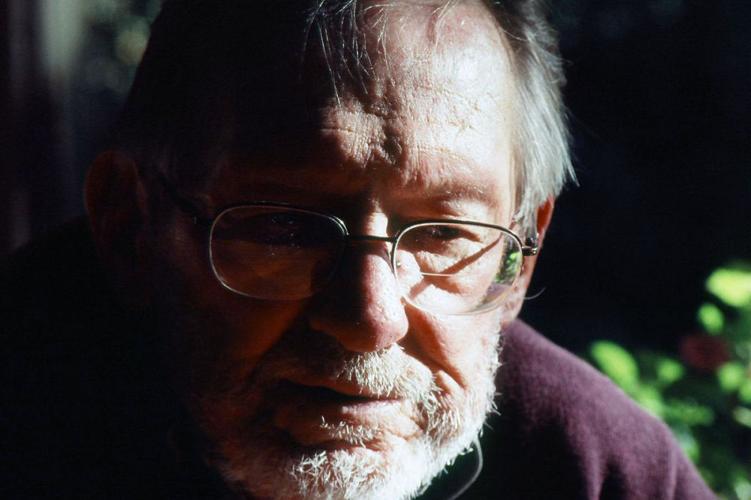

"Serial" artist and longtime Monterey County peace activist Ed Leeper once stopped by the Weekly's office, walked into the lobby and poured hundreds of golf balls out of a straw bucket onto the floor to get our attention for his latest art installation.
He needn't have bothered.
If he wanted our attention, all he had to do is show up. We flocked to him, for to bask in the Leeper light was to bask in the presence of a rare and wondrous mind.
Leeper passed away peacefully in his sleep Friday at the age of 86.
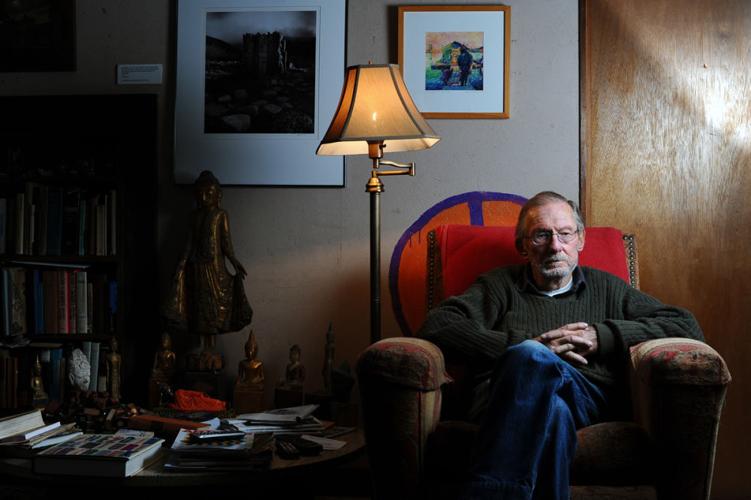
According to a text message to Weekly photographer Nic Coury from Leeper's stepdaughter, Kira Godbe, "Ed died yesterday sitting in his comfy chair, reading an article about one of his favorite artists, [Robert] Rauchenburg. He was completely at peace, his legs crossed, his glasses on and his eyes closed and that is it."
Godbe found her stepfather in his New Monterey home on Saturday.
Leeper was a fixture on the Peninsula arts and letters scene. He received a bequest of 10,000 books in 2006 and launched what became known as "Liquid Books," driving his truck to various farmers markets and events to give away the tomes and do one of the things he did best—connect with people from all walks of lives.
In 2012, he sent Weekly Managing Editor Mark C. Anderson (a frequent recipient of Leeper letters) a press release on a single sheet of white paper with red lettering that read:
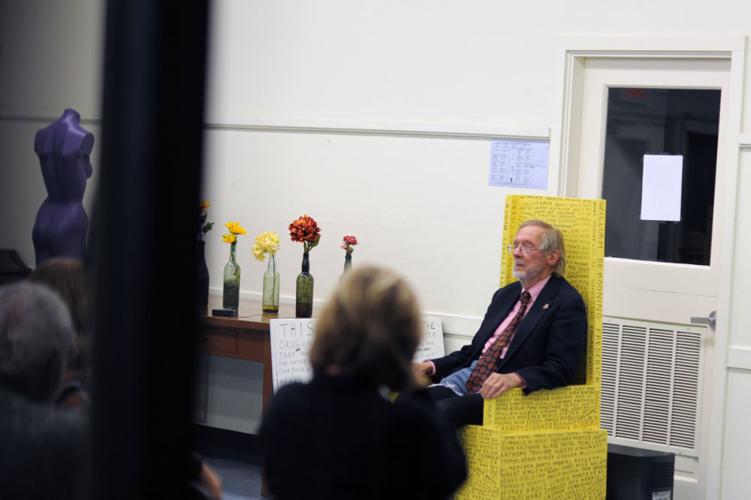
ARTIST ED LEEPER HAS CREATED A ZEN KOAN CALLED WATCHING PAINT DRY WITH 576 ART MAGAZINES. HE WILL PERFORM THIS ZEN KOAN ON SATURDAY OCTOBER 13 FROM 2 TO 4PM AT WINDOW ON THE BAY ACROSS FROM EL ESTERO ON DEL MONTE BOULEVARD. IN MONTEREY. PHONE: 373-0823.
"I'm going to be in costume," Leeper says. "I'm doing a drip painting thing with sticks and clothes and stuff. It's been quite successful."
He called it a Zen koan with tongue firmly planet in cheek, though: "I call it Zen koan pretentiously. What will happen which I like the most. People will come by on the way to the beach and see me watching paint dry and wonder what's going on and whatever."
Other Leeper projects included pouring cow blood over a soldier mannequin wearing the medals Leeper earned during his Army service, including a Purple Heart, to protest the Vietnam war.
He's also drawn 6 million lines on big pieces of paper with calligraphy pens—yes, 6 million—to better capture just how much life was lost in the Holocaust (the stack reached 5 feet and took more than three years). Now he's heading down to Window on the Bay.
In 2008, Anderson wrote a lengthy cover story on Leeper. A portion of it follows:
Ed Leeper poured animal blood all over his Purple Heart – while wearing a dress. He counted a half-ton of granite, pebble by pebble, 89,339 total, while sitting on a silent Palo Colorado ridge. He solicited urine “contributions” from an array of local artists and pickled former U.S. senator Jesse Helms’ portrait in the resulting broth.
These are the singular acts that are his art. They reveal his anger and his peace, his profundity and his profanity. They are his paint-smudged finger in the eye of the establishment, his push for the purposes he believes in – which include a dedication to things “that don’t make sense.”
Before now, Leeper says, no one had pored over the four fat binders with “Other Works by Ed Leeper” written on the cover, while tailing Leeper, now 80 and a widower, from the Last Chance Mercantile exchange that he adores to his scenic Big Sur haunt he calls a “Military Police Sub-Station.” And before now, few people have asked the one-word question that the years invested in atypical artwork beg: Why?
Fewer still got a straight answer. “Why does anyone do anything?” Leeper asks.
The journey to uncover an answer sprawls across Monterey County: It moves from a homemade cemetery by Monterey State Beach to city council chambers, rides in the back of an old Toyota pickup to Greenfield, and brakes at the Bohemian paradise bristling with mannequin limbs where Leeper lives in New Monterey.
Along the journey, the answer to why proves elusive – but it is present the whole time, just like Leeper and his 1986 flatbed on the side of so many Monterey County roads.
•••
Six million sit in a stack. The paper that constitutes the stack – an imposing tower built by patience and purpose – is gray and heavy. It sits in a room on the Military Sub-Station acre of Big Sur land Leeper and his late wife and co-conspirator, Elizabeth, named Hawk Shadow.
The stack began on June 18, 1987, when the retired Army personnel officer who hadn’t held a job in 15 years drew one small, straight line on one sheet of paper. The tiny mark represented one Jew murdered in Nazi Germany. Another small, straight line followed. And another.
After Leeper had carefully drawn around 1,400 marks on the 20-by-13-inch sheet, he set it aside, picked up another sheet, and made another mark with his black calligraphy pen. And another.
At the same time, he toiled away on another heavy project: Leeper scavenged and then lugged old chunks of cement and brick from his beloved beaches of Cannery Row over to his truck, hauled them 1,300 feet above sea level to Hawk Shadow, and dragged them onto a bluff overlooking the Pacific. He slowly fit the disparate rocks together in a beautifully cohesive hulk, cementing them in place. Ultimately the ambitious old-timer amassed an integrated structure 15 feet wide, 7 feet tall and 5 feet deep – 525 cubic feet of stone and concrete weighing roughly 40 tons – including a slender column of concrete scraps next to it. The big chunk, he says as he stands next to it, represents the Jews lost. The thin column, the Jews saved.
Leeper would retreat to the dining room table of his New Monterey home by night and lift his calligraphy pen. Over the coming months and years, one small black mark at a time, he would go through 251 of those pens.
In January and February of 1990, with both of these projects in progress, he visited the German murder camps in Poland – Belzec, Sobibor, Majdanek, Auschwitz, Chelmno and Treblinka – purposely arriving in the dead of winter to better grip the cold reality of Holocaust cruelty. He returned with stolen ashes from a field outside Chelmno where they dumped ashes from the camp’s crematorium, the powdered remains snugly tucked in a film canister. That human dust went into the heart of the Hawk Shadow stone-and-concrete memorial.
Meanwhile, the stack grew, mark by mark, murder by murder, sheet by sheet. It would reach nearly 5 feet in height.
Godbe says a memorial service for Leeper is pending. This story will be updated throughout the day on Monday.


(2) comments
I loved Ed and stopped to talk to him every week at Market, I'm going to really miss him - and his books, wisdom and humor. What a beloved character he was! I got to see his house several times, and some of his more recent artworks. The truck was a character too, I hope someone inherits it and 'keeps it rolling'. I'm so glad he went peacefully, painlessly and at home - that's the best ending any of us can hope for. I'll drop my alias for this one and say - this is from Leigh Fitz and I'll know I've died and gone to heaven when I see Ed reading a book again.
One less communist in the world.
Welcome to the discussion.
Log In
Keep it Clean. Please avoid obscene, vulgar, lewd, racist or sexually-oriented language.
PLEASE TURN OFF YOUR CAPS LOCK.
Don't Threaten. Threats of harming another person will not be tolerated.
Be Truthful. Don't knowingly lie about anyone or anything.
Be Nice. No racism, sexism or any sort of -ism that is degrading to another person.
Be Proactive. Use the 'Report' link on each comment to let us know of abusive posts.
Share with Us. We'd love to hear eyewitness accounts, the history behind an article.