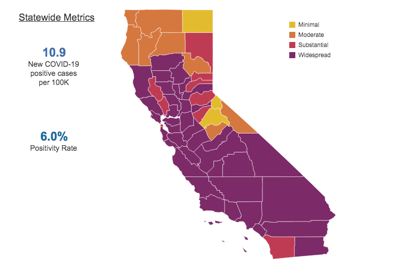

After about three months of using a monitoring list for deciding which counties get to reopen during the Covid-19 pandemic and by how much, California is turning to a color-coded system for its new "Blueprint for a Safer Economy." Counties with the least amount of virus spread are yellow, followed upward by orange, red and lastly purple for counties with the most amount of spread.
Monterey County is solidly purple, along with two thirds of the state, and expects to stay there until it can get its Covid-19 numbers much further down.
Under the system, purple counties must achieve seven or fewer new cases per day per 100,000 residents on average over seven days. The testing positivity rate must average less than 8 percent per day over an average of seven days. Those numbers have to hold for three straight weeks before a county can drop down to the red tier.
The current number of average cases calculated by the state for Monterey County for two weeks ending Aug. 18 was 15.5 new cases per 100,000 residents, Monterey County Epidemiologist Kristy Michie told reporters on a briefing call on Monday. The test positivity rate was 10.9.
Statewide the metrics are 10.9 new daily cases per 100,000 residents and a 6 percent test positivity rate. New rates will be calculated by the California Department of Public Health every Monday, after pulling new data from counties.
Under the new system, the state is allowing hair salons and barber shops to conduct business inside with modifications and 25 percent capacity. All indoor retail businesses must adhere to a 25 percent capacity limit. Shopping centers may also operate at 25 percent capacity but all public gathering areas must remain closed.
Schools stay closed for in-person instruction in the purple tier and cannot reopen until a county has been in the red tier for two consecutive weeks and only if they follow guidelines. (Some exceptions for schools that receive waivers.)
The state's website includes frequently asked questions, like why some businesses get to open while others remain shut? The state's answer: It has to do with how well a business can limit peoples' exposure to the virus.
Outside activities carry a much lower risk, as long as people are wearing masks and staying physically distant. Limiting the number of people per square foot of an indoor space also reduces risk of virus spread, as does limiting the amount of time of potential exposure.
Other ways to reduce exposure include limiting the mixing of people from different households, limiting physical interactions, increasing airflow and limiting things that experts now know increase spread including singing, shouting and heavy breathing.
How can people help their county reach a lower tier? "Wear a mask in public. Wash your hands regularly; Keep at least six feet of physical distance when in public; Limit mixing with people you don't live with."
For a complete explanation of the state's new system, visit: covid19.ca.gov/safer-economy.


(0) comments
Welcome to the discussion.
Log In
Keep it Clean. Please avoid obscene, vulgar, lewd, racist or sexually-oriented language.
PLEASE TURN OFF YOUR CAPS LOCK.
Don't Threaten. Threats of harming another person will not be tolerated.
Be Truthful. Don't knowingly lie about anyone or anything.
Be Nice. No racism, sexism or any sort of -ism that is degrading to another person.
Be Proactive. Use the 'Report' link on each comment to let us know of abusive posts.
Share with Us. We'd love to hear eyewitness accounts, the history behind an article.