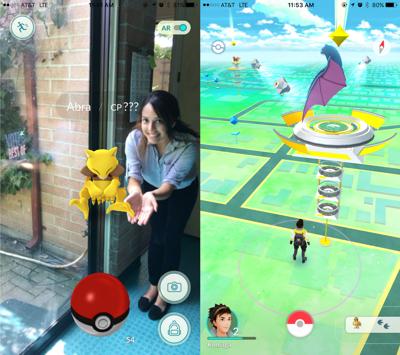

Four 18- or 19-year-old young men walk into Cherry Bean Coffee in Oldtown Salinas.
For Americans that age to be staring at their phones wouldn’t be weird, but it’s the way they’re holding them, out in front as they swerve in the direction they turn the devices. It’s like the phones are scanning the room for precious metals.
Then, in a synchronized moment, they snap out of their trance, step into line and order beverages.
Normally the height of intrigue at the Cherry Bean would be a crowd debating politics with baristas.
Not this week, when Pokémon Go pandemonium—Pokémonium?—had Monterey County and much of the Western world firmly in its grip.
As the app overlays a digital world over real surroundings, challenging users to find and capture little Pokémon characters and treasures, that zombie scene and its metal detector-like dance played out on sidewalks and at art installations across the county.
Some 7.5 million Americans downloaded the app in its first week, surpassing the amount of active users on Twitter, which has been around since 2006. Parent company Nintendo’s worth ballooned around $10 billion.
Suddenly, Go tops news feeds over the Dallas police shooting, China Sea drama and—gasp—Donald Trump.
But it’s not all Pikachus and Snorlaxes.
As Buzzfeed reports, Pokémon Go’s privacy policy allows game developer Niantic to gather your email address, IP address, previous web page you were on, your username and your location.
“And if you use your Google account for sign-in and use an iOS device, unless you specifically revoke it, Niantic has access to your entire Google account,” reporter Joseph Bernstein continues. “That means Niantic has read and write access to your email, Google Drive docs and more. (It also means that if the Niantic servers are hacked, whoever hacked the servers would potentially have access to your entire Google account).”
Just to up the scary-side quotient, opportunistic muggers used the game’s beacon function—which ups the incentive to visit real-world destinations to gain items—to lure players into robberies at a specific location in Missouri.
Suddenly getting slandered on Twitter sounds outright relaxing.
Former Weekly writer Kera Abraham observed drawbacks when she profiled the game’s less-cuddly predecessor, Ingress, also from Niantic, a year ago this month.
A fellow player casually mentioned he knew where she lived. Another participant told Abraham someone left a virtual key to the local cemetery on her doorstep.
With both games, Google harvested truly massive amounts of formerly personal information.
“The game is free…so the rule applies: If you aren’t paying, you are the product,” Abraham writes in paraphrasing a source spooked by the game.
She added a passage from tech news site PandoDaily.com: “Whether it plans to abuse this opportunity or not, Google has created an elaborate ruse to convince millions of people to share far more location and behavior data with the company than has ever been the case before.”


(0) comments
Welcome to the discussion.
Log In
Keep it Clean. Please avoid obscene, vulgar, lewd, racist or sexually-oriented language.
PLEASE TURN OFF YOUR CAPS LOCK.
Don't Threaten. Threats of harming another person will not be tolerated.
Be Truthful. Don't knowingly lie about anyone or anything.
Be Nice. No racism, sexism or any sort of -ism that is degrading to another person.
Be Proactive. Use the 'Report' link on each comment to let us know of abusive posts.
Share with Us. We'd love to hear eyewitness accounts, the history behind an article.