It’s been about nine months since Luana Conley helped conceive Measure M. She even left her admin job at CSU Monterey Bay to dedicate time to the Fort Ord open-space initiative. Now she’s bracing for the hard part.
“I’m ready for a cesarean,” she jokes at the new Bay of Pines restaurant in Monterey, where supporters are gathered on Election Night.
The crowd represents a who’s-who of progressive local leaders, including Marina Coast Director Jan Shriner, attorney Molly Erickson, artist Ed Leeper, LandWatch Executive Director Amy White, green architect Safwat Malek, Peninsula water board member Kristi Markey, peace activist Sylvia Shih and North County politician Ed Mitchell. The food is comfort with a touch of luxe: marinated portobellos, saucy wings, shrimp crostini, crème brulée.
“I don’t want to get too enthusiastic because I don’t want to get myself down,” Fort Ord open-space advocate Bill Weigle says, sliding a chicken kebab onto his plate. “Also, I think there are going to be a lot of lawsuits.”
His partner, Sustainable Seaside leader Kay Cline, is likewise cautious. “I can’t get a reading,” she says.
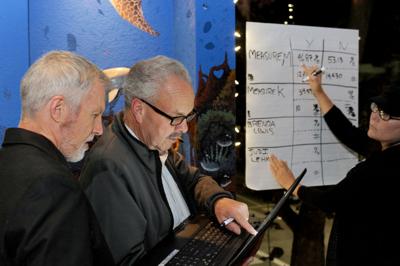
Just before 8:30pm, Fort Ord Access Alliance spokesman Jason Campbell finally takes the mic to announce the first round of election results. Measure M’s rival, Fort Ord pro-development initiative Measure K, has only garnered 39 percent support. The crowd cheers.
But the room hushes when Campbell adds that M is hovering a few points shy of victory at 47 percent. “I think it’ll turn around,” he says. “Progressives procrastinate.” (The 47-53 loss, however, would hold in updated results.)
Phone surveys from late September had shown K ahead of M, according to political strategist Natalie LeBlanc of Oakland-based voter communications firm Pivot. She views M’s lead as evidence the campaign’s strategy worked. “They spent money on broadcast [ads] and we spent it on grassroots,” she says.
As of the Oct. 19 campaign finance filings, each initiative had raised more than $300,000. The bulk of K’s money came from horse racetrack developer Monterey Downs, whose Fort Ord proposal Measure M would block. M’s biggest contributor was Monterey Bay Aquarium co-founder Nancy Burnett.
As cheerful as Campbell tries to sound on the mic—his backdrop a freshly painted marine-life mural and string lights framing a window onto downtown Monterey—there’s a dash of bitterness to his tone.
“Our opponent is nothing other than Monterey Downs,” he says. “Their motivation is simple: money.”
At first glance, Measure K’s Election Night party at the Bayonet Black Horse Grill is nothing out of the ordinary: a coming-together of energetic campaign volunteers chatting enthusiastically over flowing drinks and a fragrant buffet.
But after a few rounds, one might take stock of the campaign propaganda encircling the banquet room to see where the main push is taking place: There are eight “No on M” to only three “Yes on K” signs.
Monterey County Business Council President Mary Ann Leffel, who’s put several months into the campaign, the central issue—and the reason she got involved—is jobs. “We’ve got to have a diversity of jobs,” she says. “CSU [Monterey Bay] is graduating a lot of people, but there are not enough jobs for them to fill.”
As is, she says, the skilled young people who do stay in the Monterey Bay area end up taking jobs for which they’re overqualified.
Steve Emerson, who lost his bid for Marina mayor last year, says the planned Central Coast Veterans Cemetery—a Fort Ord parcel not directly impacted by either measure but, according to K leaders, indirectly hindered by M (a contention M leaders vehemently dispute)—is at the heart of the Measure K campaign.
“But it’s also a land issue, and it’s an economic issue,” Emerson adds.
When the first results are announced, the response is muted: Both measures are losing, though K is much further behind than M.
Working the laptops is Steve Lenard, one of the few younger adults in attendance. Even though he and his wife are about to move to Chicago, he says, he felt strongly enough to volunteer for the K campaign. “I see how much jobs are need to help out in the area, and I’m passionate about helping to bring them here,” he says.
Lenard points around the room at supporters he identifies as from King City, Carmel Valley, Marina, Salinas and Monterey. “There’s been a tremendous outpouring,” he says.
At just after 9:30pm, a bell draws attention to the center of the room, where Leffel concedes defeat of Measure K—and declares the loss of Measure M, which she interprets as victory. “I believe we all know in our hearts it is the best thing for this county,” she says. “The citizens of this county do not like ballot-box land-use planning, and that’s a good thing.”
Sid Williams, secretary of the United Veterans Council of Monterey County, speaks next. “We have gotten so much publicity for the cemetery out of this eight-month campaign, we’ve already got Phase I in the works,” he says, referring to the $9.6 million recently secured for the cemetery’s groundbreaking. “Now we can concentrate on raising the $4 million for Phase II.”
He turns to a seated Brian Boudreau, the Monterey Downs developer who largely funded the Measure K campaign, and the room erupts into whooping applause that seems to last an entire minute.
Boudreau stands. “You all should be proud,” he says. “I saw people out there holding signs today until they were sore.”
Then he turns to one of those people, points, and smiles.


(0) comments
Welcome to the discussion.
Log In
Keep it Clean. Please avoid obscene, vulgar, lewd, racist or sexually-oriented language.
PLEASE TURN OFF YOUR CAPS LOCK.
Don't Threaten. Threats of harming another person will not be tolerated.
Be Truthful. Don't knowingly lie about anyone or anything.
Be Nice. No racism, sexism or any sort of -ism that is degrading to another person.
Be Proactive. Use the 'Report' link on each comment to let us know of abusive posts.
Share with Us. We'd love to hear eyewitness accounts, the history behind an article.